 rumaruma
Is Sintered Stone Worth It in Malaysia? An Honest Look at Price, Durability and Downsides
What sintered stone actually costs in Malaysia, what it handles well, and the downsides to know before you sign a countertop quotation.
On this page
- What Sintered Stone Actually Is
- Where Sintered Stone Performs Well in Malaysian Homes
- The Downsides Suppliers Don’t Always Mention
- Sintered Stone Prices in Malaysia (October 2026)
- Why Your Final Price May Differ From What You Read Here
- So, Is Sintered Stone Worth It?
- For Fabricators and Installers
- Before You Confirm Your Sintered Stone Order
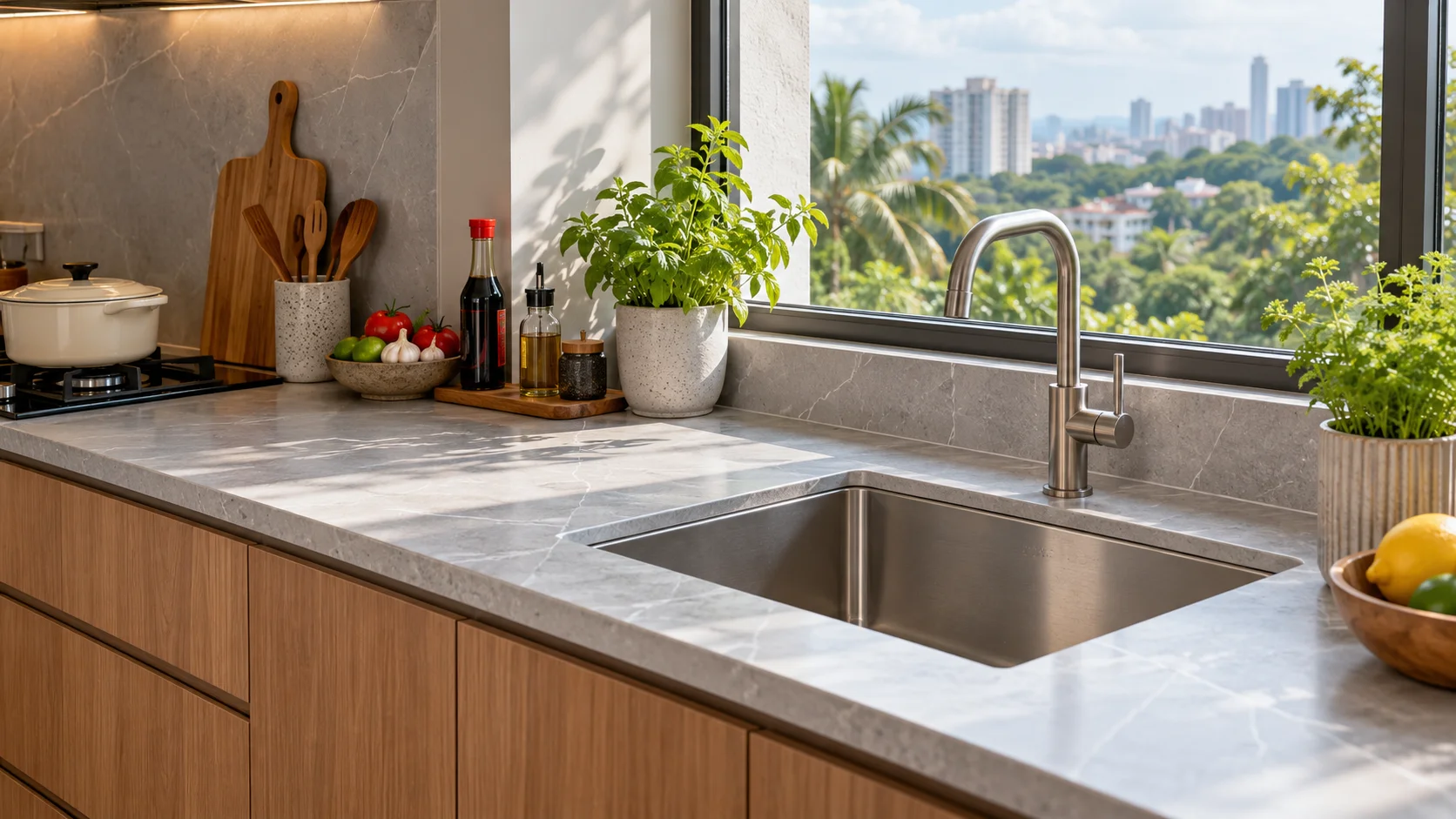
Your contractor has sketched the kitchen, the cabinet colours are picked, and now there’s one line on the quotation you can’t judge: the countertop. Someone has recommended sintered stone in Malaysia as the upgrade worth paying for, and the price per square foot looks like it could be anything from reasonable to alarming.
The short answer: sintered stone is one of the best countertop surfaces for a Malaysian kitchen, because it shrugs off heat, curry stains and humidity without ever needing a sealant. But it chips more easily at the edges than people expect, and the cheapest slab isn’t always the right one for how you cook. This guide covers both sides, with real prices.
What Sintered Stone Actually Is
Sintered stone is made from natural minerals, such as clays, feldspar and quartz, that are pressed under very high pressure and fired at temperatures above 1,200°C. The process bonds the particles into a dense slab with almost no pores. Some brands call it “ultracompact surface”; it’s the same family of material.
That near-zero porosity is the whole point. Water, oil and pigments have nowhere to soak in, so the surface stays the way it was installed.
It’s different from the two materials it’s usually compared with:
- Quartz (engineered stone) — crushed quartz held together with resin. The resin is what makes it vulnerable to heat and sunlight. Our quartz countertop guide covers its prices and quality grades. For a side-by-side on heat, edges and which suits your kitchen, see sintered stone vs quartz.
- Marble and granite — natural stone cut from a quarry. Porous to varying degrees, so they need sealing, and marble etches under acid.
Where Sintered Stone Performs Well in Malaysian Homes
Heat from daily cooking
A sintered stone countertop handles hot pots and pans far better than quartz, whose resin can scorch or discolour under a hot base. That matters in a wet kitchen where the wok comes straight off a high flame. A trivet is still a good habit for anything that will sit hot for a long time, but a brief set-down won’t mark the surface.
Stains from turmeric, curry and soy sauce
Turmeric is the real test for any Malaysian countertop, and it’s where porous stone fails. Because sintered stone barely absorbs liquid, curry, kicap and coffee wipe off instead of leaving a yellow ghost. Acidic spills like calamansi or vinegar don’t etch it the way they etch marble.
Humidity, with no sealing
In a climate where mould grows on anything that holds moisture, a non-porous surface is a practical advantage. Sintered stone never needs sealing, so there’s no annual maintenance to forget. It’s the same reason it works for bathroom vanity tops and basin counters.
Sunlight
Sintered stone is UV-stable, so it won’t yellow next to a west-facing window or on a balcony bar counter. Quartz can fade or yellow over time in direct sun, again because of its resin.
More than countertops
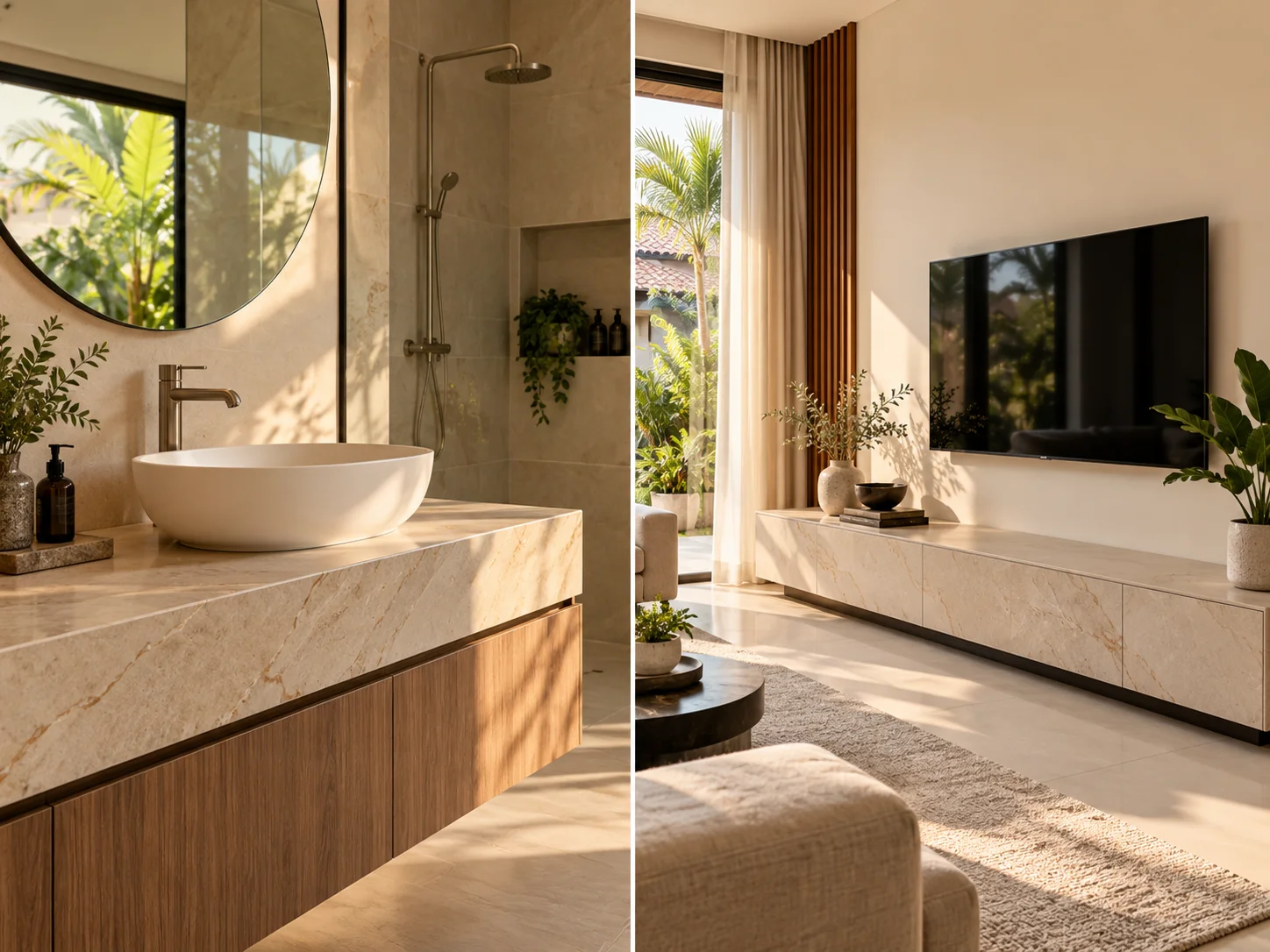
Sintered stone can also be used for TV consoles, feature walls and dining tables, with the thickness and support chosen for the application. Cabinet door panels often use thinner 6mm slabs, but these can be harder to source in Malaysia and the available colours are limited. Confirm stock, panel weight, backing and hinge requirements with your supplier and cabinet maker before choosing a design. If you’re planning a stone TV console, see how it anchors a room in our Japandi living room guide.
The Downsides Suppliers Don’t Always Mention
Edges and corners can chip
Sintered stone is very hard, and hard materials are brittle. The flat surface resists scratches well, but a heavy cast-iron pot knocked against a sharp square edge can take a chip out. Chips can be filled with coloured resin, but the repair is usually visible up close, and chips are generally not covered by warranty (more on that below).
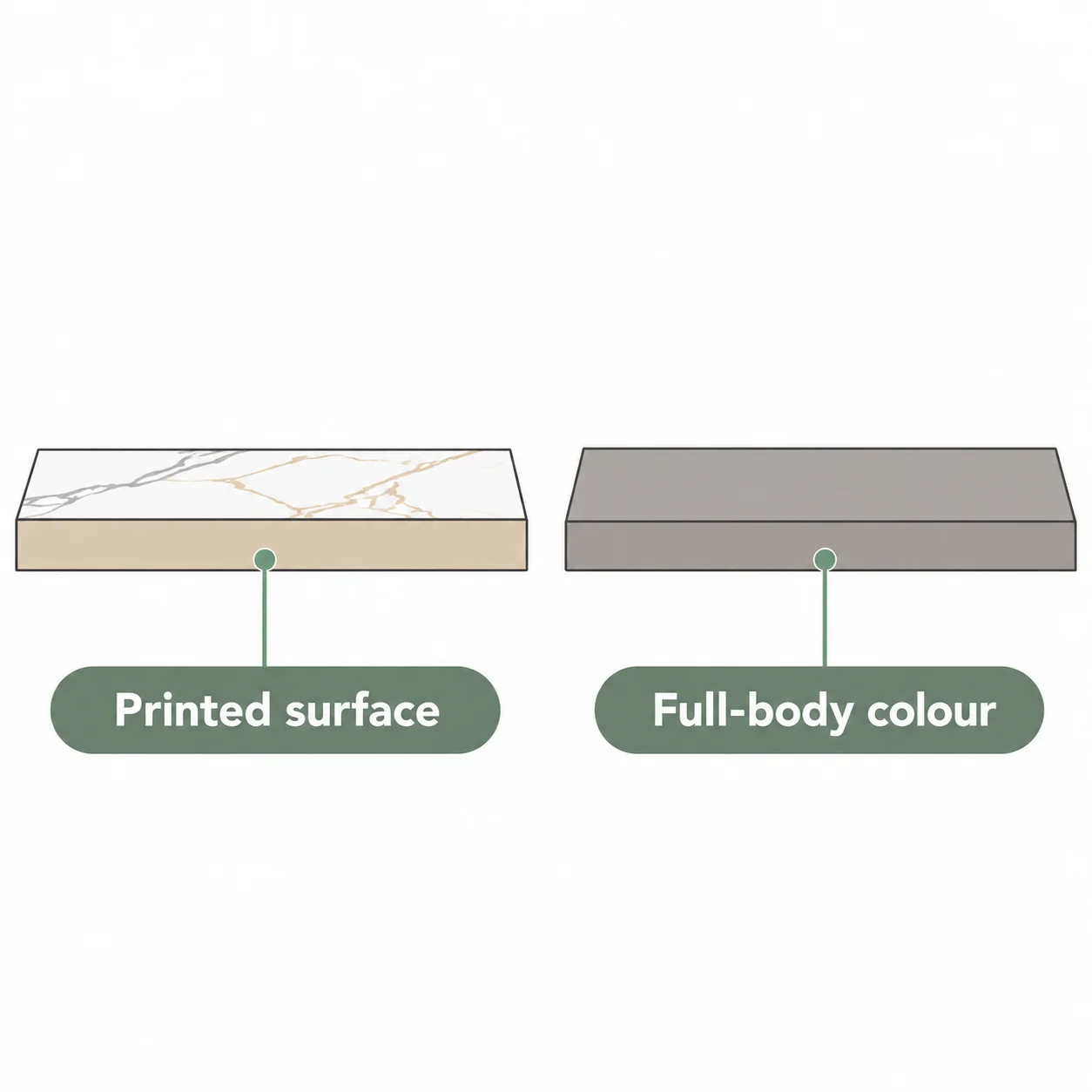
A slightly rounded (eased) edge instead of a sharp square one helps reduce the risk. Full-body colour does not make the slab more chip-resistant; it may simply make a chip less conspicuous because the exposed body colour matches the surface.
The pattern may only be on the surface
On many sintered stone slabs, the marble or stone pattern is printed onto the top face. The cut edge shows a plain body colour instead. On a straight countertop edge this can look unfinished, which is why some homeowners pay for mitred edges or choose a slab with matching full-body colour. Matching body colour does not necessarily mean the veins continue through the slab, so ask to see a cut sample of your chosen design.
It needs a skilled fabricator
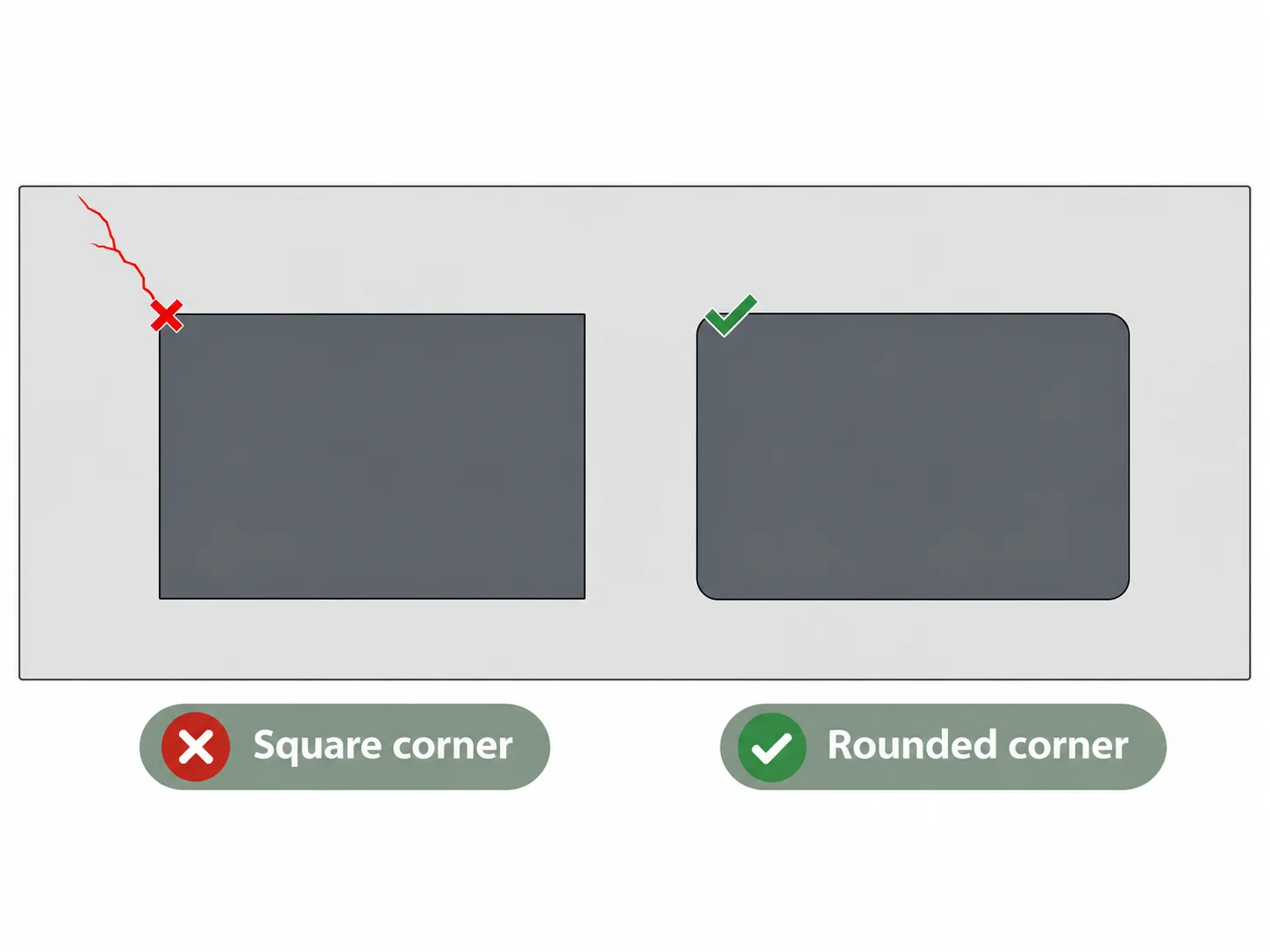
Because it’s brittle, sintered stone is less forgiving to cut than quartz. Sink and hob cut-outs need rounded inside corners and careful handling, or hairline cracks can form there later. Ask how many sintered stone jobs the installer has done, and ask to see a finished cut-out.
It can’t be repaired invisibly
Timber and solid surface can be sanded back. Sintered stone can’t. A deep chip or crack in a prominent spot usually means living with the repair or replacing that section.
Practical limits in condos
Long single-piece countertops have to fit in the service lift. In many condos, an L-shaped or very long counter will need a joint, so ask the supplier where it will fall before you approve the drawing.
Sintered Stone Prices in Malaysia (October 2026)
Prices below are per square foot of countertop surface, for 12mm slabs, and include material, fabrication, installation and transport. They come from one Malaysian supplier’s price list and cover two types: a China-made sintered stone range sold under the supplier’s own label, and Dekton, the Spanish ultracompact brand by Cosentino. Other suppliers’ prices will differ, so treat these as a reference point and compare quotes.
| Type | Collection | RM per sq ft (12mm, installed) |
|---|---|---|
| China-made | Regular | RM110 |
| China-made | Jumbo (3200 × 1800mm slab) | RM120 |
| China-made | Leather (textured matte finish) | RM130 |
| China-made | Homogeneous / Full Body | RM150 |
| Dekton | Group 0 | RM248 |
| Dekton | Group 1 | RM320 |
| Dekton | Group 2 | RM360 |
| Dekton | Group 3 | RM400 |
| Dekton | Group 4 | RM469 |
Cut-outs are charged separately:
| Cut-out | Price |
|---|---|
| Undermount sink | RM200 |
| Top-mount sink | RM150 |
| Hob | RM150 |
These prices are for reference only, as of October 2026. Your final price is the one in your supplier’s quotation on the day you confirm the order — see the next section for why it can change.
What a typical kitchen costs
A straight 10 ft countertop at the standard 2 ft depth is 20 sq ft. With an undermount sink (RM200) and a hob (RM150):
| Option | Countertop (20 sq ft) | Cut-outs | Total |
|---|---|---|---|
| China-made Regular | RM2,200 | RM350 | RM2,550 |
| China-made Full Body | RM3,000 | RM350 | RM3,350 |
| Dekton Group 0 | RM4,960 | RM350 | RM5,310 |
| Dekton Group 4 | RM9,380 | RM350 | RM9,730 |
Add a stone backsplash, an L-shaped return or an island and the area grows quickly. Ask your supplier to show the measured area and every cut-out on the quotation. If you’re weighing a stone backsplash against tile or glass, our kitchen backsplash ideas compare the costs.
What the collections mean
- Regular — the standard range and the lowest entry price, in the 3200 × 1600mm slab size most common on the market.
- Jumbo — a wider 3200 × 1800mm slab. The extra width helps on deep islands and large counters, where a standard slab would need a joint.
- Leather — a gently textured, matte surface that hides fingerprints and water spots. It’s still non-porous, so it wipes clean like the polished versions.
- Homogeneous / Full Body — the body colour runs through the slab, which can give exposed edges a more consistent appearance and make chips less conspicuous. It does not improve chip resistance or necessarily mean the surface veins continue through the thickness. Check a cut sample before ordering.
The Dekton groups are design tiers: higher groups cover more complex patterns and finishes. Dekton’s ordinary slab is 3200 × 1400mm, with a 3200 × 1600mm jumbo size, so check which size your design comes in if your counter is deep or long.
What the warranty usually covers
Sintered stone warranties typically cover colour fading and discolouration. Cracks and chips are usually not covered, because they come from impact or installation rather than the material itself. That’s another reason the edge profile and the fabricator’s skill matter.
Before you commit, read the warranty terms yourself. A supplier that publishes them openly on its website makes it easy to see exactly what you’re getting, so ask for the written terms before you pay a deposit.
Why Your Final Price May Differ From What You Read Here
You might read this in October 2026 and only renovate a year later. By then, the price per square foot may have gone up. The figure that counts is always the one your supplier quotes, and it’s tied to the date you confirm the deal.
The main reasons prices move:
- Exchange rate — both brands are imported, from China and Spain. A weaker ringgit against the US dollar or euro raises the cost of each new shipment.
- Shipping and freight — container rates rise and fall with fuel prices and global shipping disruptions.
- Your design and layout — the collection you choose, plus how much slab your kitchen uses. L-shapes, islands and vein-matched joints can mean more offcuts.
- Extra fabrication — mitred edges, waterfall ends and extra cut-outs add work beyond the standard rate.
- Site conditions — a high floor, a small lift or stairs-only access can add handling charges.
Two habits protect you. Ask how long the quotation is valid, and if your renovation timeline slips past that date, ask for a fresh quote before you commit rather than assuming the old price still holds. For the wider picture of costs that appear late, see hidden renovation costs in Malaysia.
So, Is Sintered Stone Worth It?
For most Malaysian kitchens that cook daily, yes. You’re paying for a surface that won’t stain yellow, won’t scorch and won’t need sealing, in a climate that’s hard on all three. At RM110 per sq ft installed, the entry point is within reach of a mid-range kitchen budget; see how it fits into a whole-home plan in our renovation cost guide.
Think twice, or choose carefully, if:
- You cook heavy and fast with cast-iron cookware — choose an eased edge and take care around exposed corners and sink openings. Full-body colour may make chips less conspicuous, but it does not prevent them.
- You want a surface you can sand and refresh — timber or solid surface suits you better.
- You plan to chop directly on the counter — sintered stone will dull your knives quickly. Use a board.
For Fabricators and Installers
- Cut sink and hob openings with rounded inside corners; square corners concentrate stress and are where cracks start.
- Check that cabinet carcasses are level and give continuous support. A 12mm slab bridging an uneven or open span is at risk of cracking under load.
- Agree the overhang for islands and breakfast counters with the supplier before fabrication, and add support where the layout needs it.
- Confirm lift dimensions on condo jobs before cutting long pieces, and plan joint positions with the homeowner in advance.
Before You Confirm Your Sintered Stone Order
- Brand, collection and thickness are written on the quotation
- The measured area (sq ft) is shown, not just a lump sum
- Sink and hob cut-outs are listed
- Edge profile is agreed: square, eased or mitred
- Joint positions are marked on the drawing
- The quotation’s validity date fits your renovation schedule
- You’ve read the warranty terms and know what’s not covered
Get these settled and the countertop stops being the line on the quotation you can’t judge. It becomes the surface you’ll still be happy wiping down after the hundredth plate of curry.