Our Location
304 North Cardinal St.
Dorchester Center, MA 02124

How to bring Japandi style into your Malaysian condo — with a full design breakdown of materials, palette, and budget.
You’ve scrolled past hundreds of Pinterest boards labelled “minimalist living room” — white walls, abstract art, a single potted plant. Beautiful, yes. Achievable in a 750 sq ft Malaysian condo with high humidity and one ceiling light point? That’s another story.
Japandi design is different. It’s a fusion of Japanese wabi-sabi and Scandinavian hygge that doesn’t just tolerate small spaces — it thrives in them. For Malaysian homeowners dealing with humid air, compact floor plans, and limited natural light, Japandi isn’t just an aesthetic choice. It’s a practical one.
This article breaks down every element of a Japandi living room — from the stone TV console to the exact paint colours — so you can recreate this look in your own home, with local materials and a realistic budget.
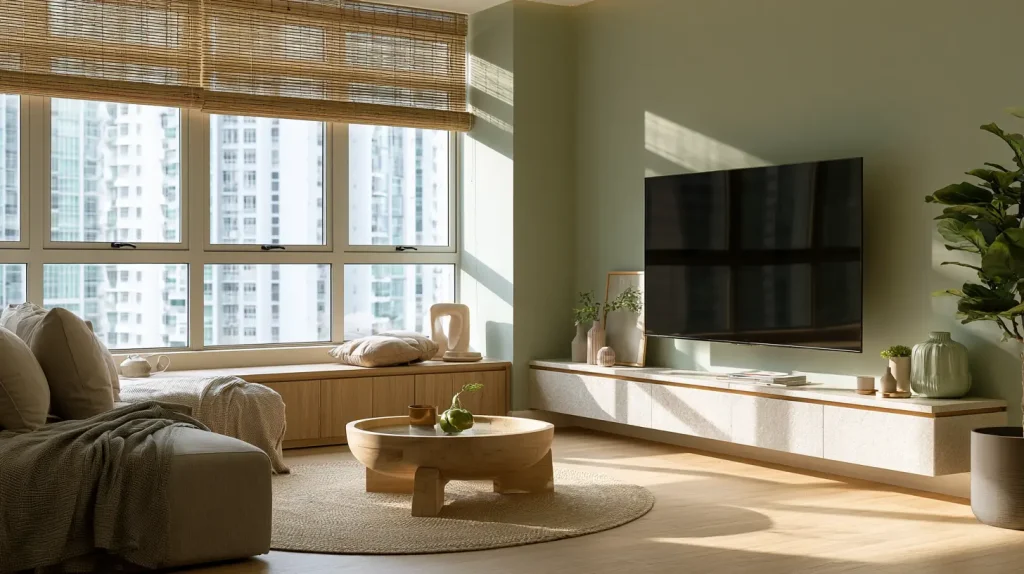
Japandi is the design child of two philosophies: Japan’s wabi-sabi (the beauty of imperfection and impermanence) and Scandinavia’s hygge (warmth, cosiness, and functional simplicity). The result is a style that strips away excess without feeling cold — natural materials, muted palettes, and furniture that earns its place by being both beautiful and useful.
For Malaysian homeowners, Japandi is a near-perfect fit. Our condos tend to run between 650–1,000 sq ft, which rewards low-profile furniture and uncluttered layouts. Our tropical climate pairs naturally with the timber, stone, and rattan that Japandi gravitates toward. And the muted, warm palette softens the harsh contrast that direct equatorial sunlight can create — something brighter, more saturated colour schemes struggle with.
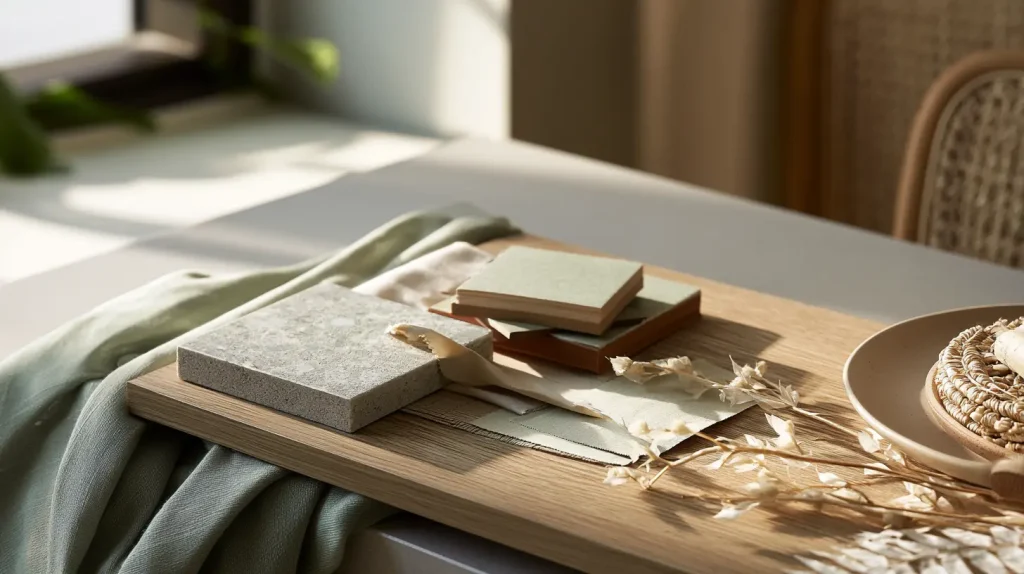
Here’s what makes this Japandi living room work — element by element.
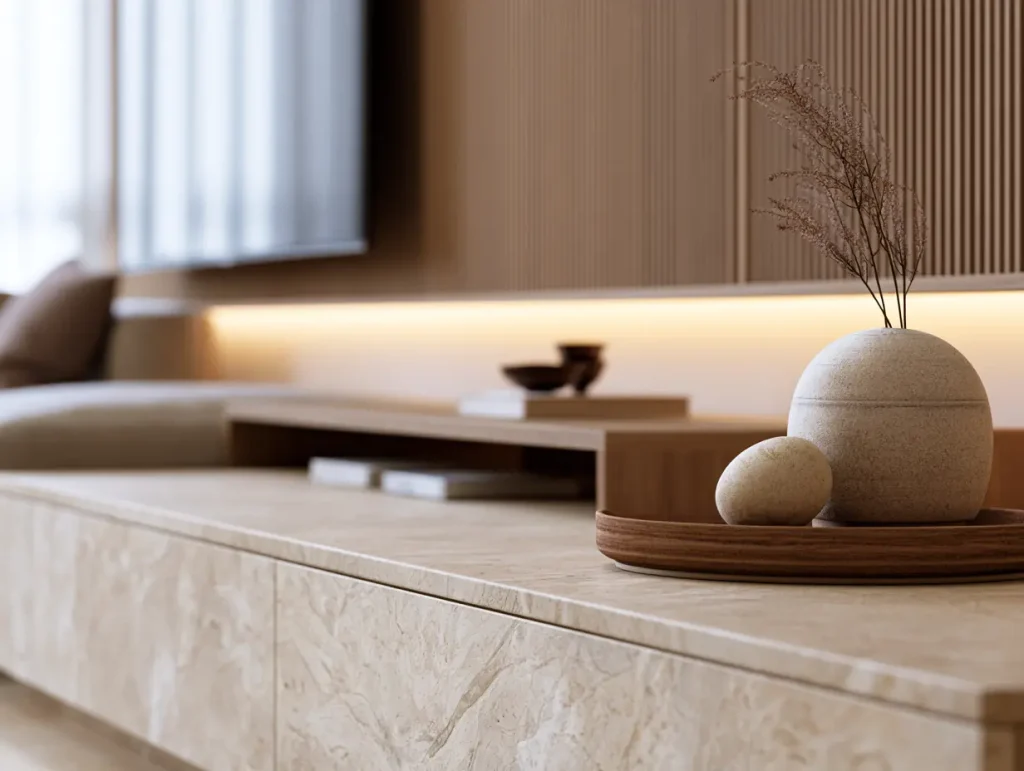
The TV console is the anchor of any living room, and in a Japandi space, it earns that role through material. A sintered stone console — like those in the Sintered Stone matte finish collection by Sinno Stone — immediately elevates the room by introducing natural texture and visual weight without bulk.
Sintered stone works as a TV console surface for three reasons specific to Malaysian homes. First, it’s completely humidity-resistant — no warping, swelling, or delamination over time, which is a real concern with solid timber or MDF in our climate. Second, the natural veining gives the wall a focal point without requiring art or décor. Third, the cool surface temperature provides a quiet counterbalance to warm timber flooring, creating the material contrast that defines the Japandi look.
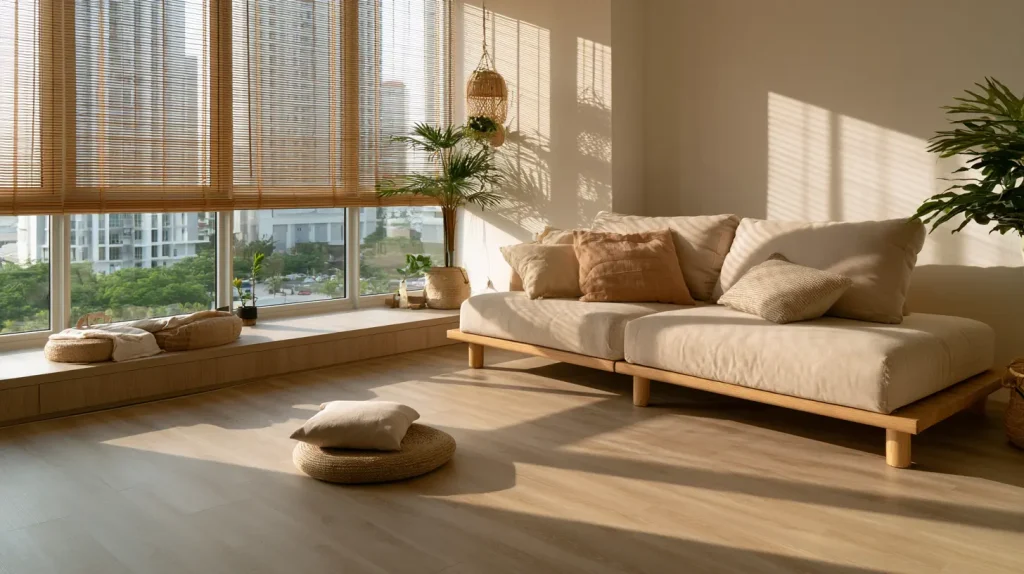
Bamboo blinds do double duty in a Malaysian Japandi living room — they filter harsh direct sunlight into soft, diffused warmth, and they allow airflow that sheer curtains or blackout blinds block entirely. In a country where cross-ventilation is your best weapon against humidity, that matters.
The natural texture of bamboo also reinforces the organic material palette. Paired with the stone console and timber flooring, it completes a trio of natural materials that grounds the room without any single element competing for attention.
Light oak timber flooring — or a quality vinyl timber look-alike — is the foundation of this Japandi living room. In small Malaysian condo units, floor colour has an outsized impact on how spacious a room feels. Light flooring reflects light upward, visually expanding the space. Dark flooring absorbs it, making rooms feel smaller and heavier.
Solid timber is the premium choice, but it requires careful maintenance in humid climates. A high-quality SPC (Stone Plastic Composite) vinyl plank gives you the same visual warmth at a fraction of the cost, with better resistance to humidity and easier replacement if damaged.
The palette in this room works on three tiers:
The key rule: keep the ratio roughly 70% base, 20% mid-tone, 10% accent. Flip this and the room tips from calm to busy.
Most Malaysian condo units have one ceiling-mounted light point per room — a single source that creates flat, unflattering light. Japandi living rooms use layered lighting to fix this.
The approach: one warm pendant or semi-flush ceiling fixture as the primary source (3,000K colour temperature — warm white, not cool white), supplemented by floor lamps or table lamps in corners to build ambient depth. Recessed downlights work if you’re doing a full renovation, but they require hacking into the ceiling slab — check with your JMB before committing.
Warm white (2,700K–3,000K) is non-negotiable for Japandi. Cool white bulbs will wash out the entire palette and make natural timber and stone look grey and lifeless.
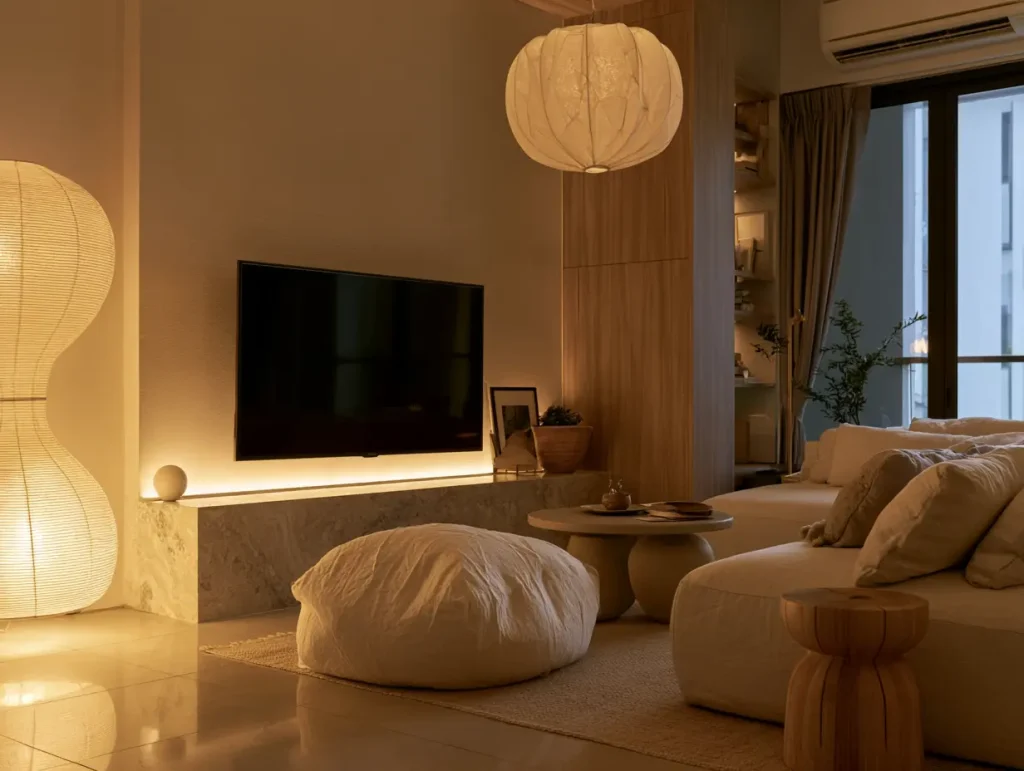
Malaysian condos typically have ceilings at 9–10 ft. Standard-height furniture — sofas with 90cm backs, tall bookshelves — can make a room feel like a box.
The Japandi fix is to go low. Choose a sofa with a seat height around 35–40cm and a back height no taller than 75cm. Keep your TV console at 40–50cm off the ground. This creates a visible gap between the top of your furniture and the ceiling, making the ceiling appear higher than it is. Combine this with a low-profile coffee table and you’ve effectively added visual height to the room without touching a single wall.
Malaysian humidity averages 70–90% year-round. This eliminates several popular Japandi materials without local modification:
If you’re replacing flooring in a strata property, your JMB or MC will almost certainly require an acoustic underlay beneath hard flooring — typically minimum 3mm. Some properties specify impact noise ratings. Get this confirmed in writing from your management office before purchasing materials.
Wet works (hacking, screeding) may also require a renovation permit and a refundable deposit. Check your building’s house rules first. Our guide on renovation timelines in Malaysia covers how long the JMB approval process typically takes.
| Element | Local Source | Estimated Cost |
|---|---|---|
| Stone TV console surface | Sinno Sdn Bhd (Sinno stone) | RM 800–2,500 depending on size |
| SPC vinyl flooring | Mr. DIY, Leewood, or renovation suppliers | RM 4–9 per sq ft (supply + install) |
| Bamboo blinds | Mr. DIY, IKEA, or local blinds specialist | RM 80–250 per panel |
| Low-profile sofa | IKEA (KIVIK, SÖDERHAMN), local furniture yards | RM 1,500–5,000 |
| Warm pendant lighting | Mr. DIY, IKEA, Shopee local sellers | RM 80–400 per fixture |
| Sage accent cushions / décor | IKEA, Shopee, Lazada local sellers | RM 30–150 per item |
For a typical 12×15 ft Malaysian condo living room:
| Scope | Budget Range |
|---|---|
| DIY-friendly refresh (paint, soft furnishings, lighting swap) | RM 2,000–5,000 |
| Mid-range (add new flooring + stone console) | RM 8,000–15,000 |
| Full renovation (flooring, console, built-ins, lighting design) | RM 18,000–35,000 |
For a detailed breakdown of where renovation costs go, see our 2026 Malaysia renovation cost guide. If you’re planning a bigger renovation alongside this refresh, our complete renovation checklist for Malaysian homeowners will help you avoid the most common planning mistakes before work begins.
The reason Japandi living rooms feel so good to live in — not just to photograph — is that every element earns its place. Nothing is decorative for decoration’s sake. The stone console isn’t just beautiful; it’s humidity-proof. The bamboo blinds aren’t just pretty; they manage tropical light and airflow. The low sofa isn’t just stylish; it makes your ceiling feel taller.
That philosophy maps almost perfectly onto the constraints of Malaysian condo living. Small footprint, humid climate, challenging lighting — Japandi doesn’t fight these realities. It works with them.
Rumaruma is here to help you make design decisions with confidence — grounded in real local materials, real costs, and real Malaysian conditions. This breakdown is your starting point.
Start with one element — swap your flooring to a light oak SPC, add a stone surface to your TV console, or change your bulbs to warm white — and watch how quickly the whole room begins to shift.
