Our Location
304 North Cardinal St.
Dorchester Center, MA 02124

Master the wabi-sabi bedroom look for your Malaysian condo — raw concrete, local rattan, and muted tones that feel intentional, not incomplete.
Most attempts at wabi-sabi in Malaysia end up looking like one of two things: a half-done renovation or a dusty storeroom. The philosophy sounds deceptively simple — embrace imperfection — but executing it in a Malaysian condo, where space is tight and humidity is relentless, takes more deliberate thinking than most people expect.
Wabi-sabi is a Japanese aesthetic rooted in the acceptance of transience and imperfection. In a bedroom, it translates to raw textures, organic materials, and a quietly muted palette that feels like it has always been there. Done right, it’s one of the most calming bedroom aesthetics you can achieve in a small urban space. This article walks you through six design elements — from the concrete feature wall to the final bedside object — and shows you how to adapt each one for Malaysian conditions.
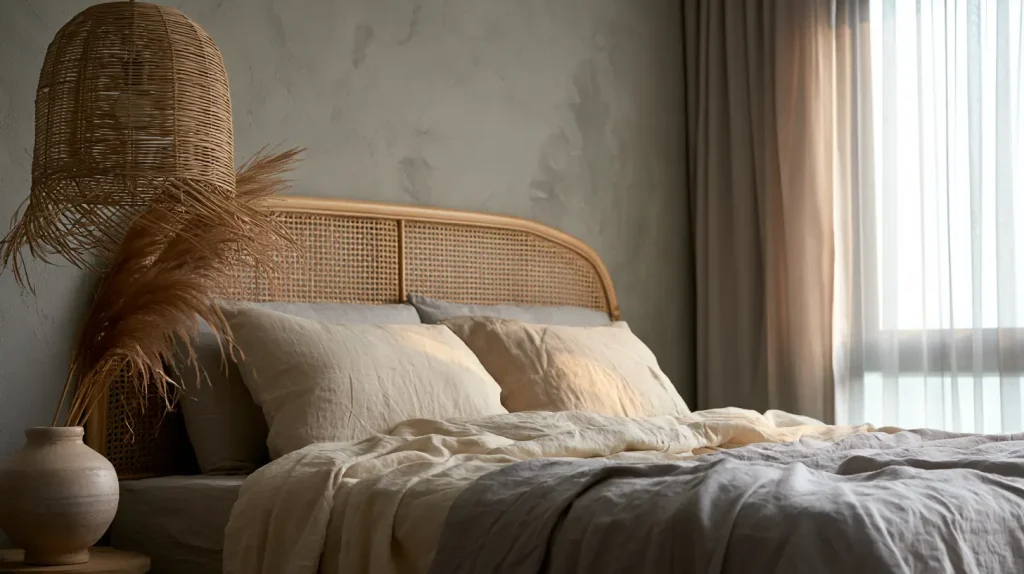
Wabi-sabi doesn’t mean leaving things unfinished. It means choosing materials and forms that carry the honest evidence of time, craft, and nature — and arranging them with enough intention that the imperfection reads as beauty, not neglect. A rough-hewn rattan frame is wabi-sabi. A melamine shelf peeling at the edge is not.
What makes Malaysia particularly well-suited to this aesthetic is what we already have around us. Rattan has been a staple of local homes for generations. Tropical humidity softens surfaces and ages timber in ways that northern climates never achieve. The materials that define wabi-sabi — natural fibres, unpolished stone, organic textures — are not exotic imports here. They’re part of the local material vocabulary. The work is in editing and elevating them, not sourcing them from scratch.
If you’ve already explored Japandi design for your living room, you’ll recognise some overlap — both styles draw from Japanese minimalism and natural materials. The key difference is that Japandi leans cleaner and more structured, while wabi-sabi allows for more organic irregularity and visual warmth.
The concrete feature wall is the most recognisable anchor of a wabi-sabi bedroom. It grounds the whole room in raw materiality and gives every softer element — linen, rattan, ceramics — something to contrast against. In Malaysian condos, though, there’s an immediate practical concern: most JMBs prohibit hacking into structural or RC walls without written approval, and even with approval, the process is disruptive and costly.
The good news is that the concrete look doesn’t require actual exposed concrete. Three workable alternatives exist for condo dwellers:
Apply the feature wall only behind the headboard. One textured wall is bold and intentional. Four textured walls become overwhelming.
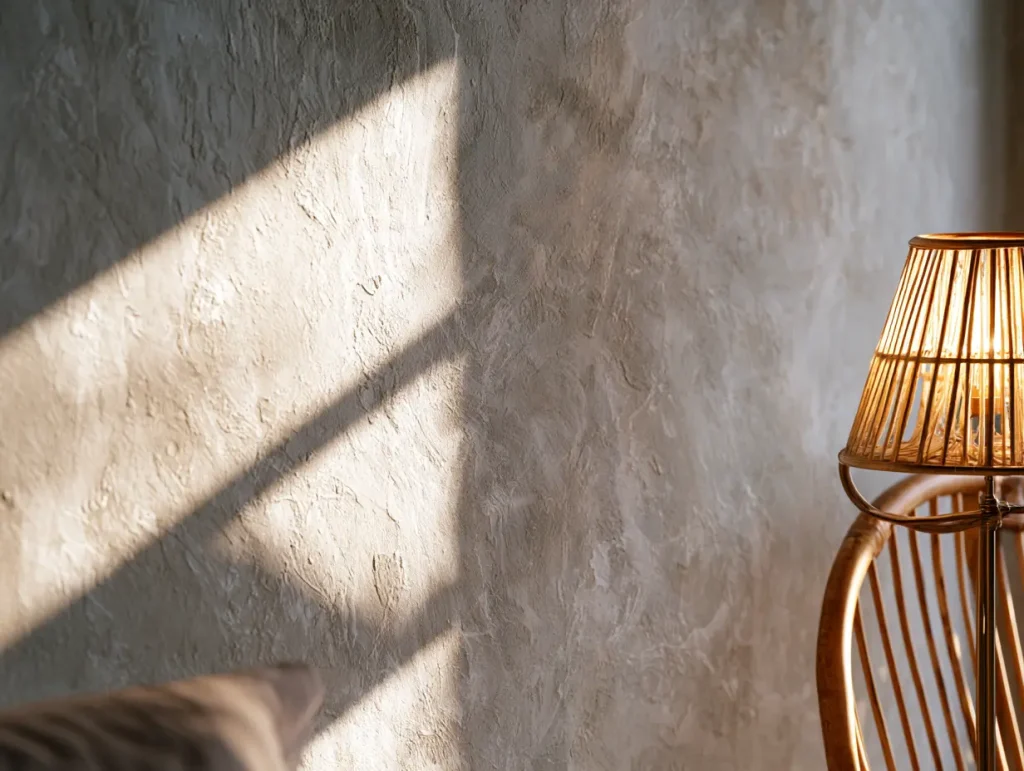
Rattan is wabi-sabi’s most natural ally in a Malaysian context — it’s inherently irregular, it ages gracefully in humidity rather than against it, and it carries a tactile warmth that no synthetic material can replicate. The goal is to use it selectively rather than filling every corner with it.
In a wabi-sabi bedroom, the most effective rattan placements are:
One or two of these pieces is enough. Stacking all four in a single room tips from curated into cluttered. For local sourcing, check furniture rows along Jalan Ipoh in KL, the Nilai 3 wholesale complex in Seremban, or handmade rattan sellers on Shopee and Lazada that carry pieces at mid-range prices.
Wabi-sabi colour is never crisp, saturated, or bright. The palette is desaturated — pulled back from its peak intensity — and tilted toward warm neutrals: greige, dusty taupe, warm clay, aged linen, and muted sage. Think of colours that look as though they’ve been gently washed by light and time.
For walls, Nippon Paint’s muted neutral range offers the right starting point. Look at tones in the warm white and greige families from their Easy Selection palette — avoid pure whites with blue or cool undertones, which read as clinical rather than organic. For the concrete feature wall, Nippon Paint Momento applied in dusty clay or pale chalk tones works well against natural rattan and linen.
The palette layering rule for wabi-sabi bedrooms is simple: keep the walls lighter than the textiles, and the textiles lighter than the floor. This creates a natural gradient from ceiling to ground that feels grounded rather than floating. In Malaysian condos with standard 9-foot ceilings, this gradient does a lot of visual work to make the room feel taller and more spacious than it is.
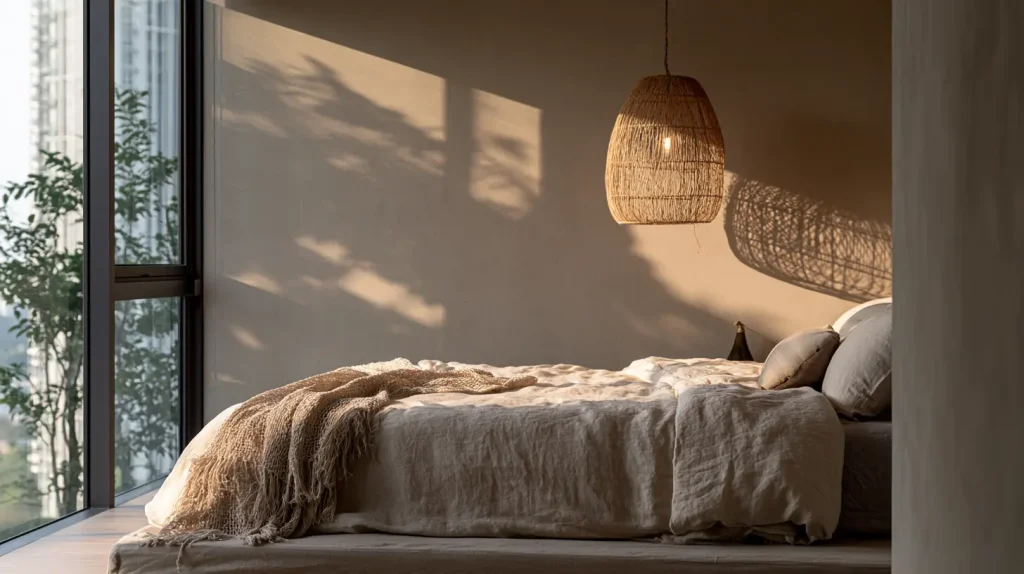
The bed is the largest visual surface in any bedroom, and in a wabi-sabi room it needs to earn its place through texture rather than colour. Linen is the definitive wabi-sabi fabric — it wrinkles naturally, softens with every wash, and carries an inherently unhurried quality that polyester and cotton-poly blends simply cannot replicate.
For a Malaysian bedroom, a linen-cotton blend is more practical than 100% linen. Pure linen in tropical humidity can feel heavy against the skin and takes longer to dry. A 55–70% linen blend gives you the visual texture and drape without the thermal heaviness.
Build the bed in three layers:
The deliberate mis-match between textures is intentional. If every cushion matches perfectly, the bed looks like a hotel room — not a wabi-sabi bedroom.
Wabi-sabi accessories don’t arrive in a curated set from a lifestyle boutique. They accumulate — a handmade ceramic piece here, a found natural object there, a bedside lamp inherited from somewhere. In practice, for most Malaysian homeowners starting fresh, this means choosing pieces that look as though they could have been collected over time.
The guiding principles for wabi-sabi accessories:
On the bedside, three objects is the maximum: a lamp, a small ceramic piece, and one other item — a book, a small dried branch, a stone. More than three tips into visual clutter, which is the enemy of wabi-sabi.
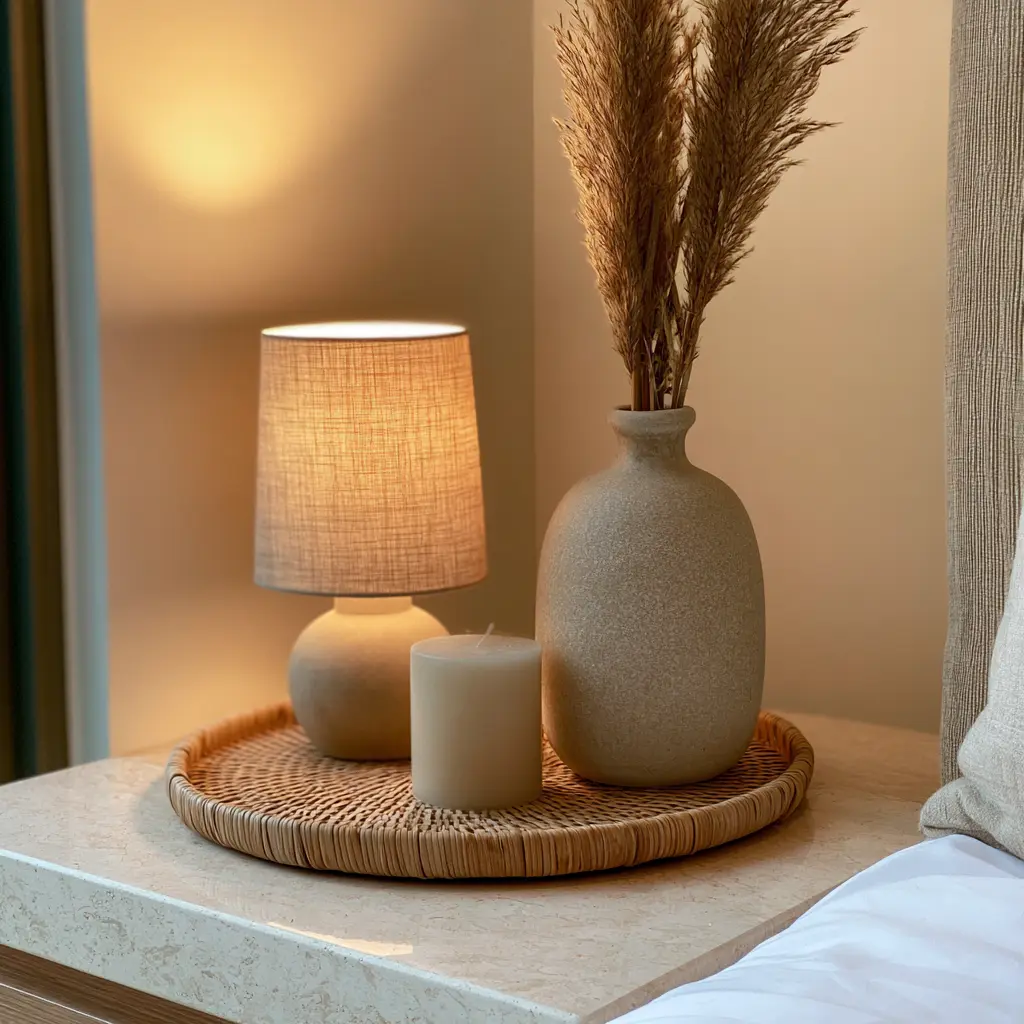
Nothing breaks a wabi-sabi bedroom faster than a harsh ceiling light switched on at full blast. Overhead lighting flattens surfaces, erases shadows, and removes the very depth that makes raw textures interesting. In a wabi-sabi bedroom, light comes from beside and below — never from directly above.
The practical setup for a Malaysian condo bedroom:
For bulb temperature: 2700K warm white is the upper limit. Anything cooler — 3000K or above — shifts the mood from intimate to institutional. In Malaysia’s climate, 2700K LED bulbs generate minimal heat and are energy-efficient, which makes them the practical choice alongside the aesthetic one.
Keep the built-in ceiling light available for functional moments — cleaning, searching for something — but treat it as a last resort rather than a primary light source.
The most common criticism of a poorly executed wabi-sabi bedroom is that it looks like the renovation isn’t done yet. The difference between intentionally imperfect and accidentally incomplete comes down to one question: does every element in the room look chosen?
Chosen imperfection — a rough concrete wall behind a carefully made bed, a rattan pendant above a neatly folded linen throw — reads as wabi-sabi. Unchosen disorder — exposed cable trays because the contractor hasn’t finished, a paint patch where a hook was removed — does not.
Three things to actively avoid:
If you can explain why every element is where it is, the room is wabi-sabi. If the answer for any element is “I haven’t got around to fixing that yet,” it’s not.
Wabi-sabi is a discipline disguised as casualness. The bedrooms that do it best look effortless precisely because every material, placement, and proportion was considered — not because someone left things rough and hoped for the best. In Malaysia, where the impulse is often to finish everything smoothly and match everything precisely, wabi-sabi requires a deliberate shift in thinking: beauty lives in the texture of handmade rattan, in the quiet variation of a plastered wall, in linen that wrinkles beautifully every morning.
The six elements in this article — concrete feature wall, rattan accents, muted palette, linen bedding, imperfect objects, and low ambient lighting — don’t all need to arrive at once. Start with one, let the room settle, and add the next layer when it feels right. That’s actually the most wabi-sabi approach of all.
For more design styles adapted to Malaysian conditions — climate, condo rules, and the real material landscape you’re working with — Rumaruma covers them all, from inspiration to implementation.
Start with the concrete wall: get one element right, and the rest of the room will follow.
