Our Location
304 North Cardinal St.
Dorchester Center, MA 02124

A full design breakdown of the biophilic kitchen — indoor plants, stone countertop, and open shelving for Malaysian homes.
Malaysian kitchens are built for function. The typical layout — closed wet kitchen with tiled walls, an exhaust fan over the hob, and a sliding door keeping the cooking smells contained — does its job efficiently. But efficiency isn’t the same as joy. Most Malaysian kitchens feel like a utility room with a better backsplash.
Biophilic kitchen design is the shift from functional to alive. It’s a design philosophy rooted in the idea that humans feel better, cook better, and spend more time in spaces that maintain a visual and sensory connection to nature — through plants, natural stone, timber, open air, and honest materials. Applied to a Malaysian kitchen, it doesn’t require a major structural overhaul. It requires a different set of choices about what materials go on your countertop, what lives on your shelves, and how you let light and air move through the space.
This article breaks down every element of a biophilic kitchen — from the stone countertop to the shelf styling — so you can bring this look into your own home with local materials and a realistic budget.
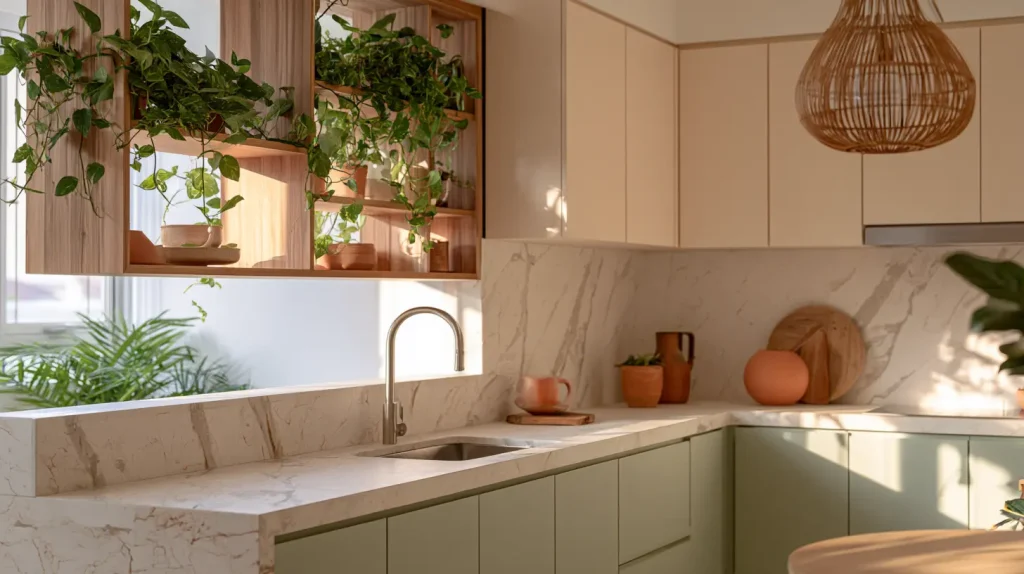
Biophilic design draws on a well-documented concept: human beings have an innate need to connect with nature, and the spaces we live in either support or suppress that need. In interior design terms, it translates into a deliberate effort to bring natural elements — plants, stone, timber, natural light — into the built environment.
In a kitchen, this plays out through materials that reference nature (a stone countertop with natural veining, open timber shelves), through living plants that introduce oxygen and greenery, and through design choices that prioritise airflow, natural light, and a visual connection to the outdoors.
What makes biophilic kitchen design unusually well-suited to Malaysia is climate. Most biophilic interiors in European design editorials rely on dull diffused light and a handful of carefully placed succulents. In Malaysia, we have something better — intense tropical light, genuine warmth, and ambient humidity levels that many houseplants actively thrive in. The challenge is adaptation. Not every biophilic material works in a Malaysian cooking environment. Open shelving needs to account for oil mist and condensation. Indoor plants need to handle heat near the hob. The stone countertop — the anchor of the whole design — needs to resist heat, staining, and humidity simultaneously.
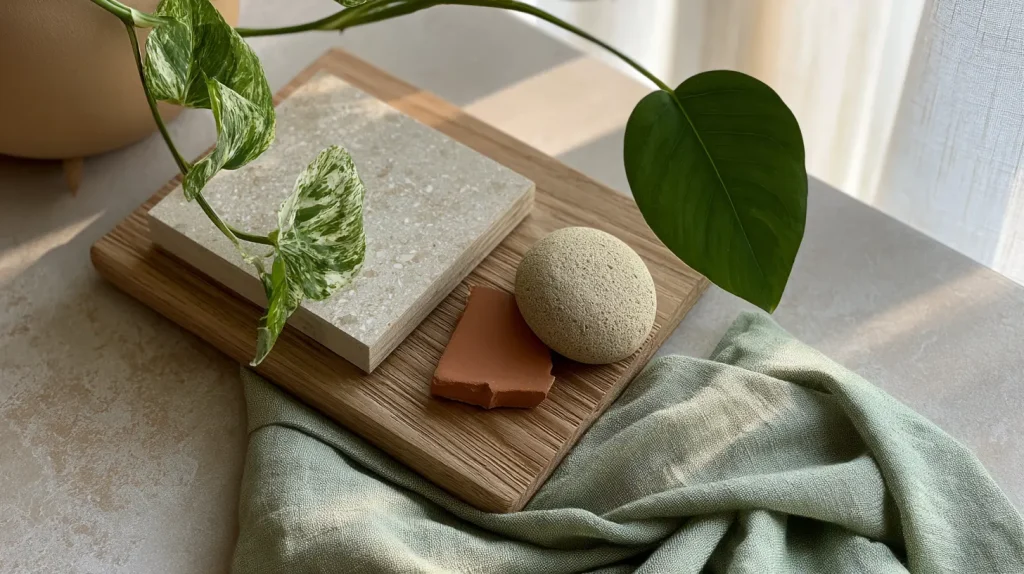
Here’s what makes this biophilic kitchen work — element by element.
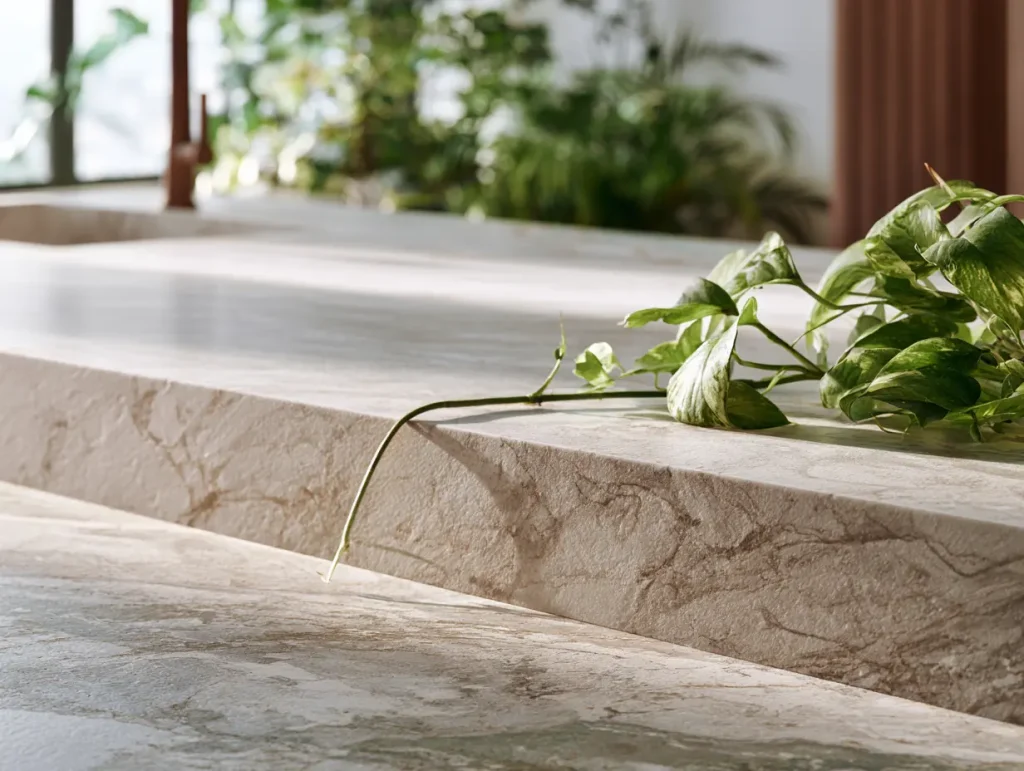
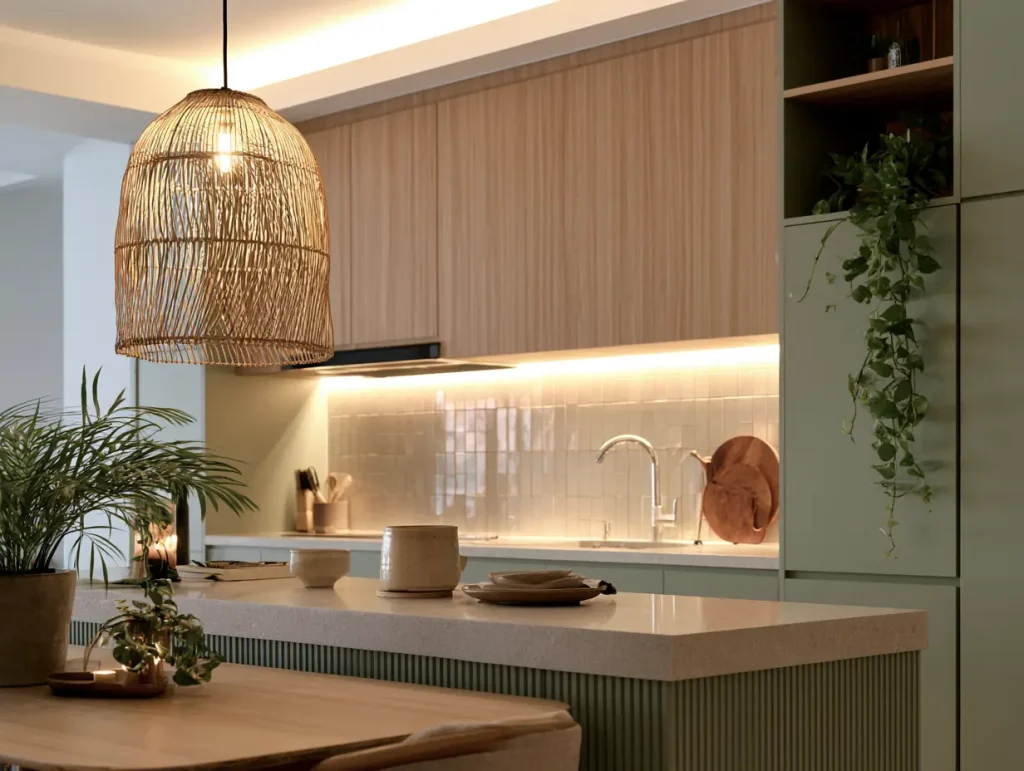
The countertop is where a biophilic kitchen earns its identity. A sintered stone countertop — like those in Sinno Stone’s Sintered Stone range — serves as the natural anchor of the space. The subtle veining and matte finish read as stone quarried from the earth, not manufactured in a factory, which is precisely the visual quality that makes biophilic design work.
Sintered stone is the right material for a Malaysian kitchen for reasons beyond aesthetics. It’s non-porous — it won’t absorb cooking oils, turmeric stains, or the acidic residue from lime and tamarind that conventional surfaces accumulate over time. It handles heat directly from the hob without damage. And it doesn’t react to the humidity swings between a hot cooking session and a well air-conditioned kitchen.
What sintered stone does for the biophilic look specifically is this: it introduces organic texture at the scale that matters most — your primary work surface. Every time you’re at the countertop, you’re in visual contact with a material that references the natural world, without any maintenance effort on your part.
Plants are the most visible element of a biophilic kitchen, and also the most mismanaged. The mistake most homeowners make is choosing plants for looks rather than context — delicate specimens that can’t handle the heat, oil mist, and occasional neglect of an active kitchen.
For a Malaysian kitchen, the best-performing plants are those that already tolerate the conditions:
Placement matters as much as species. Keep plants away from direct steam and oil spray — a shelf at eye level or above on the wall opposite the hob works well. A windowsill suits sun-loving herbs. Hanging planters above a kitchen island or along an open ceiling grid add vertical greenery without taking up counter space.
Open shelving is one of the defining features of a biophilic kitchen, and one of the most debated in the Malaysian context. The concern is valid: our cooking produces oil mist, steam, and condensation that accumulates on surfaces near the hob. Open shelves collect this.
The answer isn’t to avoid open shelving — it’s to be strategic about where you install it and what goes on it.
Open shelving works well on the wall opposite the hob, or on a side wall that doesn’t face the cooking zone directly. This positioning allows the shelves to provide visual openness and natural material warmth without becoming a grease trap. Reserve the wall directly behind the hob for closed cabinetry or a full-height tile backsplash.
For the shelving material itself, avoid MDF — it absorbs moisture and warps in humidity cycles. The best choices in a Malaysian kitchen are solid timber (teak, meranti, or treated local timber sealed with a food-safe polyurethane finish), powder-coated steel brackets with ceramic or stone shelves, or sealed concrete. Solid timber is the most visually warm option and holds up well when positioned away from the direct cooking zone.
What you put on open shelves also shapes the biophilic look. Ceramics in earthy tones, glass storage jars, pothos trailing over the edge, a few cookbooks — these reinforce the natural palette. Plastic containers and mismatched Tupperware in bold colours do the opposite.
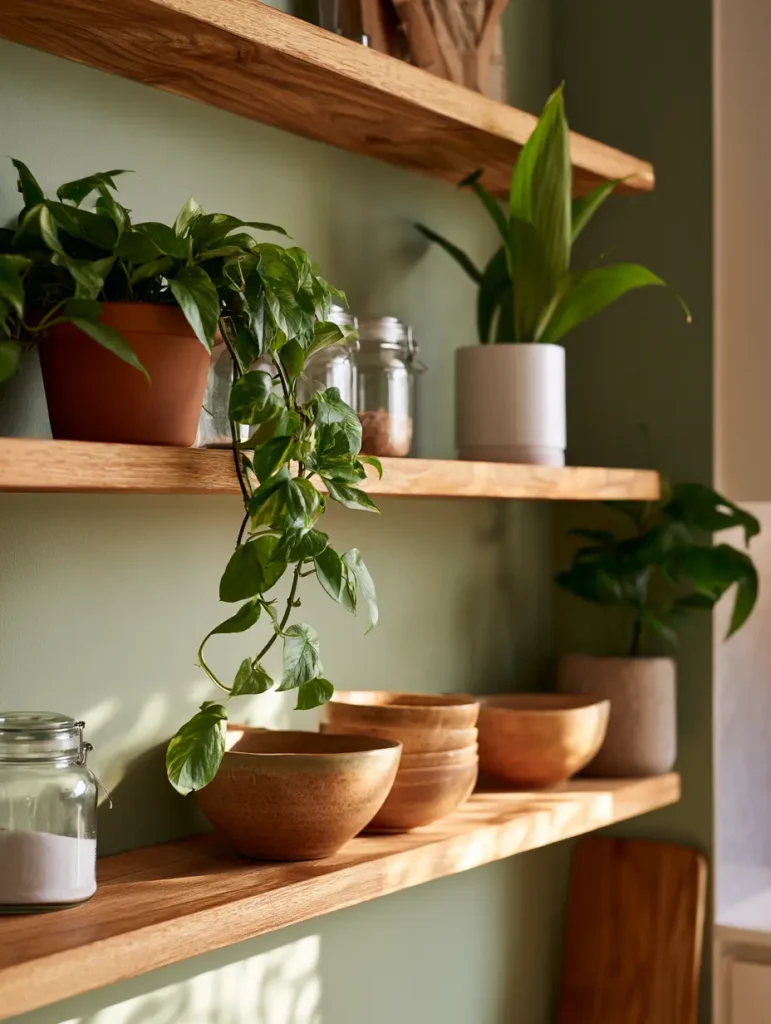
A biophilic kitchen palette draws from the natural world — the greens, warm earths, and stone neutrals that feel like an extension of an outdoor space rather than a departure from it.
The palette in this kitchen works on three tiers:
Keep the ratio consistent: roughly 70% base, 20% mid-tone, 10% accent. The moment the greens start to dominate over the neutral base, the kitchen tips from calm to busy.
Natural light is the most powerful biophilic design tool in a kitchen, and the most underused. Malaysian kitchens in condo units often receive indirect light — east-facing kitchens get morning sun, west-facing get afternoon. If you have a window in the kitchen, prioritise keeping it clear of heavy curtains or upper cabinets that block the light path. A simple roller blind in a sheer natural fabric gives you privacy without sacrificing daylight.
For artificial lighting, the biophilic kitchen uses two layers:
Avoid the common Malaysian kitchen default of a single fluorescent ceiling tube at 4,000–6,500K cool white. It’s cheap to install and functional, but it kills the biophilic atmosphere entirely.
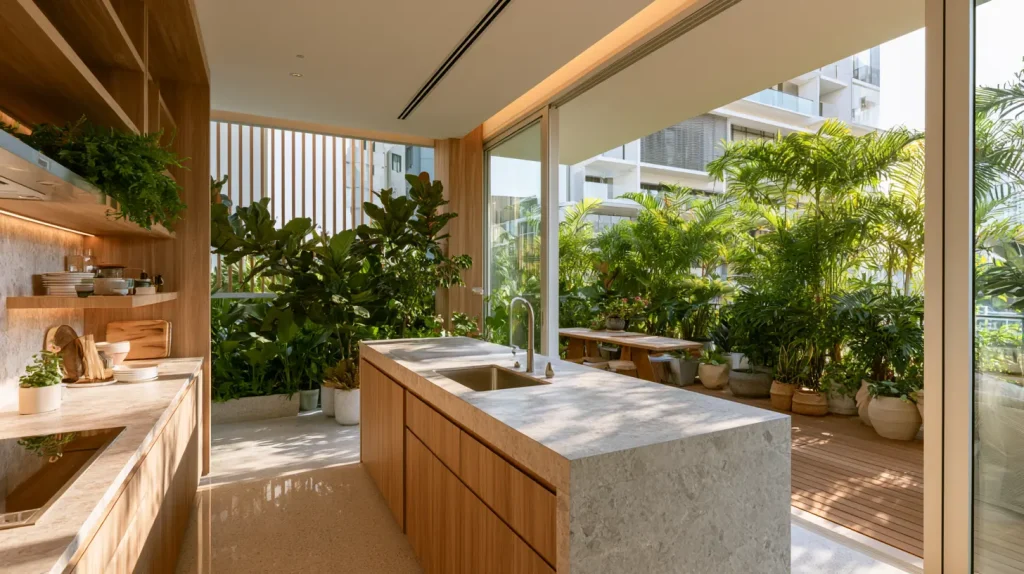
The most powerful biophilic move in a kitchen isn’t a material — it’s a sightline. If your kitchen faces a window, balcony, or outdoor garden area, design your layout so the primary work zone has a direct visual line to greenery outside. Cooking while looking at trees or a planted balcony is a fundamentally different experience from cooking facing a tiled wall.
In a Malaysian condo context, this often means positioning the kitchen island or prep zone to face the balcony sliding door rather than a wall. If you’re doing a full renovation, removing the partition between the dry kitchen and balcony (check with your JMB first) and installing full-height sliding glass panels gives you an open-air kitchen feel that works beautifully with our tropical climate.
Where an external sightline isn’t possible — a closed interior kitchen — a large-format botanical print, a living wall panel, or a wall-mounted herb planter with grow lights achieves a similar effect at a fraction of the cost.
A Malaysian kitchen’s humidity levels swing significantly — from the steam of a heavy cook to the dry cold of an air-conditioned space. This places specific demands on every material:
Kitchen renovations in strata properties carry specific JMB requirements that can affect both timeline and budget. Wet works — hacking wall tiles, moving drainage points, altering the gas line — almost always require a formal renovation permit and a refundable deposit with your building management.
If your biophilic kitchen plan includes relocating the sink, adding a kitchen island with plumbing, or removing a wall to open the kitchen to the balcony, these are classified as structural or wet works and will require written JMB approval before contractors can begin. Our guide on how long a full home renovation takes in Malaysia covers how the JMB approval process affects your renovation schedule in practice.
If you’re planning a kitchen refresh without structural changes — new countertop, open shelving, paint, plants — most JMBs don’t require a permit. Confirm with your management office in writing regardless.
| Element | Local Source | Estimated Cost |
|---|---|---|
| Sintered stone kitchen countertop | Sinno Stone — Sintered Stone range | RM 1,500–4,500 depending on size |
| Solid timber open shelves (teak / meranti, sealed) | Local timber yards, renovation contractors | RM 200–600 per shelf (supply + install) |
| Powder-coated steel shelf brackets | Mr. DIY, local hardware suppliers | RM 15–60 per bracket pair |
| Indoor plants (pothos, money plant, pandan) | Pasar malam, nurseries, Shopee local sellers | RM 5–40 per pot |
| Rattan pendant light | Mr. DIY, IKEA, Shopee local sellers | RM 80–350 per fixture |
| Warm white LED strip lights (under-cabinet) | Mr. DIY, electrical suppliers | RM 50–150 per metre (supply + install) |
| Earthy ceramic accessories | IKEA, Shopee, Lazada local potters | RM 20–120 per piece |
For a typical Malaysian condo dry kitchen (roughly 8×10 ft):
| Scope | Budget Range |
|---|---|
| Refresh only (paint, plants, open shelving, lighting swap) | RM 2,000–5,000 |
| Mid-range (add new countertop + cabinet repaint or vinyl wrap) | RM 8,000–18,000 |
| Full renovation (new cabinets, countertop, flooring, open shelving, lighting) | RM 20,000–45,000 |
For a full breakdown of where kitchen renovation costs are typically allocated, see our 2026 Malaysia renovation cost guide. If this kitchen work is part of a larger whole-home renovation, our complete renovation checklist for Malaysian homeowners will help you avoid the planning mistakes that cause most cost overruns.
The reason biophilic kitchens feel so different to live and cook in — not just to photograph — is that they remove the experience of being enclosed. A sintered stone countertop, a shelf of trailing pothos, a rattan pendant filtering warm light, a sightline out to a balcony garden — these elements don’t just look good. They change how it feels to stand in your kitchen at 7am making breakfast or 8pm cleaning up after dinner.
Malaysian conditions make this easier than most people expect. Our humidity keeps plants alive with minimal effort. Our light — equatorial, intense, and available almost every day of the year — is one of the best free design tools we have. The materials that biophilic kitchen design gravitates toward — stone, timber, ceramics, rattan — are all available locally and at competitive prices.
The adaptation challenge is real but manageable. Choose the right plants for a cooking environment, position open shelving away from the hob, and anchor the design with a surface that performs as well as it looks. Rumaruma is here to help you make those decisions with confidence, grounded in what actually works in a Malaysian home.
Start with the countertop — one material change that brings natural texture, heat resistance, and genuine biophilic character into the heart of your kitchen at the same time.
