 rumaruma
Condo Renovation Rules in Malaysia: Approvals, Deposits and Working Hours
Before your contractor lifts a hammer, your JMB or MC has to say yes. Here’s how approvals, deposits and working hours work in a Malaysian condo.
On this page
- Why Condo Renovation Rules in Malaysia Exist
- What Needs Approval in a Condo
- The JMB Renovation Approval Process, Step by Step
- Condo Renovation Deposits and Fees
- Condo Renovation Working Hours and Site Rules
- What Happens If You Break the Rules
- For Contractors: Working in Strata Buildings
- Your Condo Renovation Rules Checklist
Your contractor is ready to start on Monday. The tiles are paid for, the carpenter has a slot, and then the management office tells you the renovation application needs another week, plus drawings you don’t have. Nobody warned you about the condo renovation rules in Malaysia, and now the whole schedule slides.
It happens to a lot of new condo owners. In a strata building, almost every renovation needs written approval from the Joint Management Body (JMB) or Management Corporation (MC) before work starts. This guide walks through what needs approval, how the application works, what the deposit covers and how to get it back, and the working hours your contractor has to follow.

Why Condo Renovation Rules in Malaysia Exist
A condo unit sits inside a shared structure. The slab under your floor is the ceiling of the unit below, the water risers serve the whole stack, and the lift your contractor uses belongs to every owner. Renovation rules protect all of that.
The legal basis is the Strata Management Act 2013 and the standard by-laws in the Strata Management (Maintenance and Management) Regulations 2015. In plain terms, the by-laws say:
- You need prior written approval from the management, and from the authorities where needed, before renovating your unit.
- The work must stay inside your unit. Nothing can be done to common property such as corridors, the façade, the roof or shared pipes.
- The management can ask for a deposit and set a deadline for the work to finish.
- Approval is cancelled if you skipped a required authority approval. If the work needed a council permit and you didn’t get one, the management’s approval falls away and you answer to the council yourself.
Who you deal with depends on the building’s age. The developer manages it during the first year or so after handover, a JMB takes over until strata titles are issued, and an MC runs it after that. The rules work the same way at each stage. Each building also adds its own house rules on top, so two condos on the same road can have quite different working hours and deposits.
If you’ve just collected your keys, our key collection checklist covers registering with management before you apply.
What Needs Approval in a Condo
Assume everything does, then let the management office tell you otherwise. Most buildings want a form even for painting, because the workers still use the lift and the car park.
| Type of work | Approval needed? | What management usually asks for |
|---|---|---|
| Painting, curtains, loose furniture | Usually a simple notice or short form | Contractor details, dates |
| Built-in carpentry (wardrobes, kitchen cabinets) | Yes | Layout drawing, contractor details |
| Floor tiling or vinyl over existing tiles | Yes | Scope of work, sometimes an acoustic underlay (a layer beneath the flooring that reduces sound reaching the unit below) for upper floors |
| Bathroom or kitchen retiling (wet works) | Yes | Waterproofing method, a ponding test, sometimes inspection |
| Rewiring, new power points, water heater | Yes | Registered electrician details |
| Hacking internal walls | Yes, and often refused | Engineer’s confirmation that the wall isn’t structural |
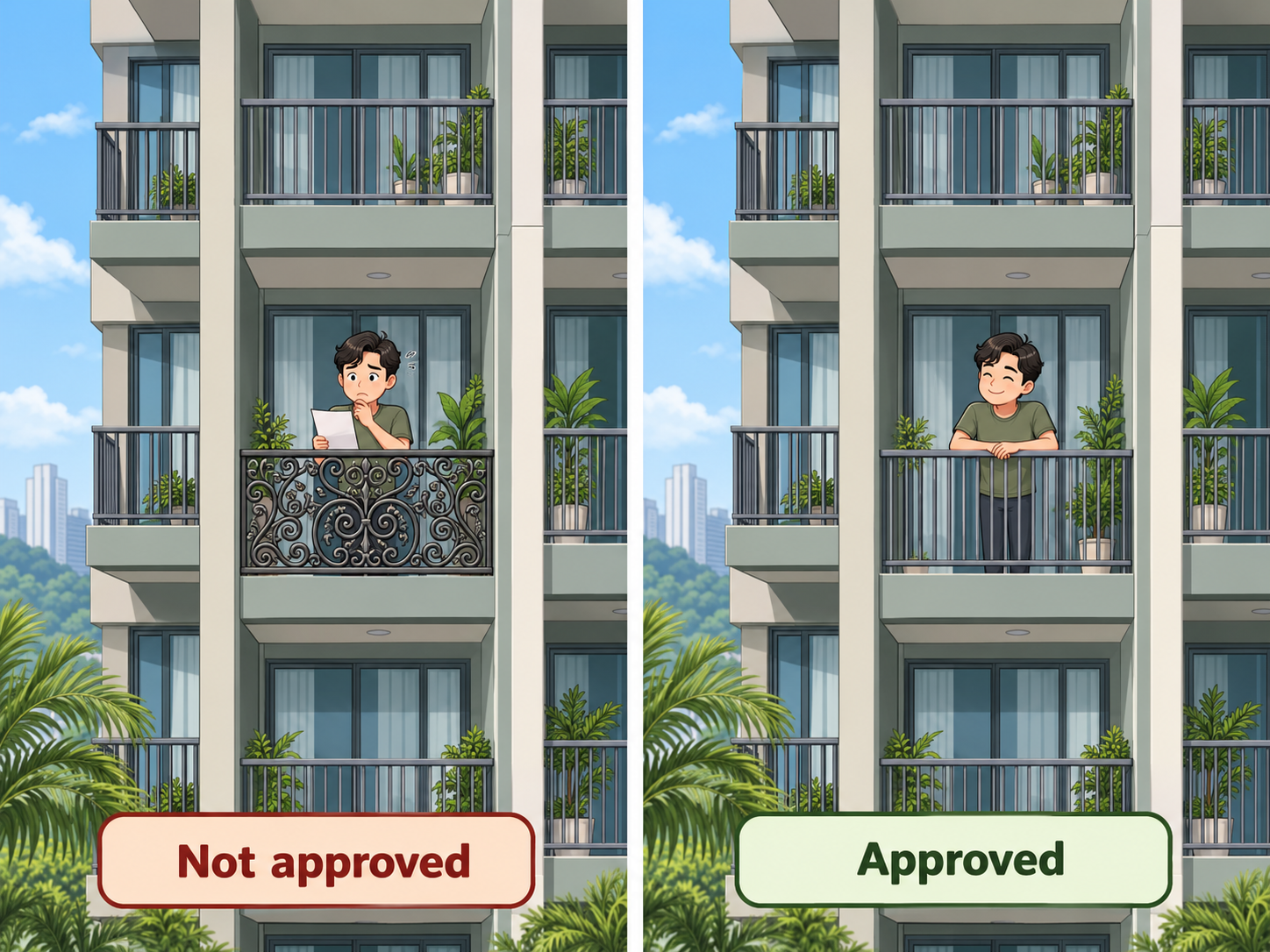
| Window grilles, balcony enclosure, door changes | Yes | Must follow the building’s approved design |
| Aircon installation | Yes | Compressor on the designated ledge only |
| Façade, external walls, common corridor | Not allowed | — |
The hard limits are the structure and the outside of the building. Many condo walls are reinforced concrete, and the façade has to stay uniform, so a grille design or balcony glass panel that isn’t on the approved list will be refused however good it looks.
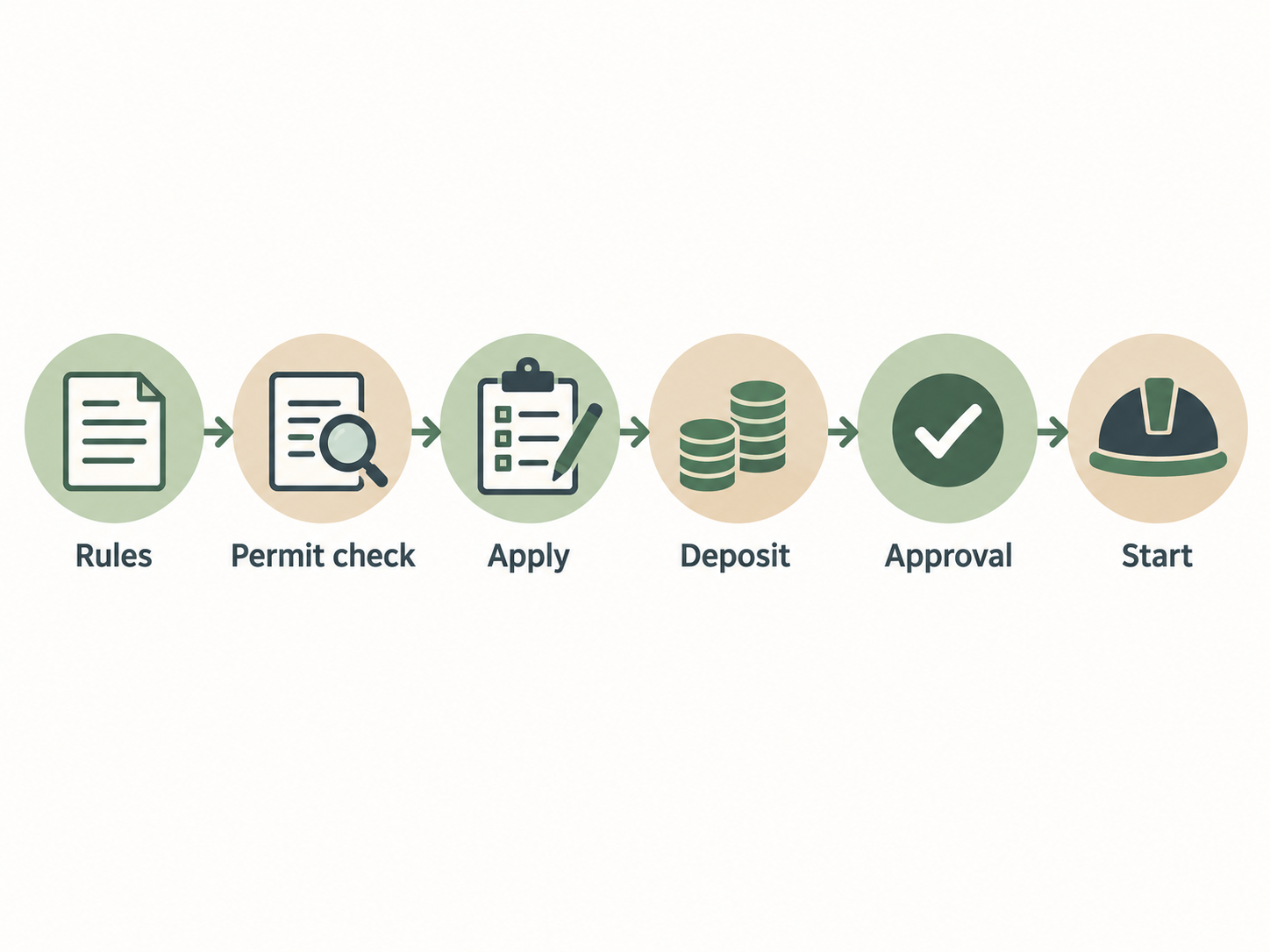
The JMB Renovation Approval Process, Step by Step
The details vary by building, but the sequence is close to this everywhere.
1. Get the renovation guidelines in writing
Ask the management office for the house rules, the renovation application form and the fee schedule. Do this before you collect quotations, because the rules decide how many working days the job takes.
2. Confirm your contractor and scope
The form asks who is doing the work and what they’re doing. You’ll usually need a final scope, not a rough idea, so finish the design and pick a contractor first. Our guide to comparing renovation quotations helps you check each quote allows for the building’s rules.
3. Check whether separate authority approval is needed
Show your proposed scope to management and ask whether any part needs separate approval from the local council or another authority. Confirm the requirements with the relevant authority before submitting your renovation application. Ask management which approval documents it needs and when, so you can plan the submissions in the right order.
Agree with your contractor who will handle any required submission, what it costs and how it affects the start date. Keep that responsibility in writing. Before work starts, make sure you have both management’s written approval and any separate authority approvals required for your scope.
4. Prepare the documents
Most applications need:
- The completed application form, signed by the owner (tenants usually can’t apply on their own)
- A description of works, room by room
- Simple drawings showing layout, carpentry and any wall or plumbing changes
- Contractor details — company registration and often registration with the Construction Industry Development Board (CIDB)
- Worker list with IC or passport copies, for access passes
- Indemnity or insurance — an indemnity is a written undertaking about responsibility for loss or damage; ask management whose signature is needed and what the form covers. Some buildings also ask the contractor for public liability insurance, which covers certain claims for injury or damage to other people’s property
- Engineer’s letter if any wall, slab or beam is affected
5. Pay the deposit and fees
The deposit and any non-refundable fees are paid when you submit. See the next section for what they usually cost.
6. Wait for approval
Approval often takes one to two weeks. Hacking, wet works or anything that needs the building’s engineer to review can take longer. Don’t let your contractor start early; work done before approval is one of the quickest ways to get a stop-work order.
7. Display the approval and start work
Many buildings give you an approval letter or notice to display on the unit door during the works. Keep a copy on site so the security guards and your neighbours can see the job is approved.
Condo Renovation Deposits and Fees
The deposit is your money, held by the management in case the work damages common property or breaks the rules. You get it back after the work is done and the management has inspected.
| Item | Typical amount | Refundable? |
|---|---|---|
| Renovation deposit | RM500–RM5,000 | Yes, after inspection |
| Admin or processing fee | Varies by building | No |
| Lift protection or debris charges | Varies by building; some include it in the deposit | Usually no |
| Worker access passes | Sometimes a small fee or card deposit per worker | Card deposit usually yes |
Amounts are for reference only. The deposit depends on the building, the scope of work and whether hacking or wet works are involved. Check your building’s fee schedule before you budget.
Before paying, ask for the refund conditions in writing, including how to request the final inspection, which documents you must submit and the expected processing time after those steps are complete. Keep these conditions with your payment receipt.
What gets deducted from the deposit
Deductions usually come from damage or breaches that the management can photograph:
- Scratched or dented lift panels and cracked lobby or corridor tiles
- Debris left in the bin room, staircase or corridor
- Work outside permitted hours, if the house rules set a penalty
- Blocked drains from cement or tile adhesive washed down the sink or floor trap
- Damage to a neighbour’s unit, such as a leak or a crack from hacking
To protect it, photograph the corridor, lift and lobby with dates before the first delivery, and again when the work ends. Ask for the inspection and refund in writing once you’ve finished. Some buildings take several weeks to process it. If the stated processing time passes, follow up with your receipt and inspection record and ask for a payment date. If management proposes a deduction, request an itemised explanation with supporting photos, repair bills or the rule it relies on. Compare these with your own records and raise any disagreement in writing. Our hidden renovation costs guide lists the other fees first budgets tend to miss.
Condo Renovation Working Hours and Site Rules
Working hours are where condo rules hit your timeline hardest. A contractor who can work 9am to 5pm on weekdays only has far fewer hours a week than one working on a landed house.
| Day | Typical rule |
|---|---|
| Monday to Friday | Around 9am–5pm; some buildings stop noisy work earlier |
| Saturday | Limited hours, often half-day, or no noisy work such as hacking and drilling |
| Sunday and public holidays | No work |
These are common patterns, not a fixed law. Your building’s house rules decide the actual hours.
Some buildings also pause work around major festive holidays such as Hari Raya and Chinese New Year. Ask when you collect the guidelines.
Beyond hours, expect these site rules:
- Access passes — Workers register at the guardhouse and wear a pass. Unregistered workers can be turned away at the gate.
- Goods lift only — Materials and debris go up and down the service lift at booked times, with the lift walls and floor protected.
- Debris removal — Debris must be bagged and taken off site by your contractor, not left in the bin room.
- Wet works and waterproofing — Bathroom and kitchen floor works usually need new waterproofing and a ponding test, where the floor is flooded for 24–48 hours to check for leaks before tiling. Some managements want to witness it.
- Drilling — Avoid drilling or chasing (cutting channels for pipes or cables) close to hidden pipes and conduits in the slab. Ask for the building’s as-built drawings, which record how it was constructed, if you’re unsure where they run.
- Fire safety — Don’t block corridors or staircases with materials, and don’t touch sprinklers, smoke detectors or the hose reel.
If you plan to stay in the unit while work goes on, our guide to living in your house during renovation covers dust, noise and which rooms to keep usable.
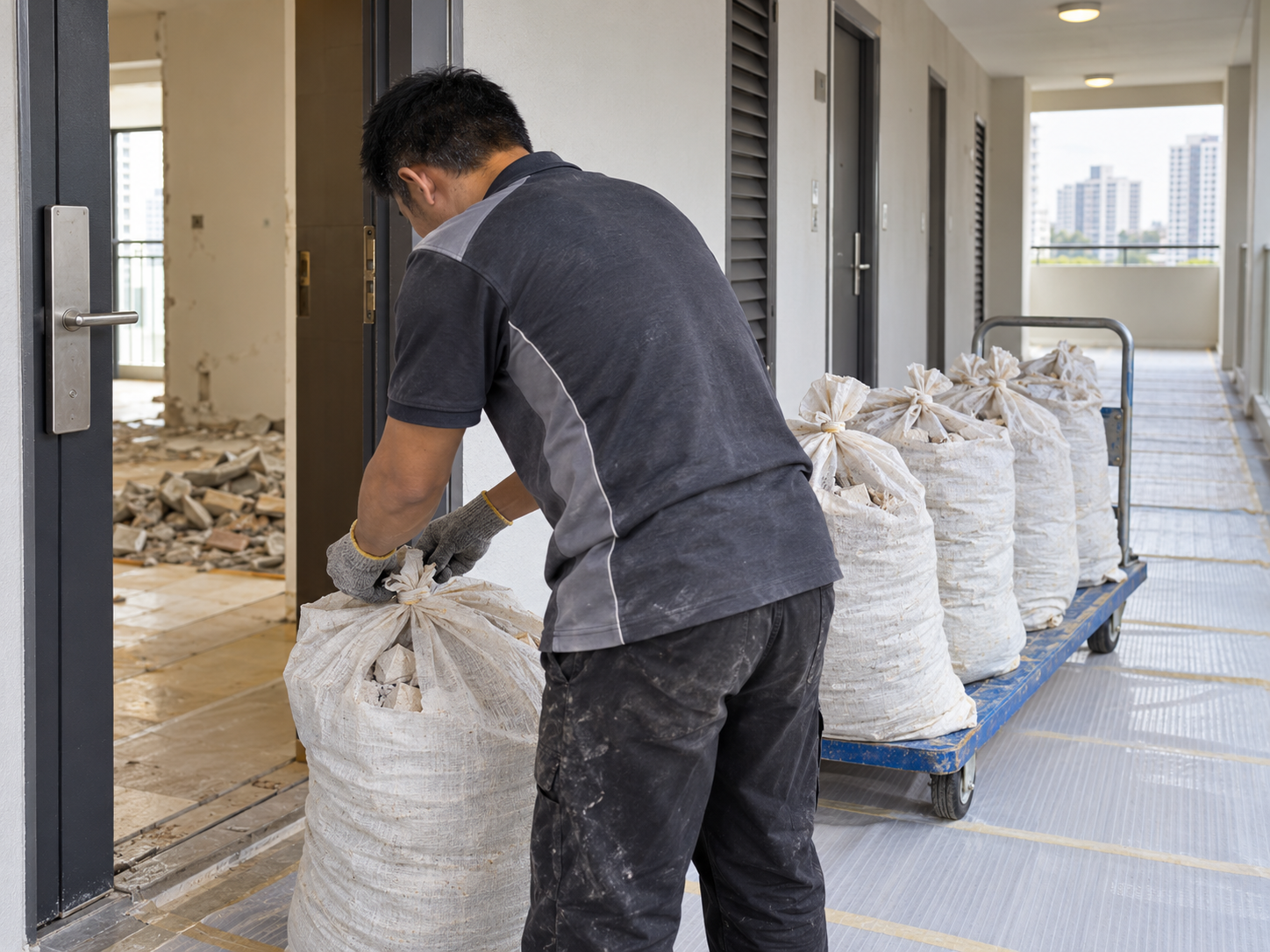
Get these rules right and condo renovation becomes oddly calm. The lift is protected, the corridor stays clean, your neighbours know the dates, and you come home on a Friday to a kitchen that’s a little closer to done, with no complaint letter waiting in the mailbox.
What Happens If You Break the Rules
Most managements start with a warning, but repeated or serious breaches cost real money and time.
- Stop-work order — Guards can turn your workers away at the gate until the issue is sorted, which leaves your contractor idle and your schedule slipping.
- Deposit deductions or forfeiture — The most common penalty, for damage, debris or working outside hours.
- Fines — The by-laws allow the MC to fine owners who breach the rules, under a resolution passed at a general meeting.
- Restoring the work at your cost — Unapproved grilles, balcony enclosures or hacked walls can be ordered removed or rebuilt, so you pay twice.
- Leak claims from below — If water from your new bathroom reaches the unit below, you’re usually expected to repair your waterproofing and the neighbour’s ceiling.
Disputes with the JMB or MC go first to the Commissioner of Buildings (COB) at your local council, such as DBKL or MBPJ, and can be taken to the Strata Management Tribunal. Both are slower than simply getting approval right the first time.
For Contractors: Working in Strata Buildings
If you take on condo jobs, the building’s rules are part of the scope, not a detail.
- Read the house rules before quoting. Allowed hours, Saturday limits, lift booking and debris rules decide your labour days. Write your assumptions into the quotation so the owner sees why a condo job runs longer.
- Register every worker. Submit the full crew list with the application, including subcontractors like the tiler and electrician, so nobody is stuck at the guardhouse on day one.
- Protect first, deliver second. Line the lift and lay corridor protection before the first load, and photograph common areas before and after.
- Do the ponding test properly. Leave it the full 24–48 hours and record it with dated photos. It’s your best defence if the unit below reports a leak later.
Your Condo Renovation Rules Checklist
Tick these off before your contractor starts.
- Collect the renovation guidelines, application form and fee schedule in writing
- Confirm the allowed working hours, including Saturdays and public holidays
- Check which walls can be hacked, and get an engineer’s letter if needed
- Check the approved designs for grilles, balcony enclosures and doors
- Confirm whether wet works need a witnessed ponding test
- Check separate authority approval requirements, agree who will handle any submission and obtain the required approvals before work starts
- Submit the form with drawings, contractor and worker details
- Get the deposit refund conditions and expected processing time in writing
- Pay the deposit and keep the receipt
- Wait for written approval before any work starts
- Photograph the lift, lobby and corridor before the first delivery
- Tell the neighbours above, below and beside you when work starts and ends
- Request the final inspection and deposit refund in writing when work ends
Read the rules once, early, and plan around them. The renovation still takes the same patience, but the surprises stop coming from the management office, and the home you end up with is one the whole building signed off on.