 rumaruma
How to Compare Renovation Quotations in Malaysia: What’s Included and What’s Missing
Three quotes, three different totals — here’s how to compare renovation quotations line by line and spot what each one quietly leaves out.
On this page
- Why Renovation Quotations in Malaysia Are So Hard to Compare
- What a Renovation Quotation Should Include
- How to Compare Renovation Quotations Side by Side
- What’s Often Missing From a Renovation Quotation
- Look Beyond the Total: Payment Terms, Warranty and Timeline
- Red Flags in a Renovation Quotation
- Choosing a Quote After You’ve Compared Them
- For Contractors and Renovators: Win on Clarity, Not Just Price
- Your Quotation Comparison Checklist
Three quotations are spread across your dining table. One says RM38,500. One says RM45,200. The third says RM52,800. They’re all for the same condo, the same kitchen and the same two bathrooms — and you have no idea whether the cheapest one is a bargain or a trap.
That confusion is normal, and it isn’t your fault. Malaysian contractors don’t share a standard quotation format, so every quote groups work differently, uses different units and names materials with different levels of detail. This guide shows you how to compare renovation quotations in Malaysia properly: rebuild them into the same shape, check what’s actually being priced, and find the gaps before you sign.
The cheapest total is rarely the cheapest renovation. A clear quotation usually is.

Why Renovation Quotations in Malaysia Are So Hard to Compare
The totals look comparable. The contents usually aren’t. Three things make side-by-side comparison difficult:
- Different units — one contractor prices tiling per sq ft, another gives a lump sum per bathroom, and a third bundles tiling into “wet works”.
- Different groupings — kitchen plumbing might sit under “plumbing” in one quote and under “kitchen package” in another.
- Different levels of detail — “supply and install tiles” tells you nothing. “Supply and lay 600×600mm homogeneous floor tiles, material allowance RM4.50/sq ft, labour RM6/sq ft” tells you almost everything.
A RM14,000 gap between quotes is rarely one contractor being greedy. More often, the expensive quote includes things the cheap one left out — or specifies better materials that the cheap one never named.
What a Renovation Quotation Should Include
Before comparing, know what a complete, itemised renovation quotation looks like. Most Malaysian residential quotes follow roughly this structure, whether they come from a contractor or a design-and-build ID firm.
| Section | What it should list | Common unit |
|---|---|---|
| Preliminaries | Site protection, JMB/MC paperwork, renovation insurance, debris disposal | Lump sum |
| Hacking & demolition | Walls, floor tiles, built-ins removed; debris removal | Per sq ft or lump sum |
| M&E (electrical & plumbing) | Number of new power points, lighting points, pipe rerouting, DB box upgrade | Per point / lump sum |
| Wet works | Waterproofing, screeding, floor and wall tiling, plastering | Per sq ft |
| Carpentry | Kitchen cabinets, wardrobes, shoe cabinet, TV console — with board type and finish | Per foot run |
| Ceiling & partition | Plaster ceiling, L-box, cornice, drywall partitions | Per sq ft / per foot run |
| Painting | Wall and ceiling area, paint brand and range, number of coats | Per sq ft or lump sum |
| Fixtures & installation | Sanitaryware, taps, lights, hood and hob installation — supplied by whom | Per item |
| Final cleaning | Post-renovation cleaning and haulage | Lump sum |
Each line should say three things: what is being done, with what material, and how much of it. If any of the three is missing, you can’t compare that line with another quote.
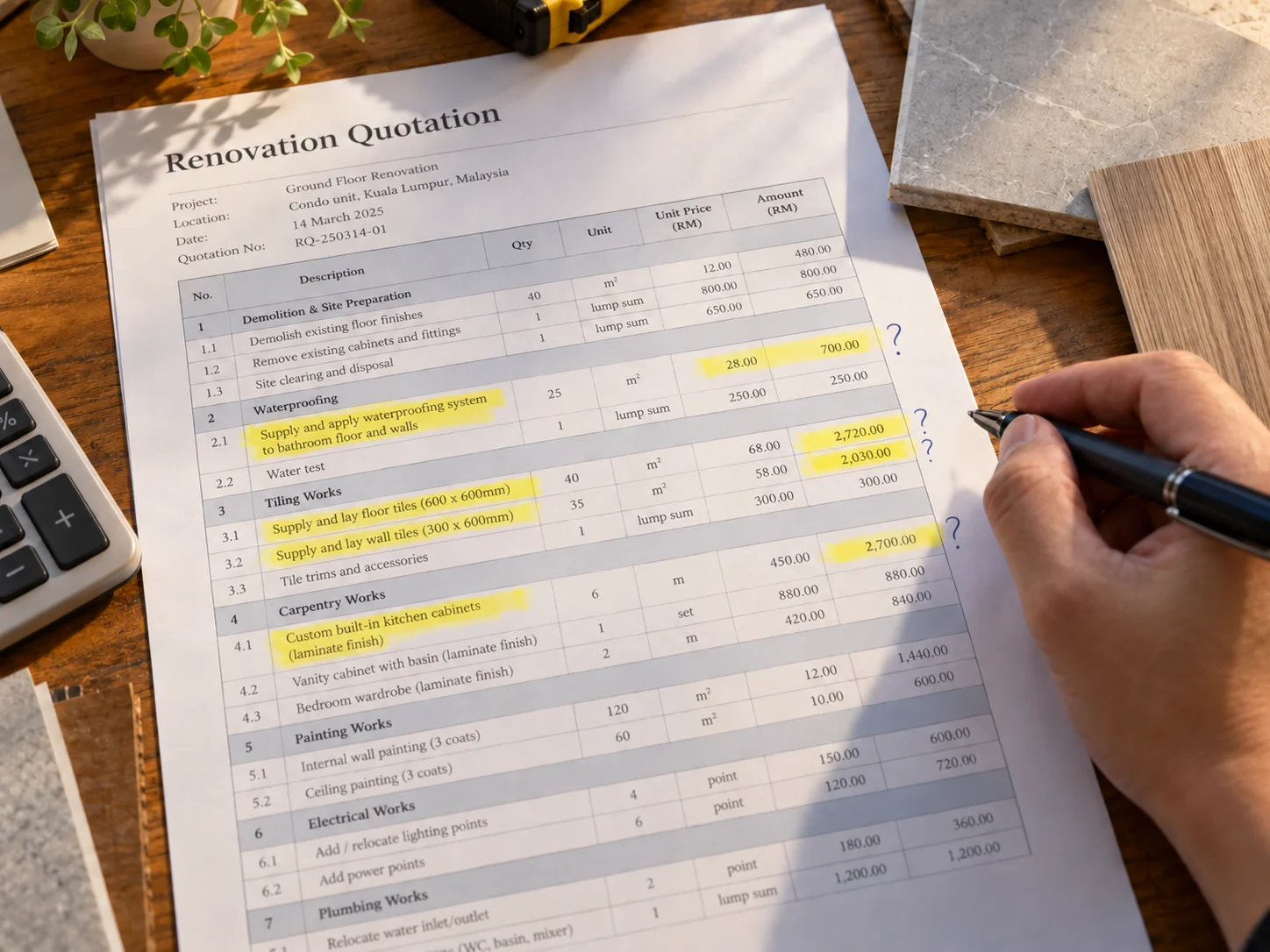
How to Compare Renovation Quotations Side by Side
This is the core method. It takes an evening with a spreadsheet or a notebook, and it’s the most valuable evening you’ll spend on your renovation.
1. Rebuild every quote into the same list of jobs
Write your own master list of every job in your project — down the left side of a page, one row per job. Then go through each quotation and write its price against the matching row, regardless of how the contractor grouped it.
You’ll quickly see rows where one quote has a number and another has nothing. Those empty cells are where the real price differences hide.
2. Convert everything into the same unit
If Contractor A quotes kitchen cabinets at RM650 per foot run for 14 ft, and Contractor B quotes a “kitchen package” at RM11,500, work out B’s per-foot-run equivalent (about RM821). Now you’re comparing like with like.
Do the same for tiling, ceiling and painting. Where a contractor only gives a lump sum, ask them for the area or quantity they priced on — a contractor who measured your unit should have that number ready.
3. Check the materials, not just the job
Two quotes can both say “kitchen cabinet” and be RM4,000 apart because of what’s inside. Look for:
- Board type — melamine-faced particleboard, plywood or moisture-resistant (MR) board. In Malaysian kitchens and bathrooms, humidity makes this choice matter more than the door finish.
- Countertop — quartz, solid surface, sintered stone or laminate, with thickness stated. For quartz, also check the brand, colour code and price unit — see what to watch for in a quartz quotation.
- Hardware — soft-close hinges and drawer runners, and whether a brand is named (Blum and Hettich are common in mid-range quotes).
- Paint — “paint” alone could mean anything. A good quote names the brand and range, such as Nippon Paint Odour-less or Dulux Pentalite, and the number of coats.
- Tiles — a material allowance per sq ft (e.g. “tile allowance RM5/sq ft”) so you know what happens if you pick a pricier tile.
If one quote names materials and another doesn’t, ask the vague one to specify. Their answer — or their reluctance — is useful information.
4. Flag provisional sums, allowances and “by owner” items
Some lines aren’t fixed prices at all:
- Provisional sum (PS) — a placeholder for work that can’t be priced until it’s opened up, such as replacing pipes behind a wall.
- Allowance — a budget cap on a material you’ll choose later, such as tiles or lights.
- By owner / supplied by owner — you buy it yourself, so it isn’t in the total.
A quote with lots of low provisional sums or “by owner” lines will look cheap on paper. Add a realistic figure for each before you compare totals.

What’s Often Missing From a Renovation Quotation
Once your quotes are lined up, look for the items that tend to vanish from cheaper quotes. Several of these only become obvious mid-project — our guide to hidden renovation costs in Malaysia covers how much to budget for each.
- Waterproofing — in bathrooms and the wet kitchen, with a membrane type and a written warranty period. Skipping it saves RM1,500–RM3,000 now and costs far more when your downstairs neighbour’s ceiling starts leaking.
- Debris disposal — most condos require debris to be bagged and removed at your cost, and some JMBs charge if it’s left in common areas.
- JMB/MC deposit and paperwork — who submits the renovation application, and who pays the refundable deposit.
- Electrical upgrades — a DB box upgrade or rewiring if you’re adding aircon or an induction hob.
- Protection of existing finishes — covering floors, lift lobbies and doors during works.
- Final cleaning — a proper post-renovation clean, not just sweeping.
- Defect liability period — how long the contractor will return to fix defects, usually 6–12 months for residential work.
If a quote doesn’t mention an item, assume it isn’t included. Ask the contractor to confirm in writing, and add the cost to their total for your comparison.
Look Beyond the Total: Payment Terms, Warranty and Timeline
Two quotes with the same price can carry very different risks. Put these terms side by side too.
| Term | Quote A | Quote B | Quote C |
|---|---|---|---|
| Total (after filling the gaps) | RM44,300 | RM46,900 | RM52,800 |
| Deposit | 50% | 20% | 10% |
| Payment schedule | Deposit + balance at end | Staged by milestone | Staged by milestone |
| Waterproofing warranty | Not stated | 5 years | 5 years |
| Defect liability period | Not stated | 6 months | 12 months |
| Estimated duration | “Around 2 months” | 8 weeks | 10 weeks, with schedule |
| CIDB registration shown | No | Yes | Yes |
Notice what happened: Quote A’s RM38,500 became RM44,300 once the missing waterproofing, debris disposal and electrical work were added back. It’s still the cheapest — but it also asks for half the money upfront and promises the least in writing.
A milestone payment schedule — deposit, then payments tied to completed stages such as hacking, wet works and carpentry — protects you if the project stalls. It also keeps the contractor motivated to finish each stage. For a fuller picture of contractor credentials, see contractor vs interior designer in Malaysia.
Red Flags in a Renovation Quotation
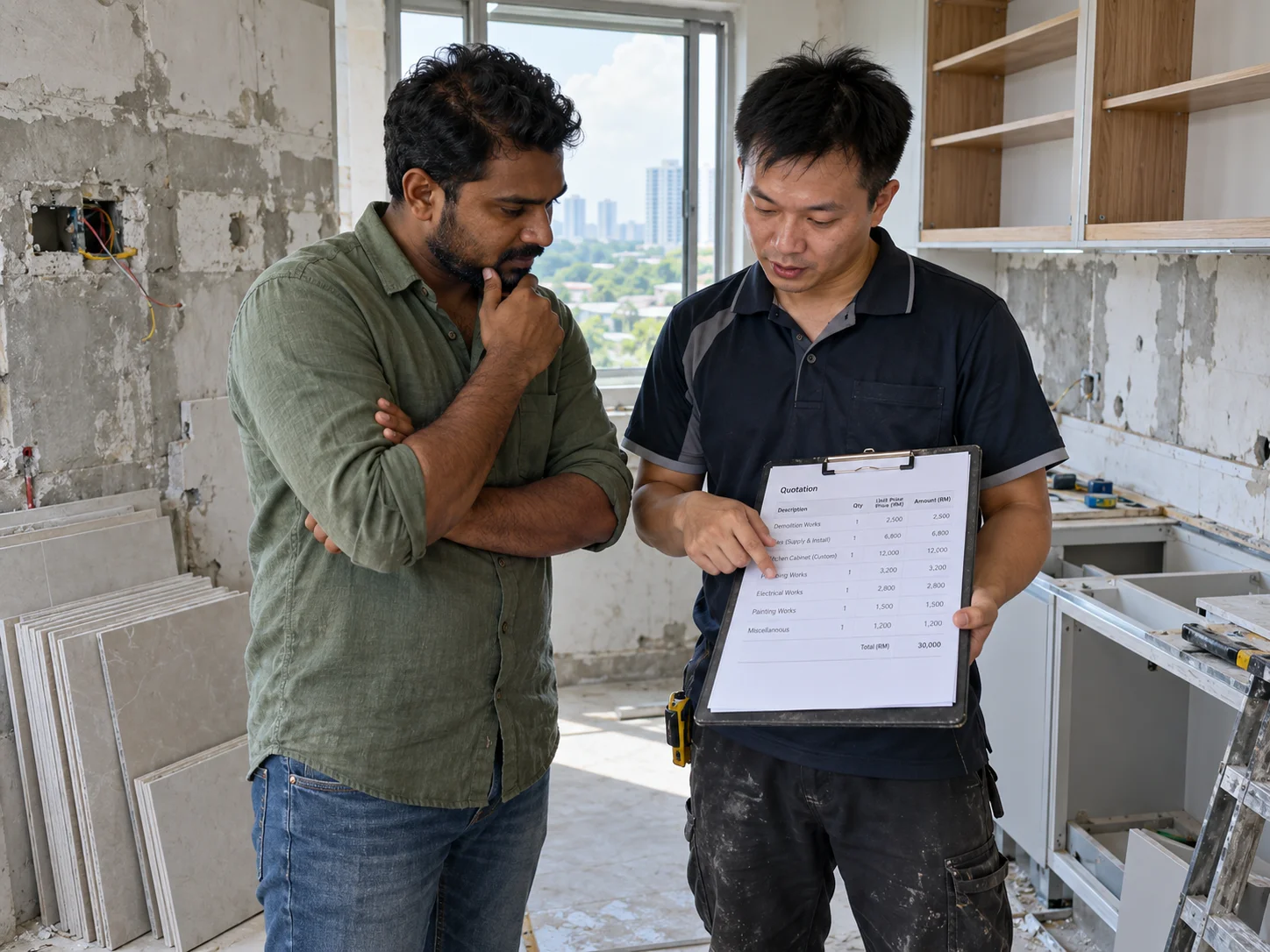
Walk away, or at least ask hard questions, if you see any of these:
- A one-line total — “Renovation works for whole unit: RM40,000.” There’s nothing to compare and nothing to hold the contractor to.
- “TBC” or “to be advised” on major items — especially carpentry, M&E or waterproofing.
- No materials named anywhere — you’ll get whatever is cheapest on the day.
- A deposit above 30% — 50% or more upfront leaves you with little leverage if things go wrong.
- No company name, SSM number or address — a quotation on plain paper or a WhatsApp message alone isn’t enough.
- Pressure to sign quickly — “this price is only valid until Friday” for a project that hasn’t been fully measured.
None of these automatically means the contractor is dishonest. But each one shifts risk from them to you.
Choosing a Quote After You’ve Compared Them
After this exercise, the “cheapest” quote often isn’t, and the “expensive” one often turns out to be the most complete. Pick the quote that is clearest, with fair payment terms and a price that fits your realistic renovation budget — then use your comparison table to talk numbers.
Your side-by-side comparison is the strongest tool you’ll have when you negotiate renovation costs without compromising quality. Asking a contractor to match a specific line item from another quote works far better than asking for a general discount.
For Contractors and Renovators: Win on Clarity, Not Just Price
If you’re quoting for homeowners, the comparison method above is exactly what your more careful clients are doing with your quote. A clear quote often beats a cheaper vague one.
- Itemise by job and unit — list area, foot run or point counts so the client can check your measurements.
- Name materials and brands — board type, countertop thickness, paint range, hardware brand.
- State allowances openly — “tile allowance RM5/sq ft; difference charged at cost” heads off variation order disputes later.
- Spell out exclusions — a short “not included” list protects you as much as the client.
- Show your CIDB registration and warranty terms — it signals that you expect to be accountable.
Clear quotations take longer to prepare. They also cut down on the disputes, unpaid variation orders and bad reviews that cost far more.

Your Quotation Comparison Checklist
Before you sign with anyone, make sure you can tick every box:
- All quotes rebuilt into one master list of jobs
- Prices converted into the same units (per sq ft, per foot run, per point)
- Materials, brands and board types named for every major item
- Provisional sums, allowances and “by owner” items given a realistic figure
- Waterproofing, debris disposal, JMB/MC paperwork and cleaning confirmed as included or excluded
- Payment schedule tied to milestones, with a deposit of 30% or less
- Warranty and defect liability period stated in writing
- Contractor’s company name, SSM number and CIDB registration on the quote
- Estimated timeline with a basic work schedule
Doing this takes one careful evening. At the end of it, you won’t just know which quote is cheapest — you’ll know which one gets you the kitchen, bathrooms and finishes you actually pictured, with fewer surprises between the deposit and handover.