 rumaruma
Kitchen Cabinet Materials in Malaysia: Melamine vs Plywood vs Aluminium Compared
What melamine, plywood and aluminium cabinets cost per foot run in Malaysia, how each copes with water and termites, and where in your kitchen each one belongs.
On this page
- The Box and the Door Are Two Different Choices
- Kitchen Cabinet Materials in Malaysia at a Glance
- Melamine-Faced Particleboard: The Budget Choice
- Plywood: The All-Rounder
- Aluminium: The Wet Kitchen Specialist
- Kitchen Cabinet Price per Foot Run in Malaysia
- Where Each Material Belongs in a Malaysian Kitchen
- Condo vs Landed: How Your Home Changes the Choice
- Board Grade Matters Too: Formaldehyde and Thickness
- For Carpenters and Renovators: Where Cabinets Fail
- Questions to Ask Before You Sign the Cabinet Quotation
You have three cabinet quotations on the table. One says melamine at a price that looks too good, one says plywood for a few thousand more, and the third is aluminium and costs almost double. All three 3D renders look the same. The difference is inside the box, where you’ll never look again until something swells, sags or gets eaten.
This guide compares the three most common kitchen cabinet materials in Malaysia: melamine-faced particleboard, plywood and aluminium. It covers what each one is, what it costs per foot run, how it copes with a wet kitchen and with termites, and where in the kitchen each one actually belongs. Most good kitchens use more than one.
The Box and the Door Are Two Different Choices
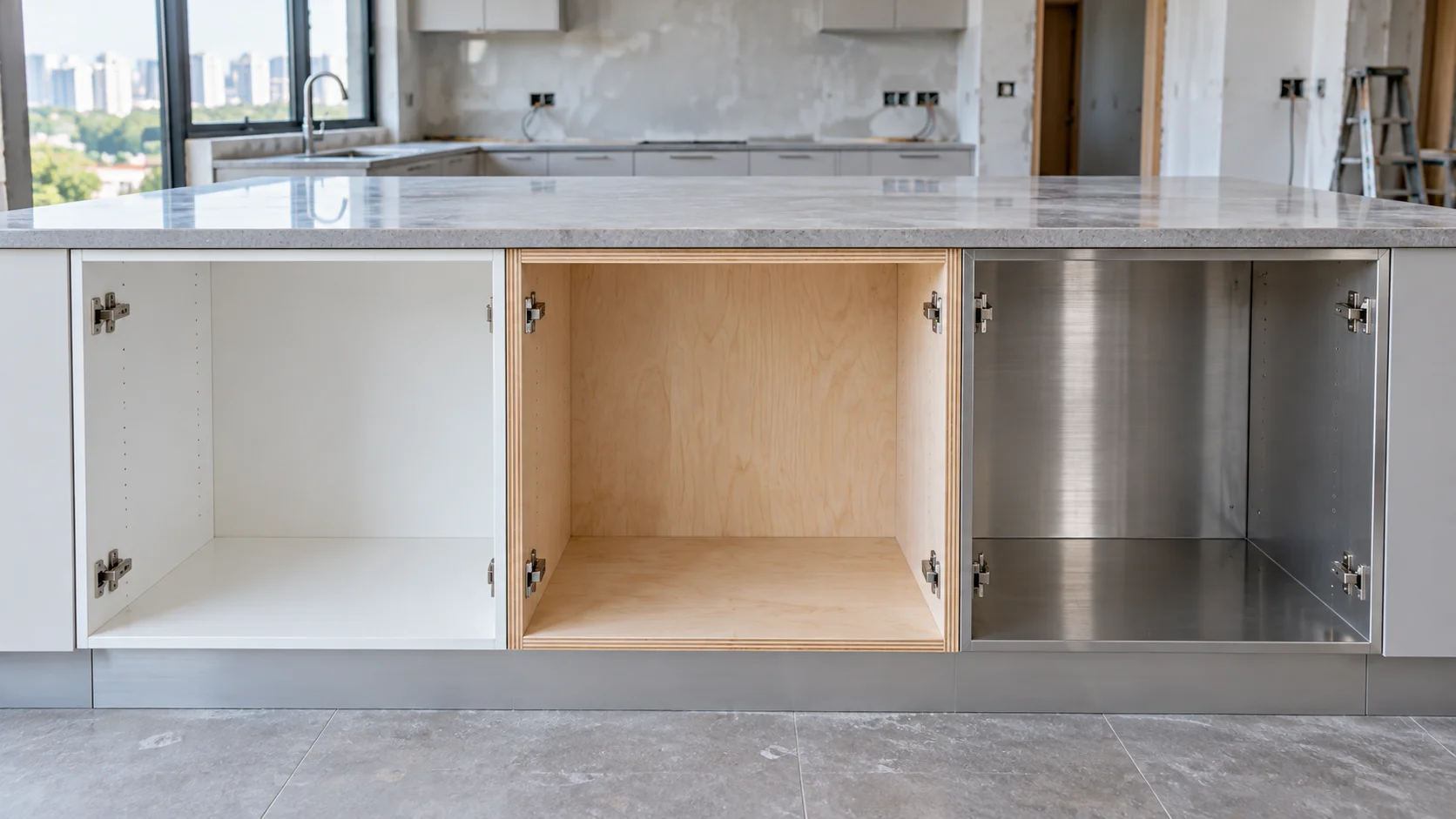
A kitchen cabinet has two parts. The carcass is the box: sides, base, back and shelves. The door is the front you see and touch. This article is about the carcass, because that’s what decides whether the cabinet survives ten years of Malaysian humidity and a leaking sink.
Door finishes (melamine, laminate, 4G glass, acrylic, spray paint) are a separate choice and can sit on almost any carcass. A plywood box can wear melamine doors; an aluminium box can wear glass-framed ones.
Quotations often blur the two. A line that says “plywood kitchen cabinet” may mean a plywood frame with a cheaper board inside, or plywood sides with a particleboard base. Ask for the carcass material, the shelf material and the door finish to be written as three separate items.
Kitchen Cabinet Materials in Malaysia at a Glance
| Melamine-faced particleboard | Plywood | Aluminium | |
|---|---|---|---|
| What it is | Compressed wood chips and glue, faced with a melamine sheet | Thin layers of timber veneer glued in alternating grain directions | Extruded aluminium frame with aluminium or composite panels |
| Water | Swells at wet edges and doesn’t recover | Tolerates splashes; delaminates if left sitting in water | Doesn’t swell or rot |
| Termites | Can be eaten | Can be eaten — the main risk for plywood | Not affected |
| Screw and hinge hold | Weakest; screws can strip if re-fixed | Strong; holds hinges well over years | Depends on the frame system and fittings |
| Feel | Solid enough for light use | Solid, quiet when doors close | Lighter; can sound hollow when slammed |
| Price per foot run | Lowest | Middle | Highest |
| Best for | Dry kitchen, wall cabinets, rental units | Wet kitchen base cabinets, tall units, islands | Under the sink, wet kitchens in termite-prone or coastal homes |
The short version: melamine is the budget choice for dry areas, plywood is the all-rounder, and aluminium is what you pay for when water or termites are a real threat.
Melamine-Faced Particleboard: The Budget Choice
Particleboard (also called chipboard) is made from wood chips pressed together with resin, then faced on both sides with a melamine paper finish. It’s flat, stable in dry conditions and the cheapest board for cabinets. IKEA’s kitchen frames are built from it, which shows that it can work well in the right place.
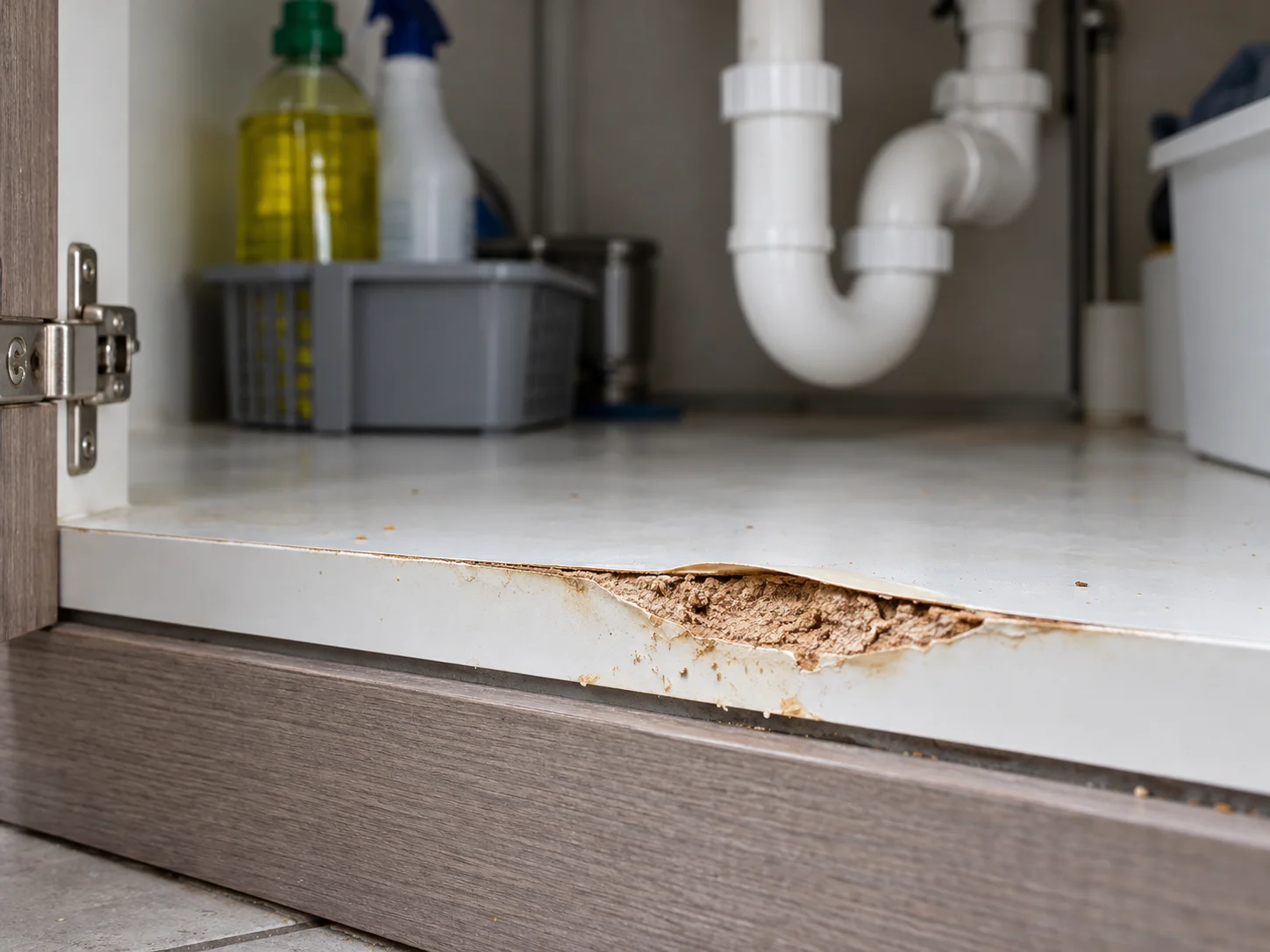
Its weakness is water. The melamine surface itself is wipeable, but the edges are sealed only by a strip of edge banding. If the banding lifts, or water gets in through a drilled hole or an unsealed cut, the chips soak it up and the board swells into a soft, crumbly bulge. It doesn’t shrink back when it dries.
- Use it for — wall cabinets, dry kitchen cabinets away from the sink, and pantry shelving
- Don’t use it for — the sink cabinet, the cabinet beside the dishwasher, or base cabinets on a wet kitchen floor that gets mopped daily
- Check — that every exposed edge is banded, including the back edges of shelves and the cut-outs around pipes
In Malaysia’s humidity, the risk isn’t the air so much as the leak you don’t notice. A slow drip from a sink trap can soften a particleboard base within weeks.
Plywood: The All-Rounder
Plywood is built from thin sheets of timber veneer, each laid at right angles to the one below and glued under pressure. That cross-grain build makes it stronger and stiffer than particleboard, and it holds screws and hinges much better, which matters for cabinet doors opened thousands of times a year.
It handles the odd splash well, which is why it’s the common mid-range choice for base cabinets in Malaysian wet kitchens. It isn’t waterproof. Water that pools on a plywood base for days will eventually lift the layers apart, and once the edge banding goes, the core can darken and grow mould.
Its other weakness is termites. Plywood is still wood, and in landed homes, ground-floor units and older terraces with a termite history, it’s the material most at risk. Treated plywood and a termite barrier around the house reduce the risk; neither removes it.
- Use it for — wet kitchen base cabinets, tall oven and fridge housings, islands and long countertop runs
- Don’t use it for — a sink cabinet in a home with an active termite problem, or anywhere water will sit for days unnoticed
- Check — the plywood grade and thickness written on the quotation, and whether “plywood” covers the whole box or only the outer frame
Solid plywood or plywood frame? Read the line
Many Malaysian quotations offer “plywood” with a block board inner frame. Block board is strips of softwood glued side by side and faced with veneer or melamine. It copes with moisture better than particleboard and costs less than full plywood. It’s a reasonable compromise, as long as you know that’s what you’re paying for and not “solid plywood” throughout.
Aluminium: The Wet Kitchen Specialist
Aluminium cabinets use an aluminium frame with aluminium, composite or honeycomb-core panels. They don’t swell, rot or grow mould, and termites can’t touch them. That’s why they’ve become popular in Malaysian wet kitchens, especially in landed homes and near the coast, where both moisture and termites are a constant concern.
Malaysian sellers market them by series names like 3G, 5G or 6G. These are trade names for different frame and panel systems, not a technical standard, so compare what each series actually includes rather than the number.
Aluminium has honest weaknesses too:
- Cost — usually the most expensive of the three per foot run
- Feel — lighter panels can feel and sound less solid than plywood when doors are closed hard
- Design range — fewer finishes and more visible frame lines than a board cabinet, though door options keep widening
- Dents — a hard knock can leave a dent that can’t be sanded out like a timber scratch
Where it earns its price:
- Use it for — the sink cabinet, wet kitchen base cabinets, outdoor or yard kitchens, and homes with a termite history
- Less value in — a dry kitchen or dry-zone wall cabinets, where there’s little water to protect against. It still works there if you like the look and the budget allows, but a timber-look board cabinet gives a warmer, more seamless finish for less
- Check — the panel type (solid, composite or honeycomb), the hinges and runners included, and how the countertop is supported
Kitchen Cabinet Price per Foot Run in Malaysia
Malaysian cabinet makers price by the foot run, the length along the wall. Wall (hanging) cabinets, base cabinets and tall cabinets are priced separately, and base cabinets cost more because they carry the countertop, drawers and heavier hardware.
| Carcass material | Wall cabinet (per ft run) | Base cabinet (per ft run) | Tall cabinet (per ft run) |
|---|---|---|---|
| Melamine-faced particleboard | From around RM220 | From around RM280 | From around RM450 |
| Plywood (often with block board inner) | Around RM330 | RM370 – RM390 | From around RM570 |
Aluminium is harder to line up against these. One Malaysian cabinet maker lists aluminium from around RM450 per row and premium honeycomb series at RM650–700 per row, without defining a row; it most likely means one run of either wall or base cabinets. The same maker puts wall and base cabinets together at RM1,000+ per foot run. Treat these as a rough guide rather than a like-for-like comparison with the table.
None of these published rates says clearly whether doors, hinges, drawer runners or installation are included. One worked example describes its total as the cabinet frame, excluding the countertop, backsplash and accessories, and the countertop and sink are priced separately in every source. When you compare quotes, check that each one covers the same items before comparing the per-foot figure.
Prices are for reference only, as of October 2026, drawn from published cabinet maker rates. Board grade, door finish, hardware, cabinet height, layout complexity and your carpenter’s location and workload all change the final figure. Get at least two itemised quotes.
For a compact condo kitchen with about 10 ft of base and wall cabinets, the gap between melamine and aluminium can be several thousand ringgit. Where you spend it matters more than how much.
Where Each Material Belongs in a Malaysian Kitchen
You don’t have to pick one material for the whole kitchen. Most well-planned Malaysian kitchens mix them, spending on the cabinets that face water and saving on the ones that don’t.
| Cabinet | Risk | Sensible choice |
|---|---|---|
| Sink cabinet | Leaks, drips, cleaning products | Aluminium, or plywood with every edge sealed |
| Wet kitchen base cabinets | Splashes, mopping, heat from the hob | Plywood or aluminium |
| Dishwasher surround | Steam and occasional leaks | Plywood or aluminium |
| Tall oven and fridge housing | Heat, weight | Plywood |
| Dry kitchen base cabinets and island | Light use, on show | Plywood, or melamine if budget is tight |
| Wall cabinets (any zone) | Steam from cooking, but no standing water | Melamine or plywood |
A common, sensible split: aluminium under the sink, plywood for the rest of the wet kitchen base, and melamine for wall cabinets and the dry kitchen. You get protection where it counts without paying aluminium prices along every wall.
Picture the kitchen five years on. The sink cabinet still closes cleanly, the base shelves are flat, and the only sign of age is a scuffed handle. That’s the result of putting the right box in the right place.
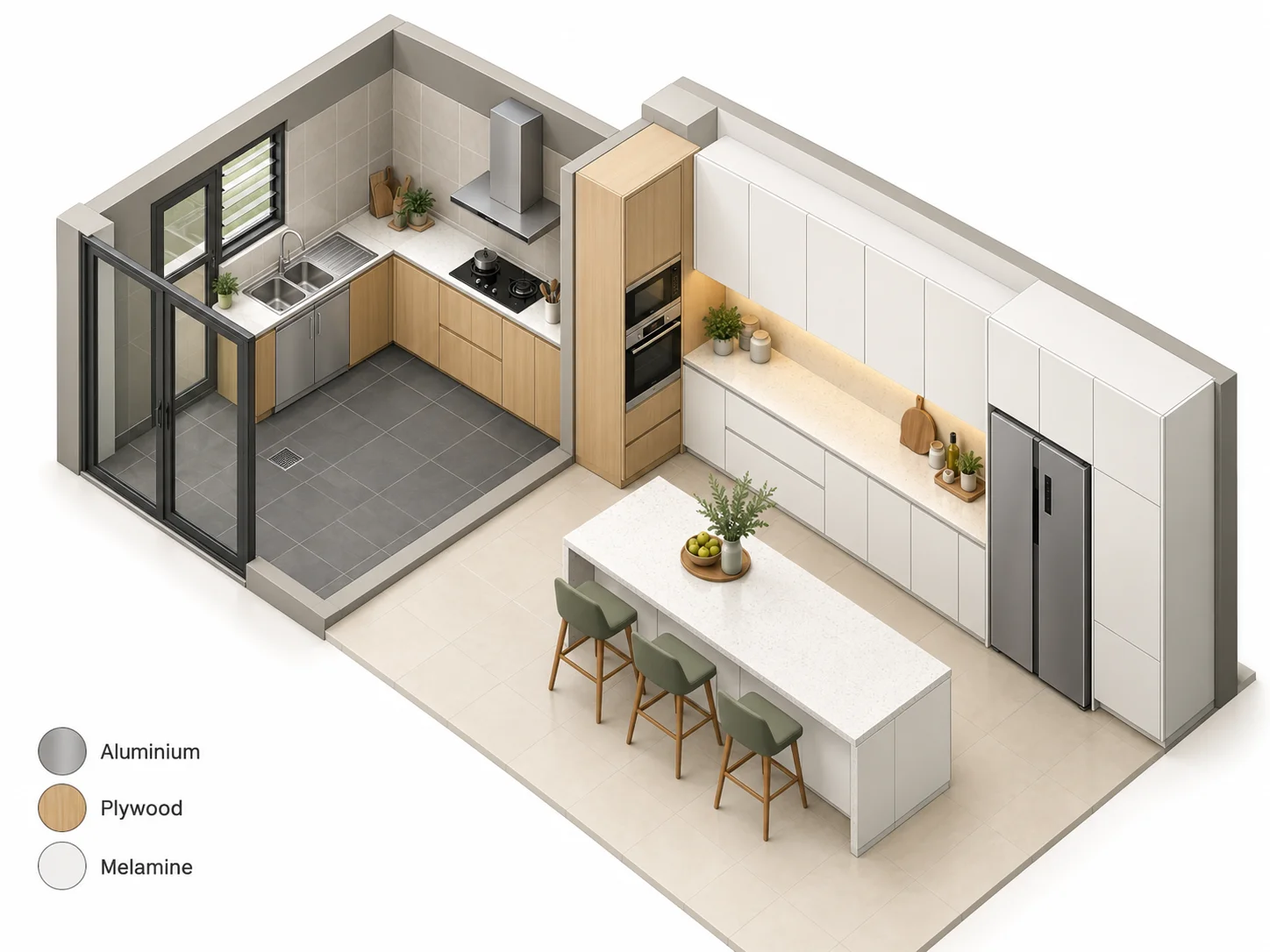
Your layout decides how much of each you’ll need, so settle it first with our guide to planning a kitchen layout. If you’re still deciding whether to separate the wet and dry kitchens, see open kitchen vs closed kitchen in Malaysia.
Condo vs Landed: How Your Home Changes the Choice
- High-rise condo — Termites are less of a concern on upper floors, though not impossible. Water is the main risk, so spending on the sink cabinet and wet kitchen base matters most. Melamine is fine for wall cabinets.
- Ground floor, terrace and landed homes — Termites are a real risk, especially in older houses or homes near gardens and drains. Consider aluminium for base cabinets on the floor and treat any plywood. Ask whether a termite treatment for the house is due before the cabinets go in.
- Coastal homes — Salty air speeds up corrosion of metal fittings. Ask for stainless or coated hinges and runners whichever carcass you choose.
Board Grade Matters Too: Formaldehyde and Thickness
Particleboard and plywood are both made with resin glues, and some of those glues release formaldehyde, which you’ll smell as a sharp “new furniture” odour in a closed kitchen. Boards are graded by emission level, commonly E1 and the lower-emission E0. Ask which grade the carpenter is using and get it written on the quotation, especially if you have young children or anyone with asthma at home.
Ask for the board thickness in writing as well. A thinner board saves the carpenter money and you won’t see the difference on the day of handover. You’ll see it when the shelves start to sag under rice, tins and a slow cooker.
Thickness alone doesn’t tell you whether a shelf will hold, though. What matters is thickness together with how wide the shelf spans, what will sit on it and how it’s supported. A short shelf of spice jars is fine on most boards. A wide shelf carrying a rice bin, a stack of plates or a slow cooker needs either a thicker board, a shorter span or extra support, such as a centre divider or a fixed back edge. Tell your carpenter which cabinets will hold the heavy items, and ask how those shelves will be supported.
For Carpenters and Renovators: Where Cabinets Fail
Most cabinet callbacks in Malaysian kitchens come from the same few places, whichever board was used:
- Unsealed cut-outs — the holes cut for sink pipes, the water filter and power points are where water gets into particleboard and plywood. Seal every raw cut, not just the visible edges.
- Base cabinets standing in mop water — raise base cabinets on adjustable legs or a sealed plinth so the board isn’t sitting on a wet floor.
- Edge banding on back edges — skipping banding on edges the client won’t see saves minutes and costs a callback.
- Mixed materials not written down — if the sink cabinet is aluminium and the rest is plywood with block board inners, say so on the quote. It protects you when the client later asks why one cabinet looks different inside.
Questions to Ask Before You Sign the Cabinet Quotation
- Is the carcass material written separately from the door finish?
- Is the plywood solid throughout, or a plywood frame with block board or particleboard inside?
- What material is the sink cabinet, and are the pipe cut-outs sealed?
- What formaldehyde grade (E0 or E1) and board thickness are being used?
- How will shelves carrying heavy items (rice, plates, small appliances) be supported?
- Are wall, base and tall cabinets priced per foot run as separate lines?
- Which hinges and drawer runners are included, and are they soft-close?
- Do base cabinets sit on legs or a sealed plinth, off the wet floor?
- What warranty covers swelling, delamination or termite damage, and for how long?
Our guide to comparing renovation quotations in Malaysia shows how to line these items up across two or three quotes. For the rest of the kitchen, from countertop to cooker hood, start with our complete kitchen renovation guide.
Spend on the box where the water goes, and save where it doesn’t. A kitchen built that way can feel just as good at year ten as it did the day the stone went on.