 rumaruma
Quartz Countertops in Malaysia: Cost, Quality Grades and What to Watch For
What quartz countertops cost in Malaysia, how the quality grades differ, and the quotation traps to check before you pay a deposit.
On this page
- What a Quartz Countertop Actually Is
- Where Quartz Works Well in Malaysian Homes
- Where Quartz Struggles
- Quartz Quality Grades: What Separates Cheap From Premium
- Quartz Countertop Price in Malaysia (2026)
- What to Watch For in a Quartz Quotation
- What to Ask Your Installer Before the Slab Arrives
- Before You Confirm Your Quartz Countertop
Three contractors have quoted your kitchen, and all three wrote “quartz top” on the same line. One says RM180, one says RM350, and one says RM120. You can’t tell whether they’re quoting the same stone, the same unit or even the same material.
A quartz countertop in Malaysia is one of the safest choices for a family kitchen: it shrugs off curry and kicap stains, it never needs sealing in our humidity, and it comes in clean, consistent colours that natural stone can’t promise. But “quartz” covers everything from imported brand-name slabs to cheap boards that aren’t really quartz at all. This guide explains what you’re paying for, where quartz falls short, and how to read the quotation.
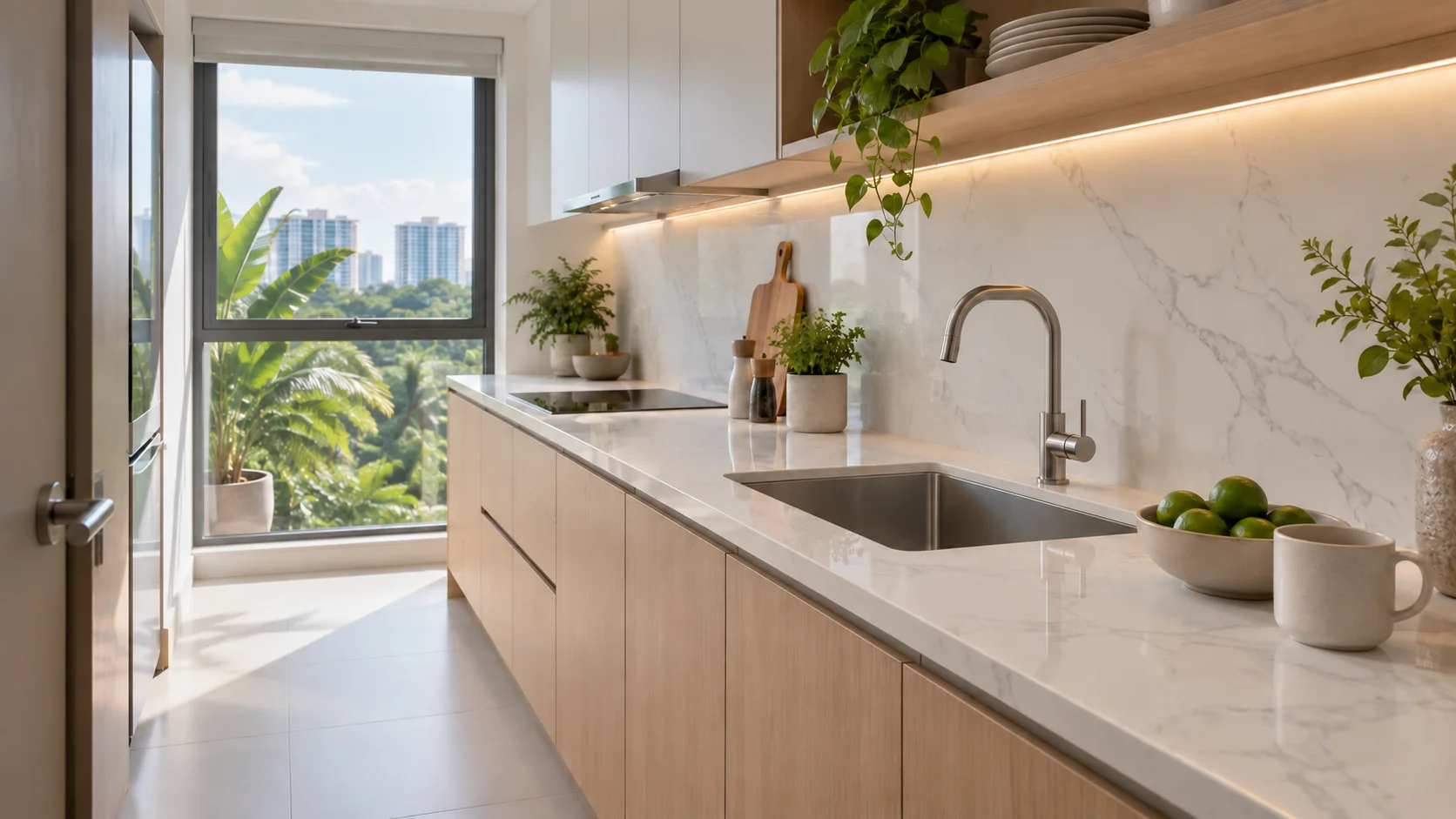
What a Quartz Countertop Actually Is
Quartz countertops are engineered stone. Manufacturers crush natural quartz, mix it with polymer resin and pigment, then press and cure it into slabs. Suppliers generally describe the mix as about 90–94% quartz and 6–10% resin.
The quartz gives the slab its hardness. The resin holds it together and seals the surface, which is why quartz absorbs almost nothing. It’s also why quartz behaves differently from the two materials it’s most often compared with:
- Granite and marble — natural stone cut from a quarry. Porous to varying degrees, so they need sealing, and marble etches under calamansi and vinegar.
- Sintered stone — minerals fired at very high temperature with no resin at all, so it handles heat and sun better but chips more easily at the edges. Our honest guide to sintered stone covers it in detail. If you’re choosing between the two, our sintered stone vs quartz comparison puts them head to head.
Where Quartz Works Well in Malaysian Homes
Stains from everyday cooking
Turmeric, soy sauce and coffee are the daily test for any Malaysian countertop. Because the resin closes the surface, a good quartz slab wipes clean instead of drinking the stain in. Wipe yellow spills promptly on very light colours, but you won’t be fighting a permanent curry ghost the way you might on porous marble.
Humidity, with no sealing
Natural stone needs resealing to keep moisture and mould out. Quartz doesn’t. In a climate where anything damp grows mould, that’s one less maintenance job to forget.
Consistent colour and pattern
Because it’s manufactured, the slab you approve from a sample is close to the slab you get. That matters on long counters and islands where two pieces sit side by side. Natural stone can vary noticeably from slab to slab.
Dry kitchens, islands and vanities
Quartz looks its best in a dry kitchen, on an island or as a bathroom vanity top: places that see daily use but not a wok straight off a high flame. In a typical wet and dry kitchen setup, it’s a natural fit for the dry side.
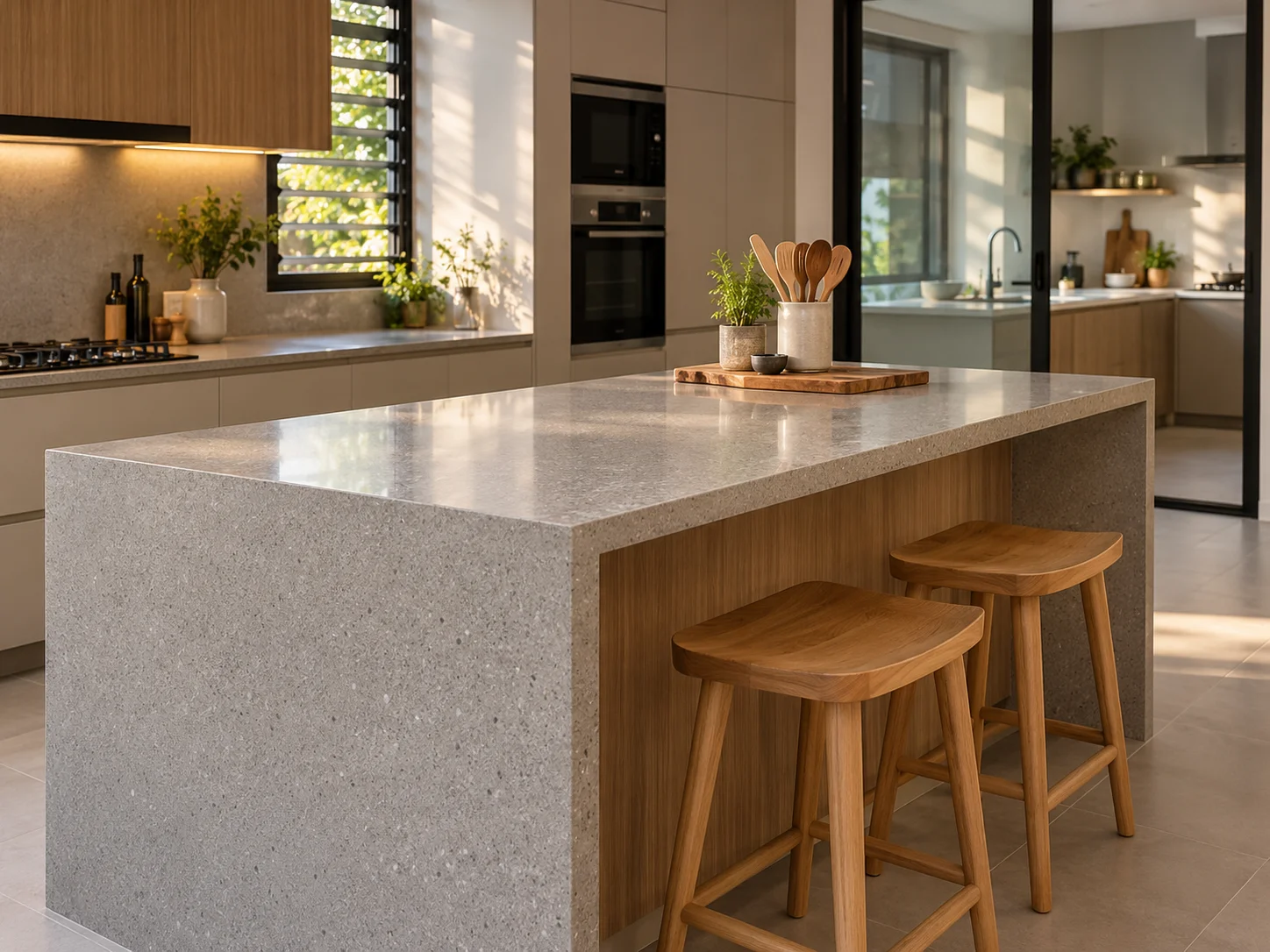
Where Quartz Struggles
Heat from hot pots and woks
The resin is the weak point. Supplier guides say quartz can start to discolour or crack under sustained heat above about 150°C, which a wok or claypot fresh off the stove easily exceeds. A brief set-down may leave no mark. A hot pot left to sit can leave a pale ring that won’t polish out. Keep a trivet beside the hob and make it a habit.
Direct sunlight
Resin yellows under long exposure to UV. A quartz top beside a west-facing window, on a balcony or on an outdoor bar counter can fade or discolour over the years. For any surface that gets direct sun, choose sintered stone or granite instead.
Harsh cleaners
Bleach, oven cleaner and abrasive scouring powder can dull the resin finish. Warm water, mild dishwashing liquid and a soft cloth are all quartz needs.
Chips that can’t be hidden
Quartz takes knocks reasonably well, but a deep chip at an edge or sink corner can only be filled with tinted resin. The repair is usually visible up close. An eased (slightly rounded) edge chips less than a sharp square one.
Quartz Quality Grades: What Separates Cheap From Premium
There’s no official Malaysian grading for quartz. What suppliers call “grades” are really market and price tiers, sorted by brand, pattern and warranty, not by any test of how the slab performs. A higher tier usually buys more design choice and a stronger warranty, but brand, pattern and price on their own don’t prove a slab will last longer.
| What differs | Entry-level | Mid-range | Premium imported (e.g. Caesarstone, Silestone) |
|---|---|---|---|
| Brand | Shop’s own label or unbranded | Regional brands | International brands with their own warranty |
| Patterns | Plain colours, simple speckles | More marble-look options | Complex veining, large-format designs |
| Warranty | Shop warranty, often short | Varies | Brand warranty; ask for the written terms |
| Often chosen for | Rentals and tight budgets, where a shorter warranty is acceptable | Family kitchens wanting more colour choice | Feature islands and statement designs |
The “often chosen for” row reflects how buyers tend to spend, not a durability rating. A well-made entry-level slab can serve a busy family kitchen, and a premium slab still scorches under a hot wok. Whatever the tier, the real checks are the ones below.
What sits behind those tiers:
- Quartz-to-resin ratio — suppliers warn that low-grade slabs can contain noticeably less quartz and more resin filler. More resin means more sensitivity to heat and sun.
- Resin quality — better resins hold their colour longer. You can’t see this in the showroom, which is why the warranty matters.
- Pattern depth — on many marble-look slabs the veining sits mainly on the surface. Ask how the edge will look once it’s cut and polished.
- Slab size — larger slabs mean fewer joints on long counters and islands.
The fake quartz warning
Suppliers warn that “quartz” offered at around RM60–70 per sq ft may actually be compressed marble, a polyester resin board or another low-grade mix. These look similar on day one but stain, scratch or yellow much faster.
Protect yourself by asking for the brand name and colour code in writing, seeing the actual slab (not just a small sample), and getting the warranty in writing from the brand or shop before you pay.
Quartz Countertop Price in Malaysia (2026)
Published Malaysian prices are indicative figures from suppliers and renovation guides, and they don’t agree with each other, so we show them side by side rather than blending them. All figures are per square foot, supplied and installed.
| Tier | Outbox Design (June 2026) | Mylestone, Johor supplier (June 2026) |
|---|---|---|
| Entry-level | RM110–180 | RM110–145 |
| Mid-range | RM250–400 | RM145–230 |
| Premium imported | RM500–1,000+ | RM280–819+ |
A third guide, ClickBina (updated October 2026, Klang Valley), quotes quartz per foot run instead: RM250–600 per ft run, which works out to roughly RM125–300 per sq ft at a standard 2 ft depth.
The pattern across all three: entry-level quartz starts around RM110 per sq ft, and everything above that depends heavily on brand and design. Quartz isn’t automatically cheaper than sintered stone, either; both start in the same RM110 range.
These prices are for reference only. Your final price depends on the brand and colour, slab size, how many slabs your layout uses, edge work, cut-outs, delivery access and the exchange rate when the slab is imported. The figure that counts is the one on your supplier’s quotation on the day you confirm.
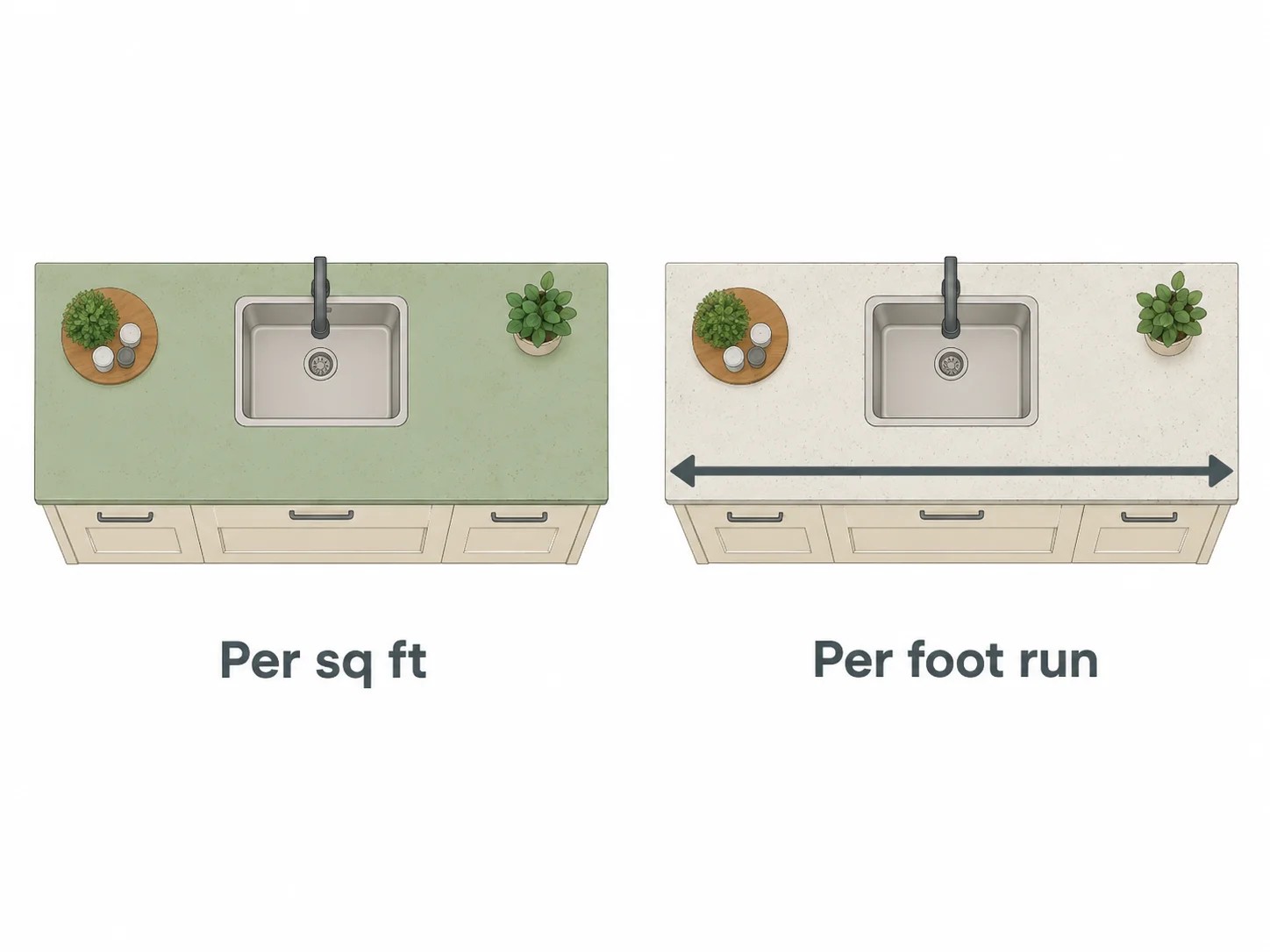
Per sq ft vs per foot run
This is where most quotation confusion starts. Per sq ft charges for the surface area. Per foot run charges for the length along the front edge, at a standard depth, usually 2 ft (600mm).
At a 2 ft depth, 1 ft run equals 2 sq ft, so RM300 per foot run is the same as RM150 per sq ft. Before comparing two quotes, convert them to the same unit. A deeper island quoted per foot run will usually carry a surcharge, so ask.
What a typical kitchen costs
A straight 10 ft counter at 2 ft deep is 20 sq ft. Using the published ranges above:
| Tier | Range across both sources (per sq ft) | 20 sq ft countertop |
|---|---|---|
| Entry-level | RM110–180 | RM2,200–3,600 |
| Mid-range | RM145–400 | RM2,900–8,000 |
| Premium imported | RM280–1,000+ | RM5,600–20,000+ |
Then check three things that can push the number up:
- Cut-outs — one guide includes sink and hob cut-outs in its rates; the Johor supplier charges them separately, from about RM100 for a hob to RM100–280 for an undermount sink. Ask which applies.
- A second slab — a straight 10 ft run is 3,048mm. That’s slightly longer than a 3,000 × 1,400mm slab, the standard size the Johor supplier quotes, though many brands also sell longer jumbo slabs. Ask whether the quote assumes a jumbo slab or a joint, and where the joint falls. The Johor supplier says running into a second slab can add 30–40% to the cost.
- Extras — mitred edges (two pieces cut at 45° and joined at the corner so the counter looks thicker than the slab), waterfall ends (the stone turns down the side of a cabinet or island to the floor), a stone backsplash, L-shaped joins, and carrying charges where the slab can’t go up in the lift. Quartz suits a dry kitchen backsplash better than the wall behind a wok; our kitchen backsplash ideas cover the alternatives.
For the wider list of costs that appear late in a renovation, see hidden renovation costs in Malaysia.
What to Watch For in a Quartz Quotation
The countertop is often a single line on a kitchen quote. These are the details that line should include, and the ones that cause disputes when it doesn’t.
- Brand and colour code — “quartz top” alone lets the supplier swap in any slab. The exact name protects you.
- Unit and measured area — per sq ft or per foot run, with the measured figure shown.
- Thickness — written on the quote. A thicker slab uses more material and costs more per sq ft, so two quotes at different thicknesses aren’t comparable. It also changes how sturdy unsupported overhangs are and how chunky the edge looks.
- Joint positions — marked on the drawing. A joint through the sink area or across the middle of an island is avoidable with planning.
- Edge profile — square, eased or mitred, and whether it costs extra.
- Cut-outs — listed, or stated as included.
- Lift and access — in a condo, a long piece must fit the service lift. Check with your building’s Joint Management Body (JMB) or Management Corporation (MC) on lift bookings and delivery hours, and confirm any carrying charges for stairs-only access.
- Validity date — imported slabs move with the ringgit; if your schedule slips, ask for a fresh quote.
Our guide to comparing renovation quotations shows how to line these items up across contractors.
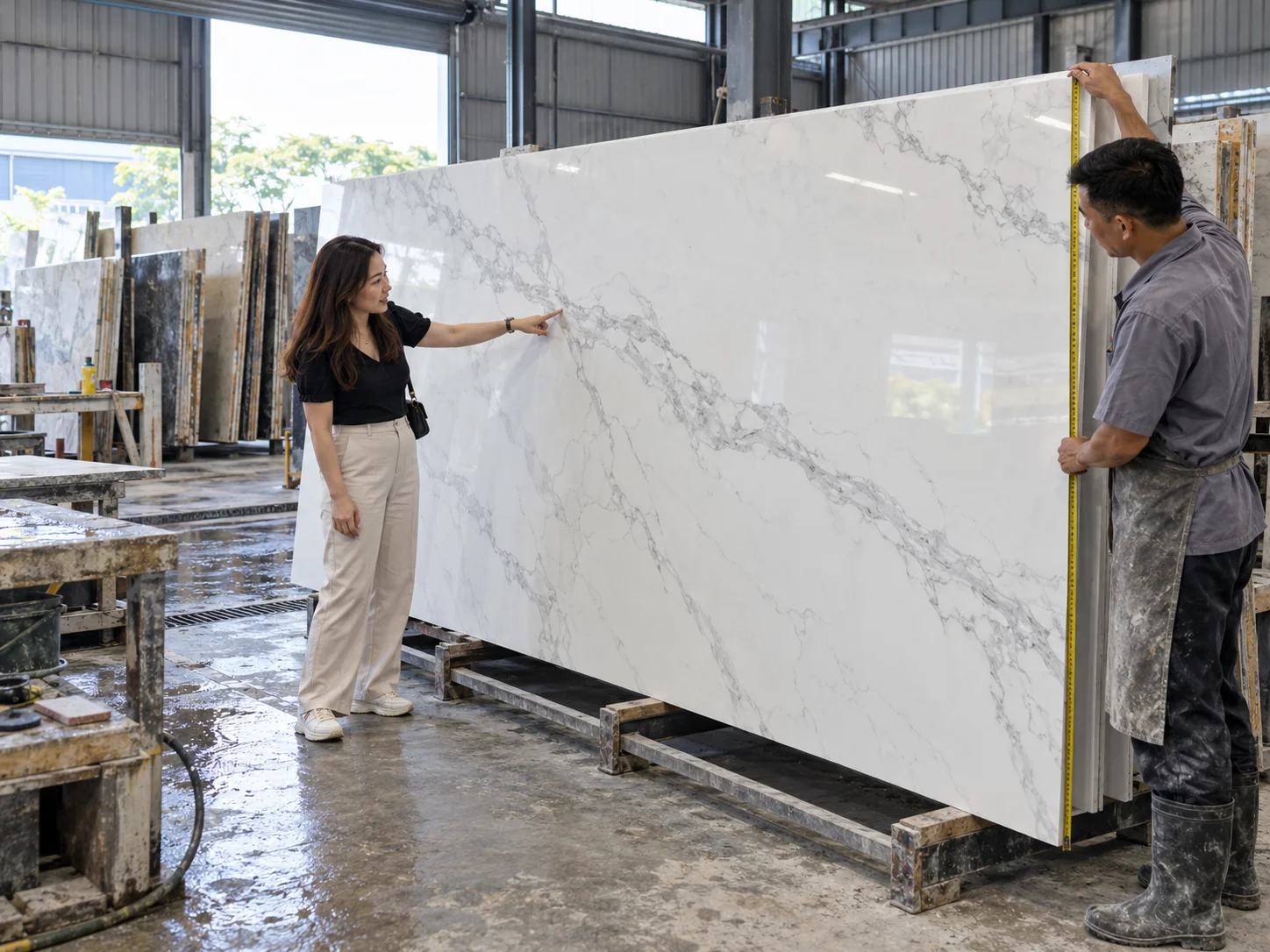
What to Ask Your Installer Before the Slab Arrives
You don’t need to know how to fabricate stone, but a few questions to your installer prevent the most common problems. A good fabricator will answer them without hesitation.
- “Will all cutting and polishing be done in your workshop?” Quartz contains a lot of crystalline silica, and its dust can cause silicosis, a serious lung disease. Australia banned engineered stone from 1 July 2024 over cases among stone workers. Cutting should happen in the workshop with water and dust extraction, not dry-cut with a grinder in your home, where the dust settles on everything and drifts to your neighbours.
- “Will the sink and hob cut-outs have rounded inside corners?” Square corners concentrate stress and are where cracks usually start.
- “Are you using the hob and oven makers’ cut-out sizes?” The hob opening should match the appliance manual, with ventilation space left around any built-in oven below the counter.
- “Are the cabinets level and ready to support the slab?” The carcass (the cabinet box underneath, without its doors) must be level and support the stone along its length, or the slab can crack under load.
- “Will the long pieces fit in the lift, and where will the joints go?” Agree this before cutting, not on delivery day.
Before You Confirm Your Quartz Countertop
- Brand, colour code and thickness are on the quotation
- The price unit (per sq ft or per foot run) and measured area are shown
- Cut-outs, edge profile and backsplash are listed or stated as included
- Joint positions are marked on the drawing
- You’ve seen the actual slab, not just a small sample
- The warranty is in writing, and you know what it excludes
- Your installer has confirmed all cutting is done in the workshop, with no dry-cutting in your home
- No quartz goes in direct sun, and there’s a trivet spot beside the hob
- The quotation’s validity date fits your renovation schedule
Settle these and the quartz line stops being a guess. What you get is a calm, even surface that still looks the way it did on handover day after years of breakfast, homework and late-night Maggi, as long as the hot wok goes on a trivet.