 rumaruma
Kitchen Backsplash Ideas for Malaysian Homes: What Works Behind a Wok, a Sink and a Dry Counter
Eight kitchen backsplash ideas for Malaysian homes, with what each costs, where it copes with wok smoke and steam, and where it doesn’t.
On this page
Your cabinets are confirmed and the countertop slab is on hold at the fabricator. Then the contractor asks the question nobody warned you about: “Backsplash what material, boss?” You have about two days to decide on the strip of wall you’ll be wiping every night for the next fifteen years.
The best kitchen backsplash ideas for Malaysian homes start with how you cook, not with a Pinterest board. A wall behind a wok that fries ikan bilis three times a week needs a different surface from the wall behind a dry kitchen coffee station. This guide walks through eight options, what each costs in RM, and where each one belongs. For the full renovation picture, from layout to cabinets, start with our kitchen renovation guide.
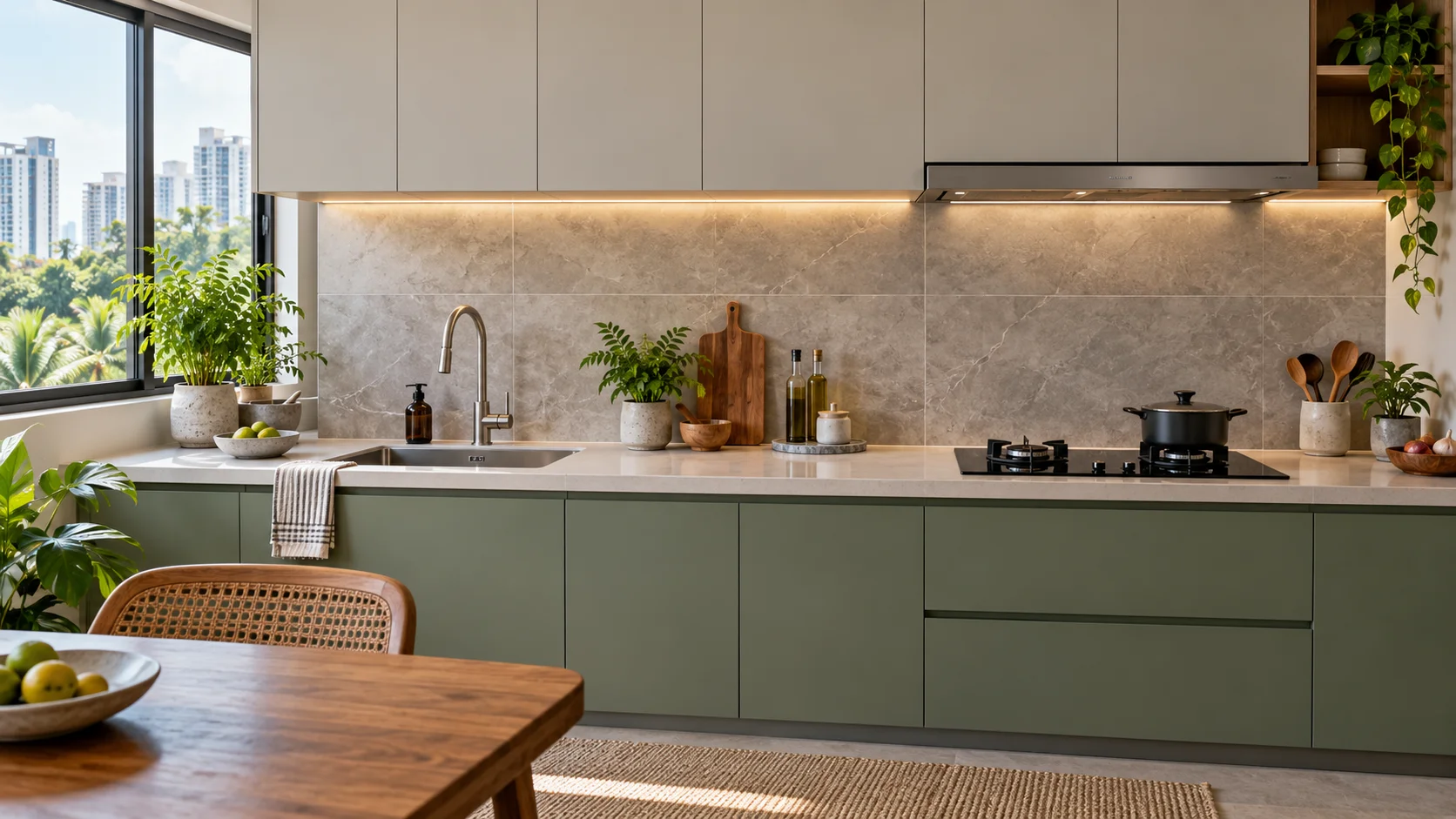
What a Backsplash Has to Survive in a Malaysian Kitchen
The backsplash is the wall between the countertop and the wall cabinets, usually a band about 600–750mm tall. Its job is to keep oil, water and food off a painted wall that would stain, peel or grow mould in our humidity.
That job is much harder in some spots than others:
- Behind the hob — oil mist, wok splatter and heat. Grease bakes onto the surface and dust sticks to the grease. This is where most backsplashes fail.
- Behind the sink — standing water, detergent and the daily splash from washing a rice pot. The joint between countertop and wall is where water sneaks in.
- Along a dry kitchen or island counter — a kettle, a toaster, the odd coffee drip. Here the backsplash can be chosen mostly for looks.
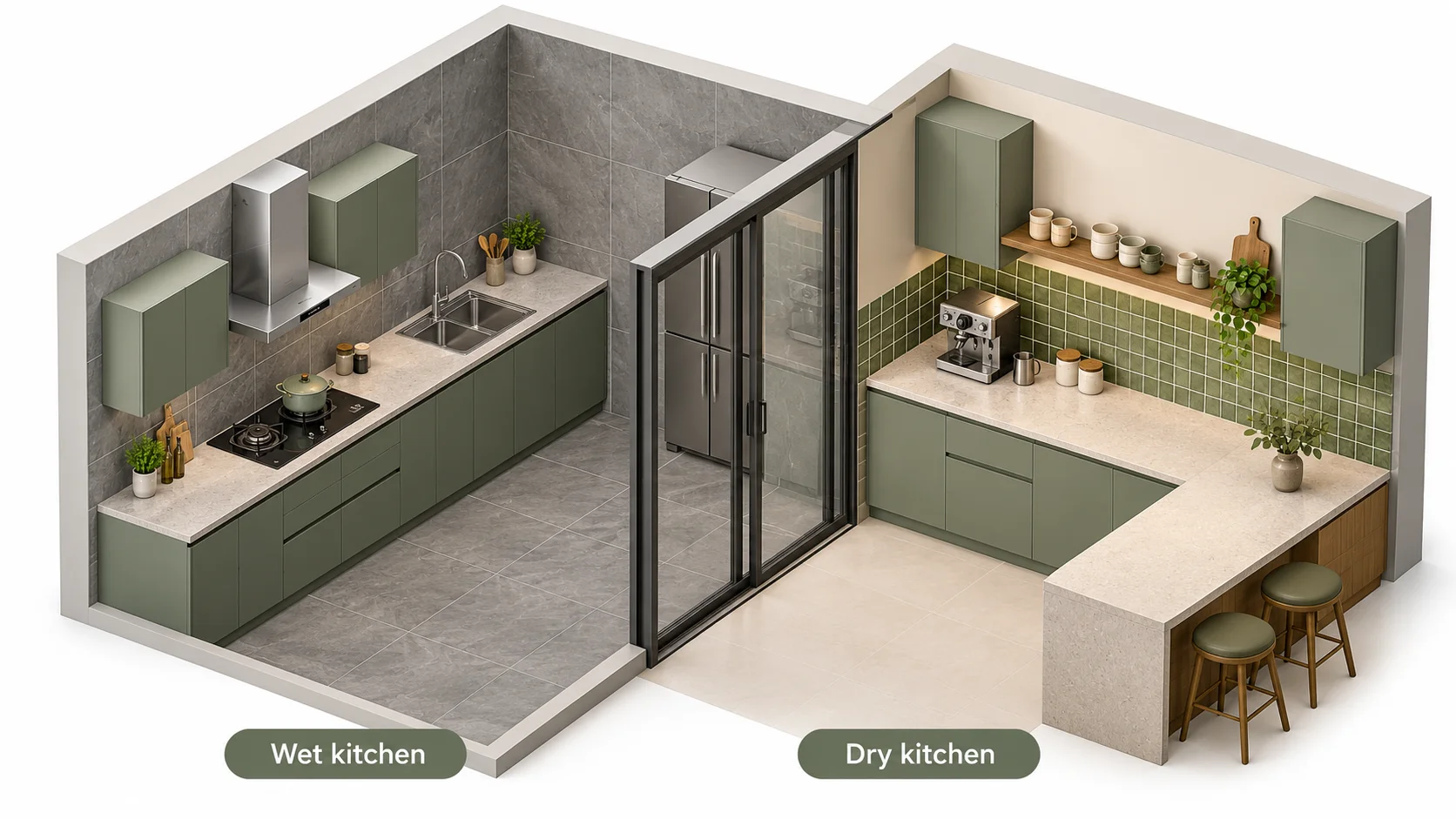
Most Malaysian homes with a wet and dry kitchen can use two different backsplashes. Spend on the hardest-working wall and let the other one be the pretty one.
One word comes up again and again below: grout, the filler pressed into the joints between tiles. Ordinary cement grout is slightly porous, so oil and water soak into it and stain it over time. Epoxy grout is a two-part resin that sets hard and non-porous, so grease wipes off instead of soaking in. It costs more and takes a more skilled tiler, which is why it’s worth paying for in the wet kitchen and optional elsewhere.
8 Kitchen Backsplash Ideas for Malaysian Homes
1. Large-format porcelain tiles
Tiles of 60 × 60cm or larger, or long 60 × 120cm planks, cover the backsplash with only a few grout lines. Fewer joints means fewer places for wok grease to settle, and porcelain absorbs almost nothing. A matt stone-look or concrete-look porcelain gives a calm, modern wall without the price of a slab.
- Works best — wet kitchens and busy cooking walls, condo or landed
- Weakness — big tiles need a flat wall and a careful tiler; an uneven wall shows as lips between tiles, and cutting around sockets wastes more tile
- Don’t use it — on a wall your contractor says is badly out of plumb (not truly vertical, so a long spirit level shows gaps against it), unless it’s skim-plastered flat first
2. Subway tiles with dark or epoxy grout
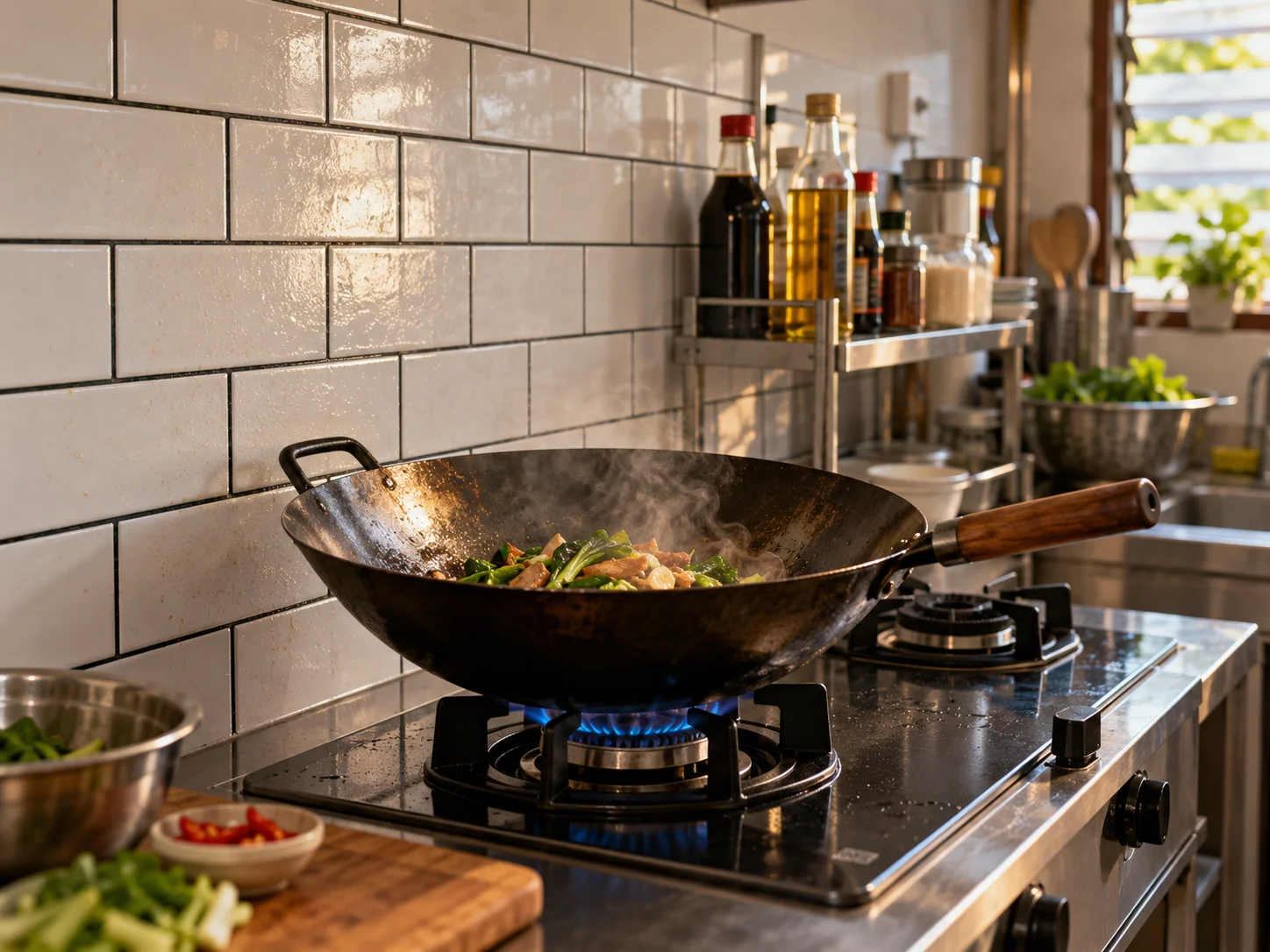
The classic 7.5 × 15cm or 7.5 × 30cm rectangular tile, laid in a brick pattern, vertical stack or herringbone. It suits almost every style, from Japandi to a kopitiam-inspired green-and-white. The catch is grout: a subway backsplash has many joints, and pale cement grout behind a wok goes yellow-brown within a few years.
- Works best — dry kitchens, sink walls, and wet kitchens if you use epoxy grout in a mid or dark colour
- Weakness — the most grout lines of any tile option except mosaic
- Don’t use it — with white cement grout behind the hob, unless you enjoy scrubbing joints with a toothbrush
3. The same stone as your countertop
Running the countertop stone up the wall gives a seamless look with no grout at all, and the veining can continue from counter to wall. It’s the cleanest-looking option, and the easiest to wipe. Sintered stone is the stronger pick behind a wok because it isn’t affected by heat or sunlight; quartz suits a dry kitchen better.
- Works best — sintered stone behind the hob; quartz or sintered stone in a dry kitchen or on an island back panel
- Weakness — entry-level slabs cost about the same per sq ft as large-format porcelain, but mid-range and branded slabs cost far more than any tile, and every socket needs a cut-out made by the fabricator
- Don’t use it — quartz on the wall right behind a busy wok burner, where its resin can discolour from heat over time
Our sintered stone vs quartz comparison explains the heat difference in detail.
4. Back-painted tempered glass
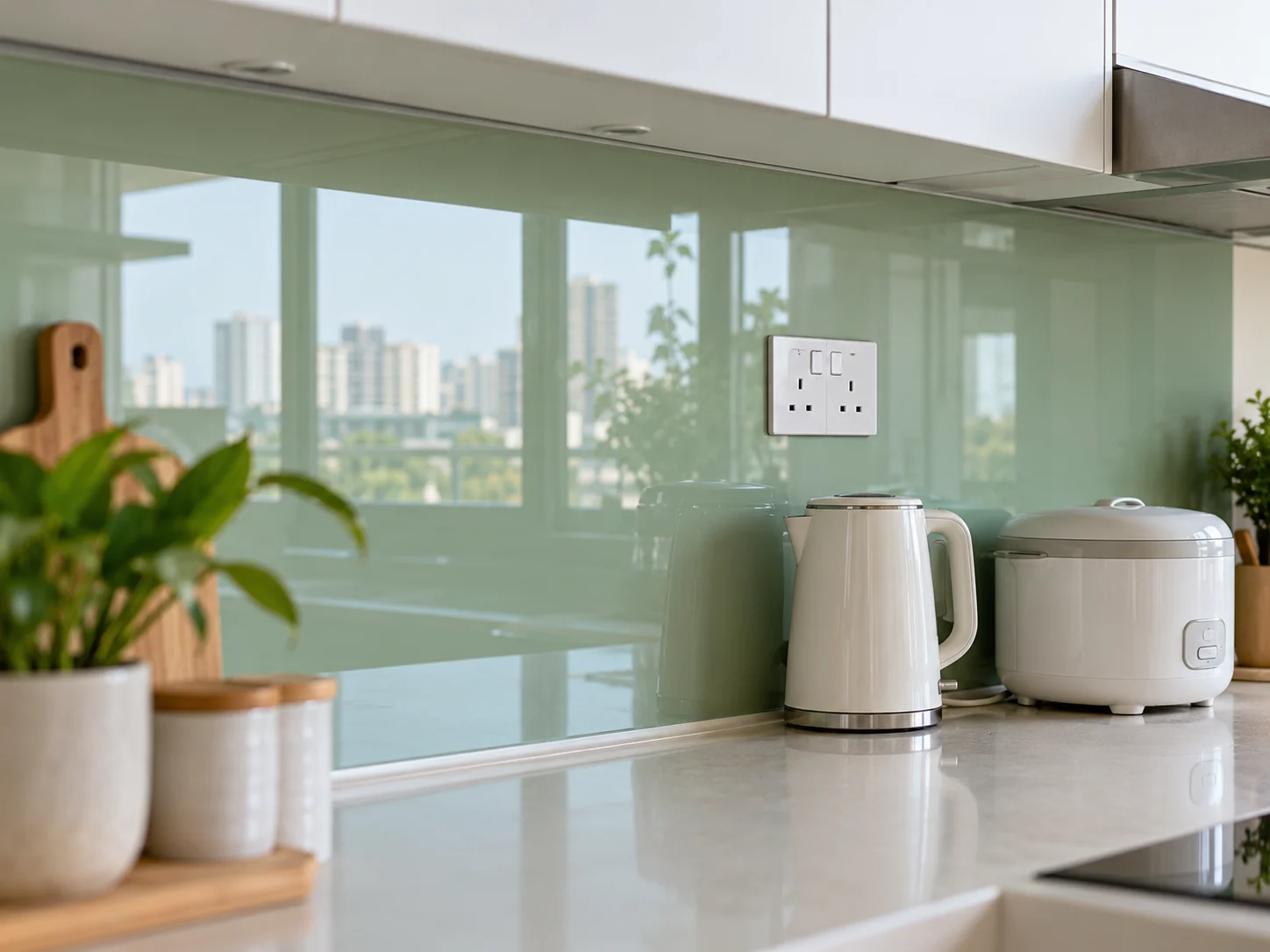
A single sheet of toughened glass, painted on the back in any colour you choose, then fixed to the wall. There are no joints, so a wipe with a damp cloth clears most grease. A soft sage or warm grey glass reflects light into a small condo kitchen and makes it feel bigger.
- Works best — condo dry and wet kitchens where you want colour and fast cleaning
- Weakness — shows every water spot and fingerprint, and glass can’t be cut after tempering, so socket holes must be measured exactly before the glass is made
- Don’t use it — if your power points might still move, or behind a gas hob where the installer says the clearance is too tight
5. Full-height tiles in the wet kitchen
Instead of a band between counter and wall cabinets, tile the whole wall from counter to ceiling. In a wet kitchen this protects the wall above the cooker hood, where steam and oil also reach, and avoids a painted strip that peels. Full height roughly doubles the area you pay for, so it’s usually done in the wet kitchen only.
- Works best — enclosed wet kitchens in terrace houses and condos, especially with open shelves instead of wall cabinets
- Weakness — more tile, more labour, more grout to keep clean
- Don’t use it — as a reason to choose small tiles; full height works best with large-format tiles
6. Stainless steel sheet
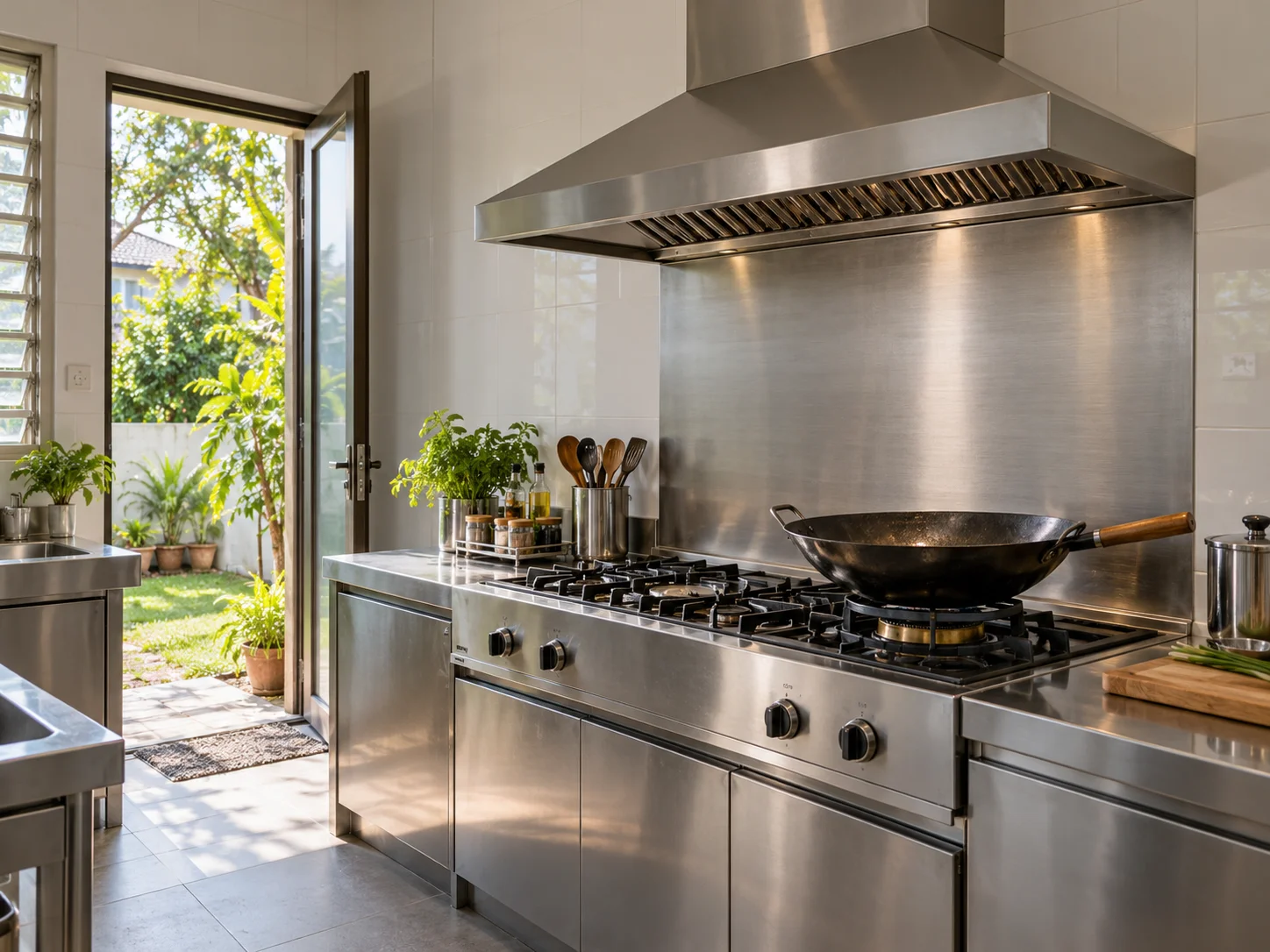
The restaurant answer: a brushed stainless steel panel behind the hob. It’s non-porous, takes heat and wipes clean with degreaser, which is why commercial kitchens use it. In a home wet kitchen it suits families who cook hard and often.
- Works best — wet kitchens with heavy wok cooking
- Weakness — fingerprints, scratches and a cold look; choose a brushed finish to hide marks
- Don’t use it — in an open dry kitchen, unless an industrial look is what you want
7. Mosaic or handmade-look feature strip
Small glass, ceramic or zellige-style tiles add colour and texture that a slab can’t. Used as a short feature panel behind a coffee station or a dry kitchen sink, they give the kitchen personality. Used across a whole wet kitchen, they become a cleaning job.
- Works best — dry kitchens, coffee corners, a short strip framed by a plainer tile
- Weakness — many grout joints and higher labour, because the tiler has to align every sheet
- Don’t use it — behind a wok burner
8. Natural stone (marble, travertine)
Real marble or travertine on the wall looks beautiful in a dry kitchen. It’s also porous and reacts with acids, so calamansi, vinegar and tomato splashes can mark it, and it needs sealing every so often.
- Works best — dry kitchens and island back panels where splashes are light
- Weakness — staining, etching and sealing upkeep in humid conditions
- Don’t use it — in a wet kitchen
A quick note on peel-and-stick vinyl tiles and PVC sheets from online stores and shops like Mr. DIY: they’re a fair stop-gap for renters or a tired dry kitchen wall. Keep them well away from the hob, because heat can soften, warp or lift them.
Kitchen Backsplash Price in Malaysia
The rates below come from one published Klang Valley estimate and are for supply and lay, per sq ft. They’re for reference only. Your actual price depends on the wall area, whether old tiles must be hacked off, how many socket cut-outs there are, the grout type, how high you go and the tile or slab you choose.
| Backsplash material | Supply and lay, per sq ft | Cleaning |
|---|---|---|
| Standard ceramic tile | RM35–RM60 | Easy, grout needs attention |
| Subway tile | RM55–RM90 | Grout lines need attention |
| Mosaic tile (glass/ceramic mix) | RM80–RM140 | Harder, many joints |
| Tempered glass panel | RM90–RM160 | Very easy, shows spots |
| Large-format porcelain (60 × 60cm or larger) | RM100–RM180 | Easy, few joints |
| Stainless steel sheet | RM120–RM200 | Easy, shows fingerprints |
| Natural stone (marble, travertine) | RM150–RM300+ | Needs sealing |
Source: ClickBina, Kitchen Backsplash Cost Malaysia 2026 (updated 25 October 2026), indicative Klang Valley figures, not quotations.
Some contractors quote tile backsplash work much lower, from around RM12–RM25 per sq ft. Before you compare, check whether that rate includes the tile itself or is labour only. Quartz and sintered stone aren’t in that table because the estimate doesn’t price them as backsplashes. Fabricators usually price a stone backsplash at the same per-sq-ft rate as the countertop, plus a cut-out for each socket:
- Quartz — from about RM110–RM180 per sq ft installed for budget slabs, RM250–RM400 for mid-range and RM500 or more for premium brands, based on the rates in our quartz countertop guide
- Sintered stone — from about RM110 per sq ft installed for entry-level China-made slabs, rising to around RM469 for premium imported ranges, based on the rates in our sintered stone guide
The RM110 starting point applies to both, but only to the cheapest slabs. Choosing the same stone as a mid-range or premium countertop puts the backsplash well above most tile options. Leftover slab from the countertop can sometimes cover the backsplash, so ask the fabricator before ordering a second slab.
The same estimate lists extras that often appear as separate lines:
- Epoxy grout — about RM150–RM400 extra for an average backsplash
- Hacking and disposal of old tiles — about RM200–RM600, depending on area
- Socket or switch cut-outs — about RM30–RM80 each
For a rough idea, a 10-foot counter with a 2-foot-tall backsplash is about 20 sq ft. At the rates above, that’s roughly RM700–RM1,200 in plain ceramic, RM1,800–RM3,200 in tempered glass and RM2,000–RM3,600 in large-format porcelain, before extras (our calculation). Take it to full height and the area, and the bill, roughly doubles.
Which Backsplash for a Wet Kitchen vs a Dry Kitchen
| Zone | Good choices | Avoid |
|---|---|---|
| Behind the hob, wet kitchen | Sintered stone, large-format porcelain with epoxy grout, stainless steel; tempered glass only where the installer confirms enough clearance from the burner | Quartz, marble or travertine, mosaic, peel-and-stick |
| Sink wall, wet kitchen | Large-format porcelain, subway with epoxy grout, tempered glass, a quartz or sintered stone slab | Marble or travertine, pale cement grout |
| Dry kitchen, behind hot appliances (hob, air fryer, toaster, kettle) | Porcelain or ceramic tile, tempered glass, quartz or sintered stone | Peel-and-stick, marble or travertine |
| Dry kitchen, decorative stretches away from heat | Any of the above, plus subway, mosaic, handmade-look tile, marble or travertine | Pale cement grout where coffee and sauces splash |
| Island back panel | Quartz, sintered stone, fluted or timber-look panels away from water | Materials that need grout cleaning at knee height |
A two-zone kitchen is where the better home shows. Picture the wet kitchen in a plain matt porcelain that wipes clean after Sunday’s sambal, and the dry kitchen in a soft green handmade-look tile that catches the morning light over your coffee. One wall works hard. The other one makes you smile.
Details That Make or Break a Backsplash
The material gets the attention, but these small decisions decide how the wall looks in five years.
- Seal the countertop joint — the line where the backsplash meets the countertop needs a neat bead of mould-resistant silicone. Water that gets behind the tiles here loosens the adhesive and grows mould you can’t see.
- Fix the power points first — decide where the rice cooker, kettle, air fryer and microwave live, then mark the sockets on the wall before tiling. Moving a socket afterwards means cutting tile, or replacing a whole glass panel.
- Line up the tiles with the cabinets — ask the tiler to set out the tiles so cuts land at the ends of the run or behind appliances, not as thin slivers in the middle of the wall.
- Test it with the under-cabinet light on — LED strips under the wall cabinets light the backsplash from a low angle, which shows every uneven tile edge. Check the wall with those lights on before final payment.
- Agree the order of works — a tiled backsplash usually goes up after the countertop is fitted, so the tile cuts sit tight on the stone. A stone backsplash is templated with the countertop. If you’re unsure where the counter run will end, our kitchen layout guide helps you fix that first.
- Keep a few spare tiles — store a box of the same batch. If a tile cracks later, a matching replacement is much easier than hunting for a discontinued design. Our guide to tile repair in Malaysia covers what to do when one does.
For Tilers and Kitchen Contractors
Most backsplash complaints come back to three things. Cement grout behind the hob discolours, so quote epoxy grout for the hob and sink zones as a separate line and explain why. Large-format tiles on a wavy wall leave lips that under-cabinet lighting exaggerates, so check the wall with a straightedge before quoting and include skim-plastering if it’s needed. And for glass, take the final socket and switch positions from the electrician, not the drawing, before the panel goes for tempering.
Before You Confirm Your Backsplash
- Decided which material goes behind the hob, behind the sink and along the dry counter
- Confirmed the backsplash height: to the wall cabinets only, or full height to the ceiling
- Marked every power point and switch on the wall
- Quotation shows the area in sq ft, the tile or slab name, and whether supply is included
- Grout type written in, epoxy for the wet kitchen
- Hacking, cut-outs and silicone sealing listed, not assumed
- Tile set-out agreed so cuts don’t land in the middle of the wall
- Spare tiles from the same batch kept after handover
A good backsplash is one you stop thinking about. It’s the wall you wipe in ten seconds after frying, the one that still looks new when the cabinets are five years old, and the one that makes the kitchen feel finished the first time you switch on the lights over the counter.