 rumaruma
How to Choose a Cooker Hood and Hob for Your Malaysian Kitchen
Which hood type, how much suction, gas or induction, what the pair costs to buy, and what to ask for on the installation quotation.
On this page
- Start With the Way You Cook
- Cooker Hood Types in Malaysia
- How Much Suction Do You Need?
- Size and Height: Matching the Hood to the Hob
- Planning the Duct Route
- Hood Filters and Cleaning
- Gas vs Induction Hob in Malaysia
- Cooker Hood and Hob Prices in Malaysia
- For Carpenters and Renovators
- Checklist Before You Buy
The cabinet maker wants a hob model by Friday, the electrical shop has forty hoods on the wall, and every one of them claims “powerful suction”. Meanwhile you just want to fry fish without the whole condo smelling of it for two days.
Choosing a cooker hood and hob in Malaysia comes down to a handful of numbers and one question: where will the smoke go? This guide walks through hood types, suction, ducting, gas versus induction, what the hood and hob cost to buy, and which installation items to get quoted, so you can walk into the shop knowing what to ask.

Start With the Way You Cook
Before looking at any spec sheet, be honest about what happens on the hob most nights. The answer decides almost everything else.
- Heavy wok cooking — stir-frying on high heat, deep-frying, sambal tumis, pan-fried fish. This throws oil droplets and thick smoke upwards fast, and needs a ducted hood with strong suction.
- Mixed cooking — boiling, simmering curries and soups, some light stir-frying. A ducted hood is still the right call, but you don’t need the most powerful model.
- Light cooking — eggs, instant noodles, reheating, the occasional pasta. Common in a dry kitchen or a small condo where most meals are bought in. A smaller hood and an induction hob may be all you need.
Many Malaysian homes have more than one of these. A wet kitchen for the heavy cooking and a dry kitchen for breakfast and drinks usually get different hobs and hoods. Our guide to planning a kitchen layout explains how the two zones are laid out.
Cooker Hood Types in Malaysia
There are five common types on sale at Malaysian electrical retailers. They differ in how close they sit to the pan and how much air they can move.
| Hood type | How it works | Best for | Main weakness |
|---|---|---|---|
| Chimney (wall-mounted) | A canopy on the wall with a tall chimney cover hiding the duct | Most wet kitchens and closed kitchens | Sits higher above the pan, so some smoke escapes at the edges |
| Slanted (angled) | An angled glass or steel face that sits lower and closer to the cook | Wok cooking in compact kitchens | You need to check head clearance, especially for taller cooks |
| Slim (under-cabinet) | A thin unit fitted under a wall cabinet | Light cooking only | Low suction, often up to around 500 m³/h |
| Built-in (integrated) | Hidden inside a wall cabinet, only the bottom panel shows | Dry kitchens where looks matter | Usually less powerful than a chimney hood of the same price |
| Island | Hangs from the ceiling over an island hob | Open kitchens with an island | Long duct through the ceiling, and no wall to stop smoke drifting |
For most Malaysian wet kitchens, a chimney or slanted hood is the safe choice. Slanted hoods were designed with Asian cooking in mind: they sit lower, so smoke rising from the wok reaches the intake before it spreads.
Ducted vs recirculating
This matters more than the type.
- Ducted — the hood pushes smoke and oil through a pipe to the outside. It’s the only setup that actually removes fried-fish smell from your home.
- Recirculating (ductless) — the hood traps grease in a filter, passes the air through a carbon filter, then blows it back into the kitchen. It removes some smell, but not the heat or moisture, and the carbon filter needs replacing regularly.
Recirculating hoods only make sense where there’s truly no way to duct out, usually an island in the middle of a condo or a kitchen with no external wall. If that’s your situation, a recirculating hood can still be a sensible buy, as long as you choose it carefully and accept its limits. Our open vs closed kitchen guide explains why this decision often decides whether an open kitchen works at all.
If you can’t duct out
Use this checklist instead of the ducting steps further down:
- The hood is sold as recirculating, or comes with a recirculation kit for that exact model
- It takes a carbon filter made for that model, not a generic one
- Replacement carbon filters are easy to buy locally, and you know the price and how often they need changing
- The grease filter is washable (stainless steel baffle or aluminium mesh), so the carbon filter doesn’t clog with oil
- The air outlet isn’t blocked by a cabinet or ceiling, so filtered air can flow back into the room
- You open a window or switch on a fan while cooking, since the hood won’t remove heat or steam
- Heavy frying moves to a ducted wet kitchen if you have one, or happens less often
How Much Suction Do You Need?
For daily wok frying, aim for about 1,200 m³/h or more; for mixed cooking, about 1,000–1,200 m³/h is enough, and a slim hood’s 500 m³/h or so only suits light cooking. That figure is the airflow on the spec sheet, in cubic metres per hour (m³/h), and it’s the single most useful number when comparing hoods.
| Cooking style | Suggested airflow | Typical hood |
|---|---|---|
| Light cooking, dry kitchen | Up to about 500 m³/h | Slim or built-in hood |
| Mixed cooking | About 1,000–1,200 m³/h | Chimney or built-in hood |
| Heavy wok cooking, wet kitchen | About 1,200 m³/h and above | Chimney or slanted hood |
Wall-mounted hoods sold in Malaysia are commonly rated around 1,200–1,850 m³/h at full speed, and mid-range chimney hoods at major retailers sit around 1,000–1,500 m³/h. Brands test differently, so treat the number as a guide for comparing models in the same shop, not an exact measure.
Two things quietly reduce real suction at home:
- A long or bent duct — every extra metre and every bend makes the fan work harder. A hood rated 1,500 m³/h on a long duct with three bends may perform like a much weaker one. Some hoods have an auto-boost or turbo mode that helps on longer runs.
- Mounting too high — smoke spreads as it rises. A hood mounted well above its recommended height catches less of it, however strong the fan.
Noise
Higher suction usually means more noise. Spec sheets list noise in decibels (dB) at each speed, so compare the figure at the speed you’ll actually use, not just the lowest. In an open kitchen, a loud hood competes with the TV, so it’s worth switching a display model on in the shop and listening.
Size and Height: Matching the Hood to the Hob
Get these two measurements right and an average hood performs well. Get them wrong and an expensive one disappoints.
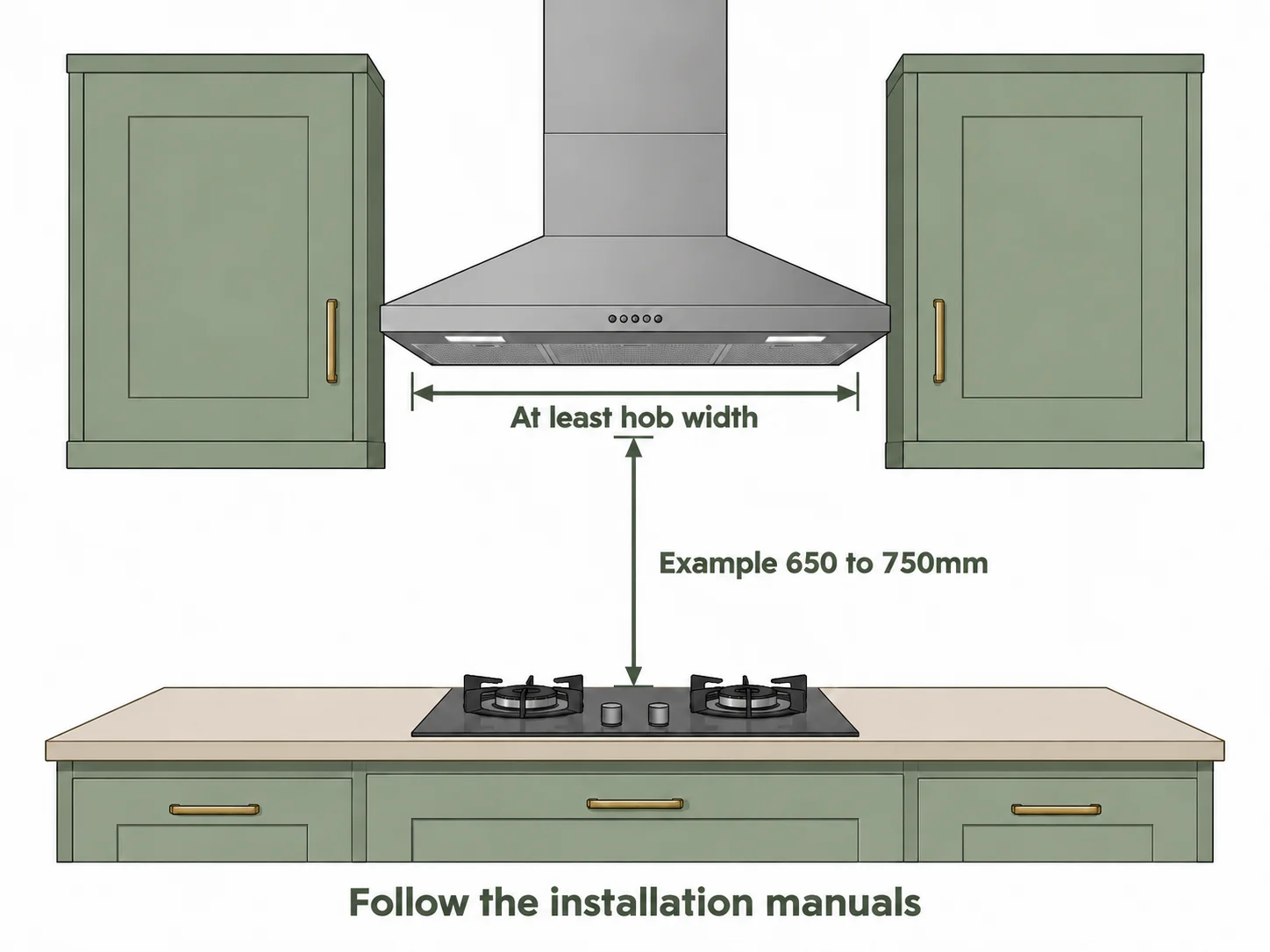
- Width — the hood should be at least as wide as the hob, ideally a little wider. Hobs are typically 60–90cm wide, and most wall-mounted hoods come in 90cm, which covers a standard two-burner gas hob.
- Height — for a standard wall-mounted chimney hood, a common range is about 650–750mm above the hob. Slanted hoods are designed to sit lower. Always follow the hood’s own installation manual, since gas and induction hobs can have different minimums.
- Wall cabinets — the hood needs a gap in the wall cabinet run. Tell your cabinet maker the exact hood model so the gap and the chimney cover fit, and so no cabinet sits where the duct needs to go.
Planning the Duct Route
The duct is the part most homeowners never think about, and the part that most often lets a good hood down.
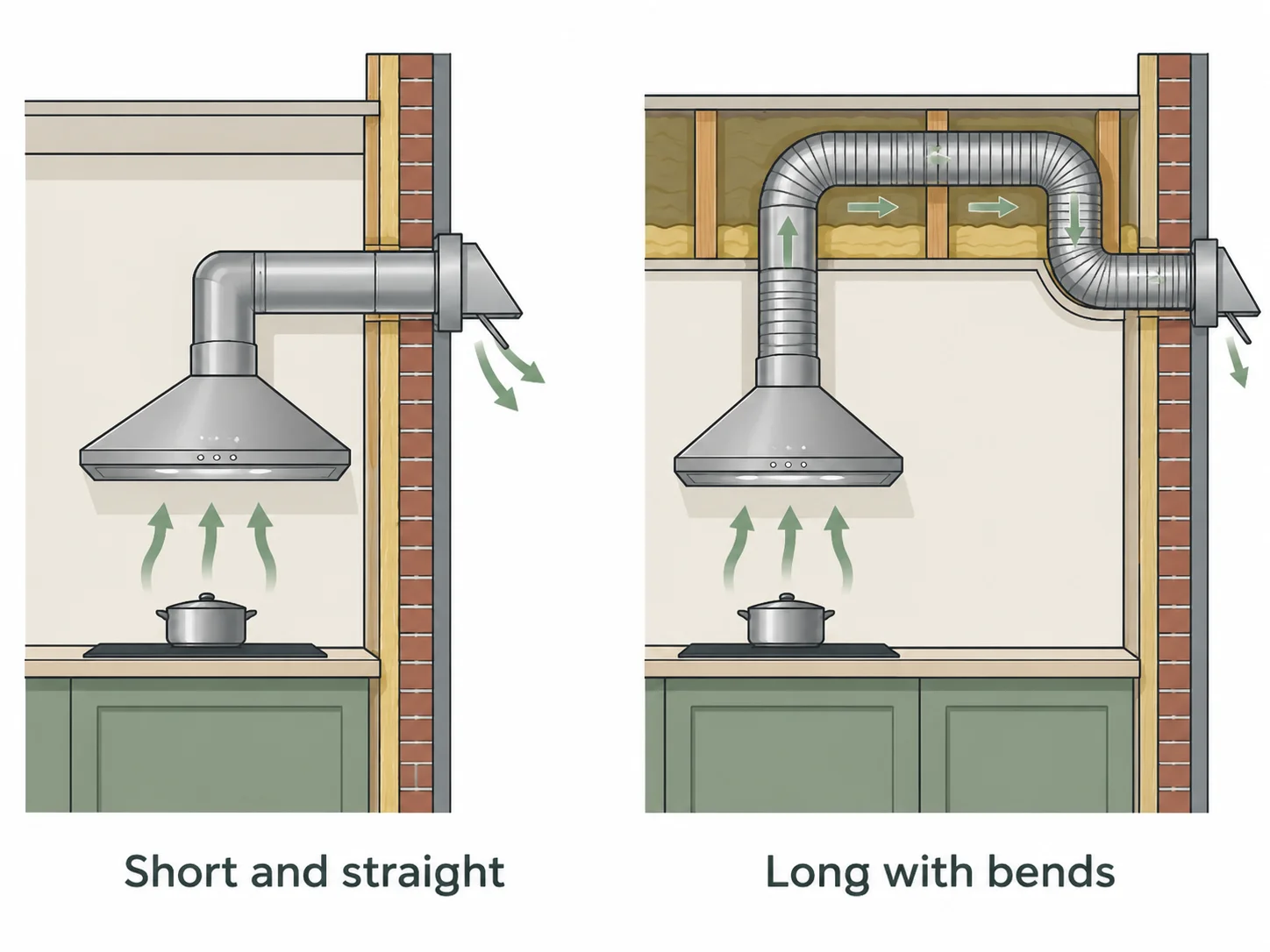
- Keep it short and straight — the best route goes straight out through the wall behind or beside the hood. One or two bends is fine; a long route across the ceiling is not.
- Use a rigid, smooth duct where you can — smooth-walled ducts move air better than flexible foil ones, which sag and collect grease in their ridges.
- Match the hood’s outlet size — the wall opening is often around 17cm across, but this varies by brand. Never reduce the duct to a smaller size than the hood’s outlet.
- Fit a back-draft flap and a rain cowl — a one-way flap stops wind, cockroaches and monsoon rain blowing back down the duct when the hood is off. An outside cover angled downwards keeps the heavy afternoon downpours out.
Condo rules for ducting
In a condo, the outside wall is common property. Before coring a new hole, check with your Joint Management Body (JMB) or Management Corporation (MC). Many buildings already provide a hood exhaust point or sleeve on the kitchen or service-yard wall, and some won’t allow a new opening on the façade at all. Our guide to condo renovation rules in Malaysia covers the approval forms and deposits.
Landed homes have more freedom, but the duct should still discharge where it won’t blow smoke straight into a neighbour’s window or onto a shared back lane wall.
Hood Filters and Cleaning
Malaysian cooking is oily, so the filter you choose decides how often you’re scrubbing.
- Stainless steel baffle filters — angled steel channels that trap grease as the air turns. They handle heavy frying well and can go in the dishwasher or a basin of hot soapy water.
- Aluminium mesh filters — layers of fine mesh. They work, but clog faster with heavy oil and can dent or discolour after repeated scrubbing.
- Oil cup or oil tray — common on slanted hoods. It catches dripping oil so it doesn’t run back onto the hob. Empty it every week or two if you cook daily.
- Carbon filters — only on recirculating hoods. They absorb smell and need replacing every few months, depending on use.
A clean hood is a quieter, stronger hood. Grease-clogged filters make the fan strain and the suction drop, and old grease near a hot hob is a fire risk.
Gas vs Induction Hob in Malaysia
This is the hob decision most households argue about. Neither is better for everyone.
| Gas hob | Induction hob | |
|---|---|---|
| Wok cooking | Round-bottom wok works; the flame wraps around the pan for real high-heat frying | Needs a flat-bottom, magnetic wok; round-bottom woks don’t sit or heat properly |
| Heat control | Instant and visible | Fast and precise, with exact power levels |
| Kitchen heat | Heats the kitchen noticeably | Little heat lost to the room, which helps in a hot condo kitchen |
| Cleaning | Pan supports and burner caps to remove and scrub | Flat glass top, wipe after cooling |
| Supply needed | LPG cylinder or piped natural gas | A dedicated electrical circuit for many larger models |
| Safety | Open flame; look for a flame failure device | No flame; surface stays hot after cooking |
| Main weakness | Smoke, heat and gas supply to manage | Your cookware may need replacing |
Many Malaysian homes do both: a gas hob in the wet kitchen for wok frying, and an induction hob in the dry kitchen for boiling, eggs and coffee. Some brands also sell hybrid hobs, with one gas burner and one induction zone on the same glass top, which suit kitchens that only have room for one hob.
What to check on a gas hob
- Gas type — hobs are set up for either LPG (cylinder) or natural gas (piped). Buy the version that matches your home, or ask for the conversion jets.
- Burner power — listed in kW. Wok burners on hobs sold in Malaysia are commonly around 4–5.8kW. Higher power gives a stronger flame for stir-frying, but also more heat and smoke for the hood to handle.
- Flame failure device — it cuts the gas if the flame goes out, from a boil-over or a gust of wind. Treat it as essential, not an extra.
- Top material — tempered glass looks sleek and wipes clean, but it can shatter from a heavy knock or a sudden temperature change. Stainless steel is more forgiving but shows scratches and water marks.
- Ignition — battery ignition works during a power cut; mains ignition needs a power point under the hob.
What to check on an induction hob
- Power and wiring — check the total rated power on the spec sheet. Many larger induction hobs need their own circuit from the distribution board, not a 13A socket. Get a registered electrician to confirm this before the cabinets are built.
- Cookware — stick a fridge magnet to the bottom of your favourite pots and wok. If it holds firmly, the pan works on induction. If not, budget for new ones.
- Zone size — check that the zones are big enough for your largest pot. Small zones heat only the centre of a wide pan.
- Child lock and timers — worth having if young children can reach the counter.
Cooker Hood and Hob Prices in Malaysia
Here’s what to expect at major Malaysian electrical retailers. Prices are for reference only, as of October 2026, and change with brand, promotions, size and features. Your final price is the retailer’s and installer’s quotation.
| Item | Typical price (RM) | Notes |
|---|---|---|
| Two-burner built-in gas hob | RM350 – RM1,100 | Entry models on promotion at the low end; premium models cost more |
| Two-zone built-in induction hob | From about RM1,200 | Entry two-zone and induction-ceramic combo models near RM1,200; premium European models from about RM2,800 |
| Chimney cooker hood (unit only) | RM900 – RM4,000 | Mid-range models with 1,400–1,550 m³/h sit around RM900–RM1,900 |
| Hood installation and ducting | Quoted by the installer | Depends on duct length, number of bends, coring a new wall opening and any ceiling work |
As a rough example, a two-burner gas hob at RM800 and a mid-range chimney hood at RM1,300 come to about RM2,100 for the units alone. Installation and ducting, gas piping changes, a new induction circuit and the countertop cut-out are quoted separately, so ask for each as its own line on the quotation.
The countertop cut-out is where hob choice gets expensive if it changes late. Stone fabricators cut the hob opening to the model’s exact size, and a bigger hob after the slab is cut means a new countertop. Our kitchen renovation guide shows where the hood and hob fit in the order of decisions.
For Carpenters and Renovators
Most hood and hob complaints after handover trace back to the cabinet and stone drawings, not the appliances.
- Get the model numbers before drawing — the hob’s cut-out size, the hood’s width and its chimney cover height all come from the installation manual. Don’t draw from a “standard” size.
- Leave ventilation under the hob — many built-in gas hobs need an air gap or vent in the base cabinet below, and the gas hose must not touch hot surfaces or sharp edges. Check the manual and keep the drawer layout clear of the hose and regulator.
- Mark the duct route on the plan — show the wall opening, the duct path and any cabinet it passes through, and confirm the opening position with the JMB or MC in condos.
- Plan power before closing up — a socket for the hood, a power point for mains-ignition hobs, and a dedicated circuit for induction, all reachable for servicing.
Checklist Before You Buy
- I know how I cook most nights: heavy wok, mixed or light
- If ducting is allowed: the hood is ducted, with a short duct route to an outside wall
- For a condo, the JMB or MC has confirmed where the duct can exit, or that it can’t, in which case I’ve used the recirculating checklist above
- The hood’s airflow suits my cooking (about 1,200 m³/h or more for heavy wok cooking)
- The hood is at least as wide as the hob
- The mounting height follows the hood’s manual
- The gas hob matches my gas type (LPG or natural gas) and has a flame failure device
- For induction, an electrician has confirmed the circuit, and my wok and pots pass the magnet test
- The filter type suits how oily my cooking is
- The cabinet maker and stone fabricator have the exact hob and hood model numbers
Pick the hood for the dish that makes the most smoke, and the hob for the cook who uses it most. Get those two right, and the kitchen stays bright, the cabinets stay grease-free, and Sunday’s fried chicken leaves only the memory behind, not the smell.