 rumaruma
Can a Tile Hole or Crack Be Repaired? A Guide to Tile Repair in Malaysia
Most holes and cracks in floor and wall tiles can be repaired without hacking. Here’s how it works, what it costs and when replacement is the better call.
On this page
- The Quick Answer: Yes, If the Damage Is in the Tile Itself
- Holes vs Cracks: What’s the Difference for Repair?
- Repair or Replace? Check These First
- Why Repair Often Beats Replacing One Tile
- How Tile Repair Works, Step by Step
- Which Tiles Repair Best
- The Honest Limit: Glossy Tiles
- Tile Repair Cost in Malaysia
- How Long a Repair Lasts and How to Care for It
- How to Avoid Holes and Cracks in the First Place
- FAQ
- Before You Book a Repair
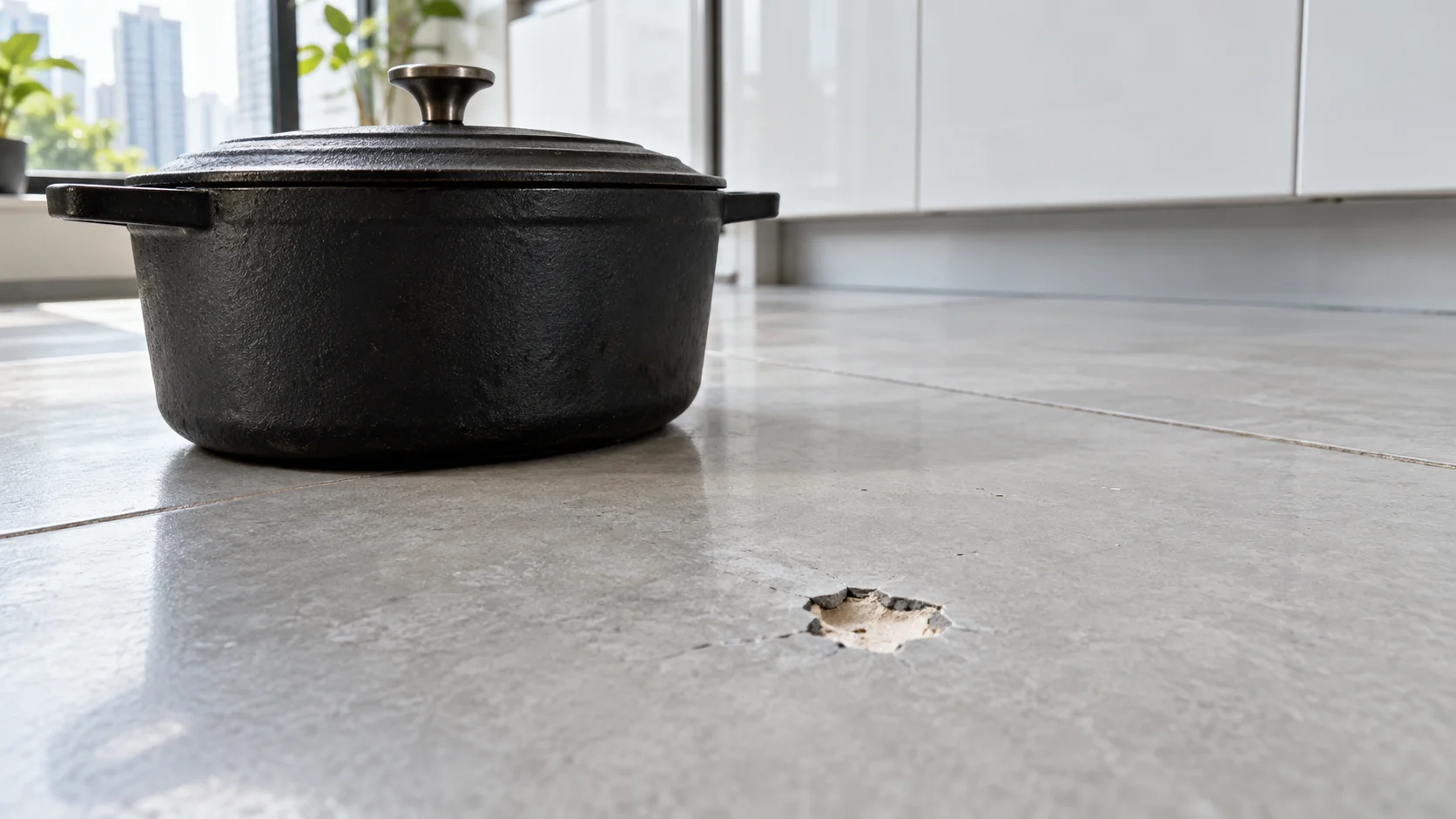
The cast-iron pot slipped, hit the kitchen floor, and left a crater in the middle of a tile you can’t buy anymore. Or you’ve just taken down the old towel rack and found four drill holes in a bathroom wall you were otherwise happy with. Your first thought is that the tile has to be hacked out and replaced.
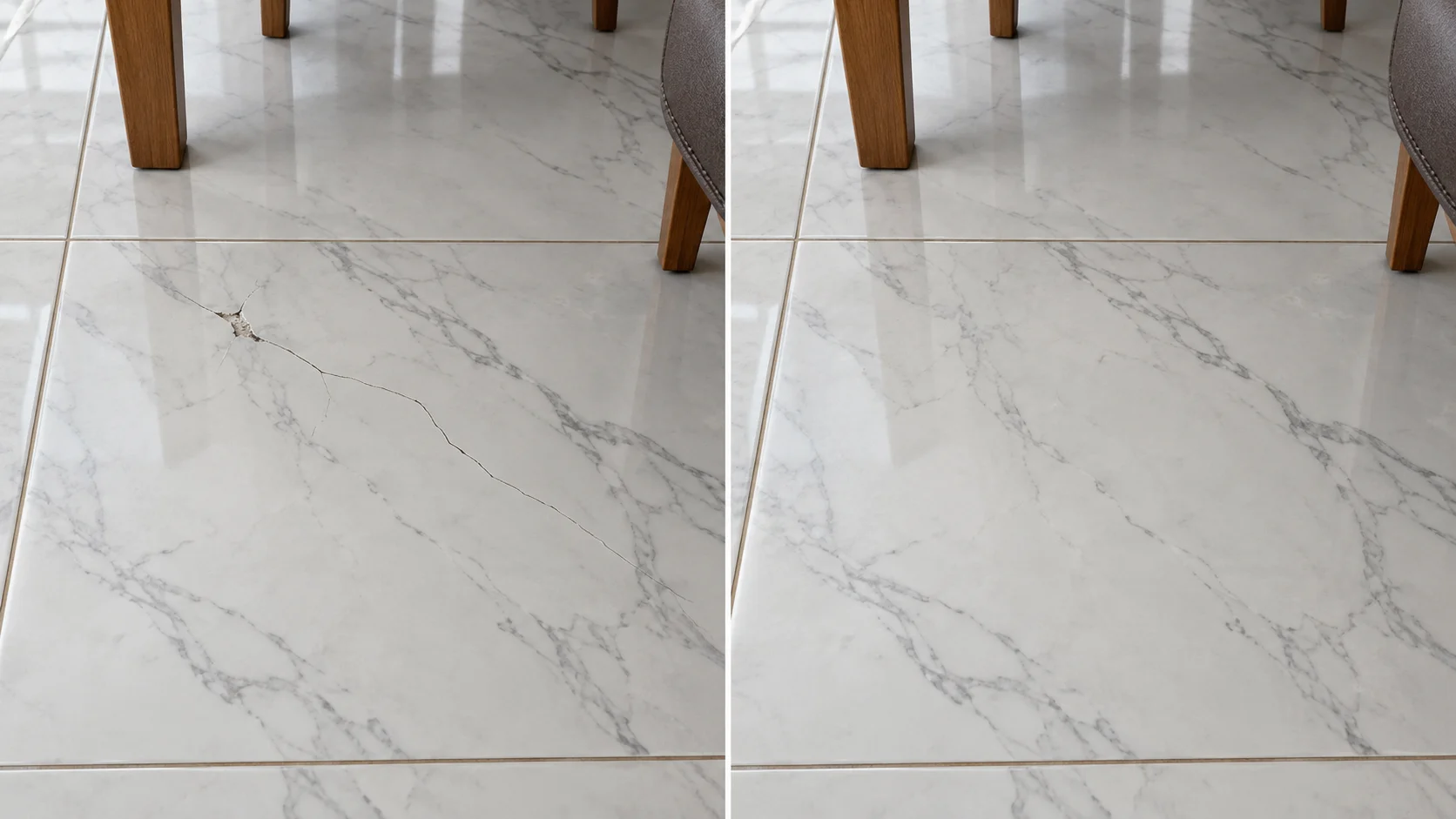
Usually, it doesn’t. Tile repair in Malaysia has moved well past the old “fill it with white cement and hope” approach. A skilled repairer can fill a hole or a crack, rebuild the tile’s surface, match the colour by hand and seal it, without removing a single tile. Done well, you have to know where to look to find it.
This guide explains how the repair works for holes and cracks, what it costs, and when repair is the wrong answer.
The Quick Answer: Yes, If the Damage Is in the Tile Itself
Holes and cracks that sit in the tile’s surface can almost always be repaired. That covers impact holes from dropped objects, old drill holes from fixtures you’ve moved, chipped edges and corners, and cracks that start from a point of impact.
What a surface repair can’t fix is a problem underneath the tile. A tile that sounds hollow or has lifted has lost its bond with the floor, and that needs a different fix. We’ll cover hollow and popped-up tiles in a separate guide.
Holes vs Cracks: What’s the Difference for Repair?
The repair method is the same, but the two types of damage behave differently.
- Holes — a missing piece of tile, whether from an impact, a chipped corner or old screw holes. The repairer rebuilds the missing material, so the size and depth of the hole decide how much work it takes.
- Cracks — a line through the tile where no material is missing, or only a little. The repairer opens and fills the whole length of the line, so the longer the crack, the more work and the higher the price.
A crack that starts from a clear impact point, like where something heavy landed, is a good candidate for repair. A long, straight crack that runs across several tiles in a line usually follows movement in the floor slab below. Filling the surface won’t stop it reappearing, so have a contractor check the cause first.
Repair or Replace? Check These First
Run through this before you call anyone. You can answer every point in a few minutes with a torch and a coin for scale.
- Size of the hole — note roughly how wide and deep it is. Most coin-sized holes and chipped corners are routine repairs.
- Crack length and path — measure the crack and check whether it stays within one tile or continues into the next.
- Location — dry floors and walls are good candidates. A shower floor that’s wet every day is not, because constant water and soap break down the repair faster.
- Spare tiles — check the storeroom. If you have the same batch left over, replacing the tile becomes a realistic option.
- Finish — note whether the tile is matte, satin or high-gloss. It affects how invisible the repair will be (more on this below).
- Number of damaged spots — several holes in one area may be better priced together, or may tip the decision towards replacement.
If the damage stays within the tile, sits in a dry area and you have no matching spares, repair is likely the better choice.
Why Repair Often Beats Replacing One Tile
Replacing a single tile sounds simple. In practice, it’s one of the more awkward jobs in a finished home.
- The tile may no longer exist. Tile designs are discontinued every few years, and even the same design from a new batch can differ slightly in shade. A “matching” replacement can stand out more than the hole did.
- Hacking can damage the neighbours. Breaking out one tile without cracking the ones around it takes care, especially with large-format porcelain laid with tight joints.
- The grout won’t match. New grout around one tile looks brighter than ten-year-old grout around the rest.
- It’s noisy work. Hacking needs a hammer drill. In a condo, that means working within JMB or MC renovation hours and, for some buildings, a renovation notice.
A surface repair avoids all four. No hacking, no new tile to source and no new grout lines.
How Tile Repair Works, Step by Step
Repairers use slightly different products, but a proper hole or crack repair follows the same sequence. Knowing it helps you tell a skilled job from a quick patch.
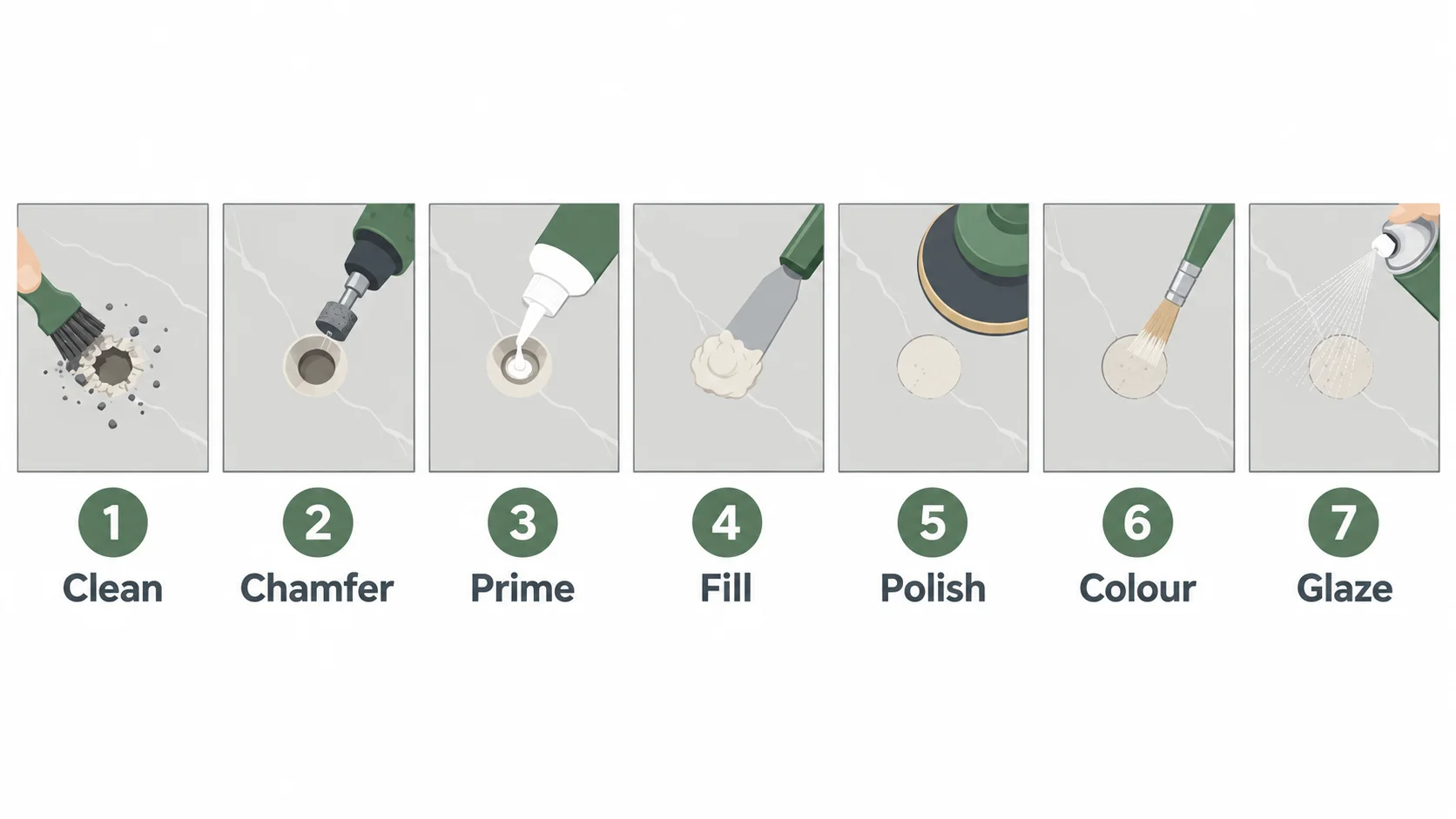
1. Clean the surface
The damaged area is degreased and dusted out. Kitchen floors carry a thin film of cooking oil, and bathroom walls carry soap residue. Either one stops the filler from bonding.
2. Chamfer the hole or crack
The repairer grinds a slight bevel around the edge of the hole, or along the line of a crack. This removes loose fragments and gives the filler a sloped edge to grip, so the join fades in rather than ending at a sharp line.
3. Prime with instant glue
A thin coat of cyanoacrylate glue (the instant glue sold in hardware shops as “502”) goes into the damaged area. It locks down any fine cracks around the damage and helps the filler stick.
4. Fill with stone resin
The hole or crack is filled with marble adhesive, a polyester stone resin mixed with a hardener. It’s the same type of glue used to join stone slabs, and it sets hard enough to be sanded and polished like the tile around it.
5. Polish flat
Once the resin hardens, it’s sanded and polished down until it’s level with the surrounding tile. You should be able to run a finger across it without feeling an edge.
6. Colour match by hand
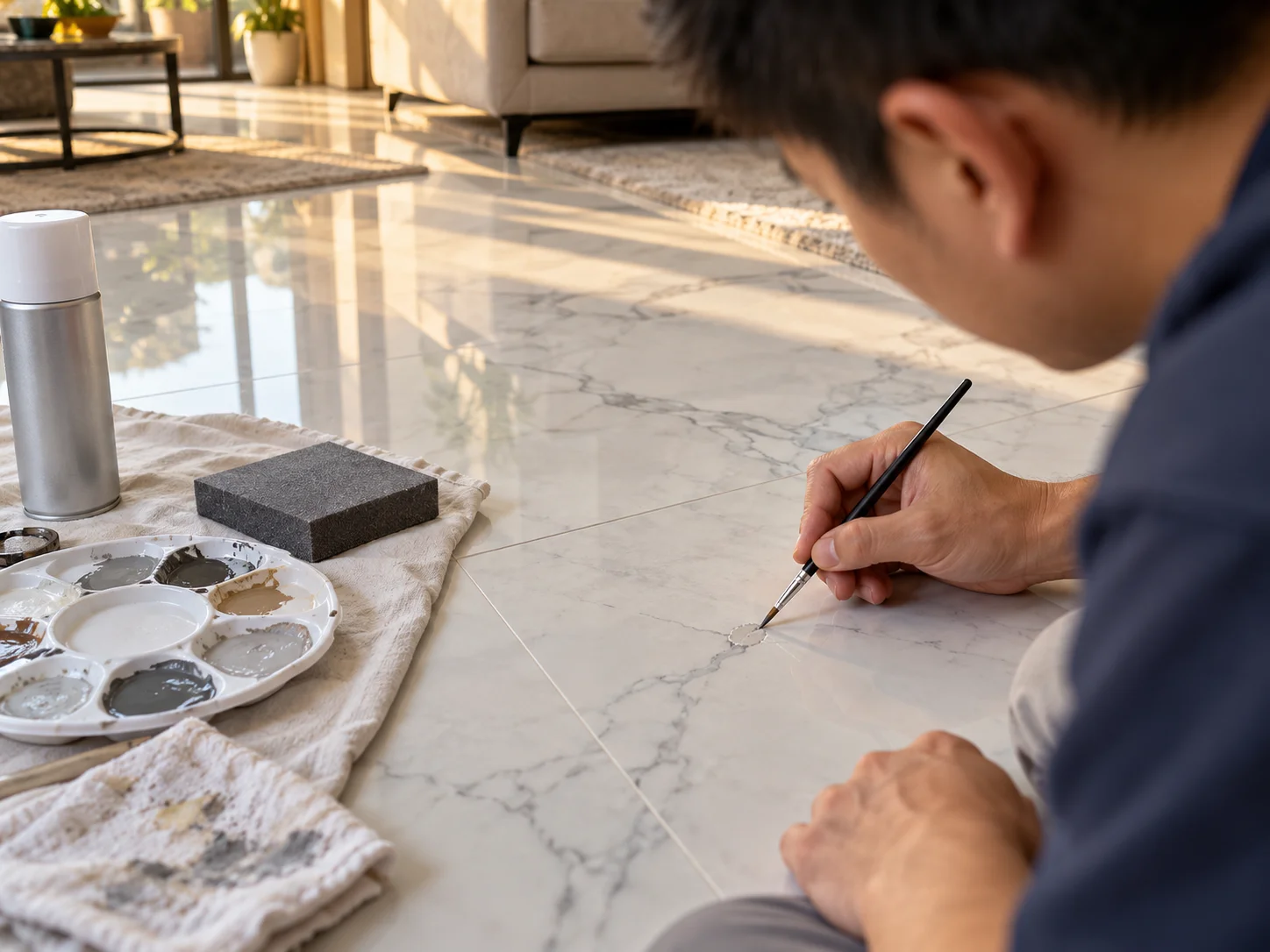
This is where skill shows. The repairer mixes pigments to match the base colour, then paints in veining, speckles or texture to continue the tile’s pattern across the repair. A good colour match reaches about 95% similarity: hard to spot at normal viewing distance, though you may still find it if you know where it is.
7. Spray a clear glaze
Finally, a clear glaze is sprayed over the repair to seal the colour and bring back the sheen of the surrounding tile.
Which Tiles Repair Best
Not every tile hides a repair equally well. The pattern and finish matter more than the price of the tile.
| Tile type | How well it repairs | What to know |
|---|---|---|
| Marble-look and patterned porcelain | Very well | Veining and pattern help the repair disappear |
| Matte or textured tiles | Very well | No mirror-like shine to compare against |
| Full-body porcelain | Well | The colour runs through the tile, so less colour needs to be built up |
| Glazed ceramic | Well | The body underneath is often a different colour from the glaze, so the colour match does more work |
| High-gloss polished porcelain | Good colour, visible shine difference | See the glossy-surface limit below |
| Plain bright white tiles | Harder | Any slight shade difference catches the eye |
Busy patterns are your friend. A hole in a marble-look tile with grey veining is far easier to hide than the same hole in a plain, bright white tile.
The Honest Limit: Glossy Tiles
Colour is the easier part to match. Shine is harder.
A sprayed glaze can’t fully copy the factory-fired gloss of a polished porcelain tile. On high-gloss tiles, the shine on the repaired spot typically reaches around 80% of the original. Look at it straight on and it blends in. Look at it at a low angle against a window or downlight, and you’ll likely see a slightly duller patch.
On matte, satin or textured tiles, this gap mostly disappears. If your floor is high-gloss and the hole sits right in a sunlit walkway, go in expecting “barely noticeable”, not “invisible”.

Tile Repair Cost in Malaysia
As a reference, one Malaysian stone repair team we checked with charges RM400 per hole. Cracks start from the same RM400 and go up with the length of the crack.
| Damage | Reference price | What changes the price |
|---|---|---|
| Hole or chipped corner | RM400 per hole | Size and depth, how complex the tile pattern is |
| Crack | From RM400 | Length of the crack, whether it runs across the pattern |
| Several holes in one visit | Priced per hole | Ask whether nearby holes can be done together |
| How invisible you want it | Varies | A near-invisible finish needs a senior repairer and costs more |
Prices are for reference only (October 2026). Other repairers charge differently depending on the tile, its finish, how far they travel and how much colour-matching the pattern needs.
Why a less visible repair costs more
The more invisible you want the repair, the higher the price. Filling a hole is quick to learn. Mixing pigments by eye until they match a ten-year-old tile, then painting veining that flows naturally across the repair, takes a repairer years of practice. You’re paying for that skill, not for the resin.
So match the finish to the spot:
- High-visibility spots — the middle of the living room, the kitchen walkway, a feature wall. Ask for an experienced repairer and expect to pay more for a near-invisible result.
- Low-visibility spots — the storeroom, behind the washing machine, under the bed, inside a cabinet. If you just want the hole filled and sealed, ask whether a junior repairer can do the job at a lower price.
Cheap handyman patch jobs sit at the far end of this scale. They usually fill the hole with a single-colour filler and skip the chamfering, hand colour-matching and glazing. Fine for a corner nobody sees; on a floor you look at every day, the colour-matching step is what you’re paying for.
Compare the repair price with the real cost of replacement: tracking down a matching tile, a contractor’s minimum charge for one small job, hacking and re-laying, new grout, and the clean-up. Small jobs like this are exactly the kind of hidden renovation costs that add up after you move in.
How Long a Repair Lasts and How to Care for It
A properly bonded repair is hard and stable, and for everyday use it’s treated like the rest of the tile. The repair team we checked with gives a 6-month warranty against the repaired spot chipping again under normal use. Ask whoever you hire what theirs covers.
The repair’s weak point is chemicals, not foot traffic. Solvents can soften the glaze and resin and strip the colour. That warranty doesn’t cover a spot that’s been cleaned with harsh chemicals, especially thinner.
- Do — clean with water and a mild, pH-neutral floor cleaner, the same as the rest of the floor.
- Do — wipe up oil and curry spills on kitchen floors promptly.
- Don’t — use thinner, acetone, paint stripper or strong descalers on the spot.
- Don’t — scrub it with abrasive pads or scouring powder, which dull the glaze faster.
Tell whoever cleans your home where the repair is. Someone reaching for thinner to remove paint drips after the next touch-up job is the most common way a good repair gets ruined.
How to Avoid Holes and Cracks in the First Place
Repairs are good. Not needing one is better.
- Plan fixture positions before tiling. Decide where towel racks, shelves, the TV and the aircon will go during the design stage, so you don’t drill holes you’ll later want to fill.
- Choose full-body porcelain for busy floors. Because the colour runs through the tile, a chip shows less than on glazed ceramic with a white body underneath.
- Protect floors during works. Ask your contractor to lay protective board or thick corrugated sheets before moving furniture, appliances or tools. A cracked tile caused by a dropped toolbox is far cheaper to prevent than to repair.
- Keep spare tiles. Store a box of leftover tiles from your renovation. It gives you the option to replace instead of repair later.
- Use furniture pads. Felt pads under chairs and dining tables stop the slow chipping at tile edges.
FAQ
Can I repair a hole in a tile myself?
Yes, for small holes in low-visibility spots. Hardware shops and Mr. DIY sell epoxy tile fillers and touch-up kits. They’ll fill the hole, but matching colour, pattern and gloss by hand is hard without practice, so DIY repairs on a visible floor usually look like a patch.
Can old drill holes in wall tiles be filled?
Yes. Screw holes left after moving a towel rack, mirror or shelf are among the easiest repairs, because they’re small and usually on a wall that isn’t walked on.
My new property has cracked tiles. Who pays?
If you bought from a developer, check whether you’re still within the defect liability period, which is usually 24 months from vacant possession. Holes and cracks that existed at handover should be reported to the developer to fix, which is why starting your renovation before the defect liability period ends is one of the renovation mistakes Malaysians make. Damage from your own renovation or moving in is yours to repair.
Does a repair work in a bathroom?
On walls and dry areas, yes. On a shower floor that’s wet every day, constant water and soap shorten the repair’s life, so replacement is often the better long-term call there.
Will the repair change colour over time?
A sealed repair is stable under normal indoor use. Strong chemicals and abrasive cleaning are what cause fading or dulling, which is why cleaning advice matters more than age.
Before You Book a Repair
- Take clear photos in daylight, plus one close-up with a coin for scale
- Measure any cracks and check they don’t continue into the next tile
- Note the finish: matte, satin or high-gloss
- Count how many holes or cracks need repair
- Decide how invisible each spot needs to be, and ask whether a junior repairer can handle the low-visibility ones
- Ask the repairer whether they chamfer, hand colour-match and glaze, or only fill
- Ask what the warranty covers and what voids it
- If you’re in a condo, check with your management office whether repair works need notice
A hole or crack feels like a permanent scar on a floor you chose carefully. More often than not, it isn’t. With the right repair, the damage disappears into the tile’s pattern, the floor stays whole, and the only person who knows where it was is you.