 rumaruma
Cabinet Door Finishes in Malaysia: Melamine vs Laminate vs 4G Glass vs Spray Paint
How melamine, laminate, 4G glass and spray paint cabinet doors compare on price, humidity, heat and daily knocks, and which finish suits each part of a Malaysian kitchen.
On this page
- Carcass, Door Core and Finish: Three Separate Choices
- Cabinet Door Finishes at a Glance
- Melamine: The Budget Finish
- Laminate: The Hard-Wearing All-Rounder
- 4G Glass: Glossy and Easy to Wipe
- Spray Paint: Seamless, Any Colour
- Cabinet Door Finish Prices in Malaysia
- Choosing a Cabinet Door Finish in Malaysia, Zone by Zone
- Condo vs Landed: Does It Change the Finish?
- For Carpenters and Renovators: Where Door Finishes Fail
- Questions to Ask Before You Choose a Door Finish
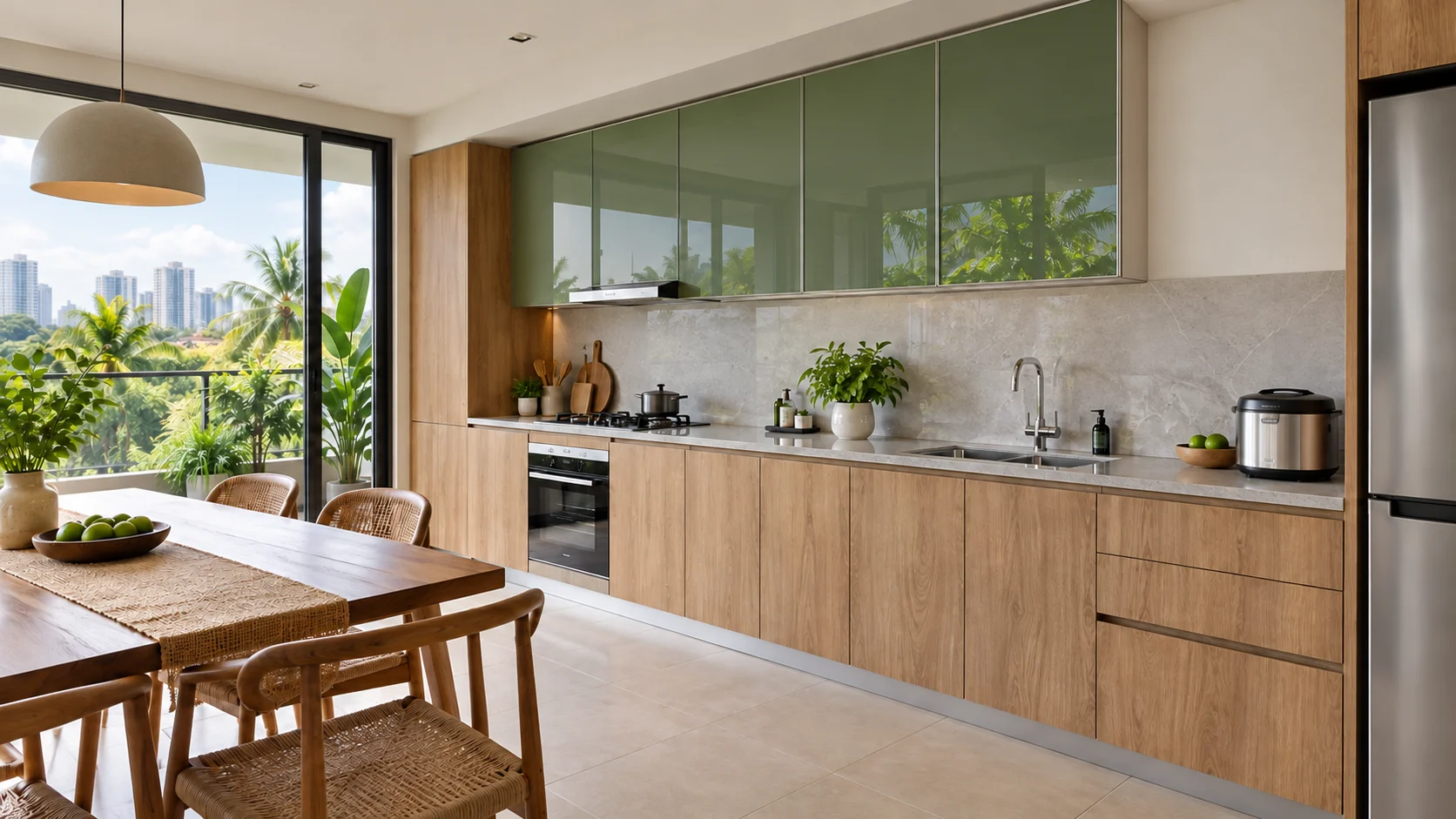
The carpenter has laid out a fan of sample chips on your dining table: a woodgrain, a matt grey, a glossy glass panel in sage, and a smooth painted white. They all look good under the showroom lights. What nobody has said yet is which one will still look good after five years of rice cooker steam, wok splatter and a toddler’s toy truck.
Your cabinet door finish is the part of the kitchen you see and touch every day, and in Malaysia it has to cope with humidity, heat from daily cooking and constant wiping. This guide compares the four finishes you’ll meet on most quotations, melamine, laminate, 4G glass and spray paint, on price, durability and where each one belongs.

Carcass, Door Core and Finish: Three Separate Choices
A kitchen cabinet has three parts worth naming on a quotation:
- Carcass — the box: sides, base, back and shelves. It decides whether the cabinet survives a leaking sink or termites, and we cover it in our guide to kitchen cabinet materials in Malaysia.
- Door core — the board the door is cut from. It’s usually particleboard (wood chips pressed with glue), MDF (medium-density fibreboard, a smooth, dense board made from fine wood fibres) or plywood. 4G glass doors are the exception: they use an aluminium frame instead of a board.
- Surface finish — the layer you see and touch: melamine, laminate, glass or paint. It decides how the kitchen looks, how easy it is to clean and how well it takes knocks.
The core and the finish work together. A tough finish protects the board underneath, but if water or steam gets past an edge, it’s the core that swells. Particleboard and MDF both soak up moisture at an unsealed edge, which is why edge sealing comes up again and again below.
All three can be mixed. A plywood box can wear melamine doors, and an aluminium box can wear 4G glass ones. When a quotation says only “laminate kitchen cabinet”, ask what the box is made of, what the door core is and what the finish is, and get all three written down.
Cabinet Door Finishes at a Glance
| Melamine | Laminate (HPL) | 4G glass | Spray paint | |
|---|---|---|---|---|
| What it is | Resin-soaked decorative paper fused onto the board at the factory | A thicker high-pressure laminate sheet glued onto the door board | Glass facing in a slim aluminium frame, colour applied behind the glass | Several coats of hard-wearing paint sprayed onto the door, all faces sealed |
| Usual door core | Particleboard or MDF | MDF, particleboard or plywood | Aluminium frame, no board | MDF |
| Look | Solid colours and woodgrains, matt or light texture | Widest range: woodgrains, stone looks, matt, textured, anti-fingerprint | Glossy, reflective, modern | Any colour, seamless, matt to high gloss |
| Scratches and knocks | Fair; a chip can’t be patched | Good | Glass resists scratches; corners can chip on a hard knock | Fair; edges can chip |
| Heat and steam | Fair; edges can lift | Good, if the edge band holds | Good | Good |
| Cleaning | Easy | Easy | Easy to wipe, but shows every fingerprint | Easy on gloss; matt can mark |
| Repair | Replace the door | One door can be re-faced | Replace the panel | Can be resprayed |
| Relative cost | Lowest | Low to middle | Middle to high | Middle to high |
The short version: melamine is the budget choice for doors that see little action, laminate is the hard-wearing all-rounder, 4G glass suits a glossy modern look that you’re happy to wipe often, and spray paint buys you a seamless look in any colour, at a price.
Melamine: The Budget Finish
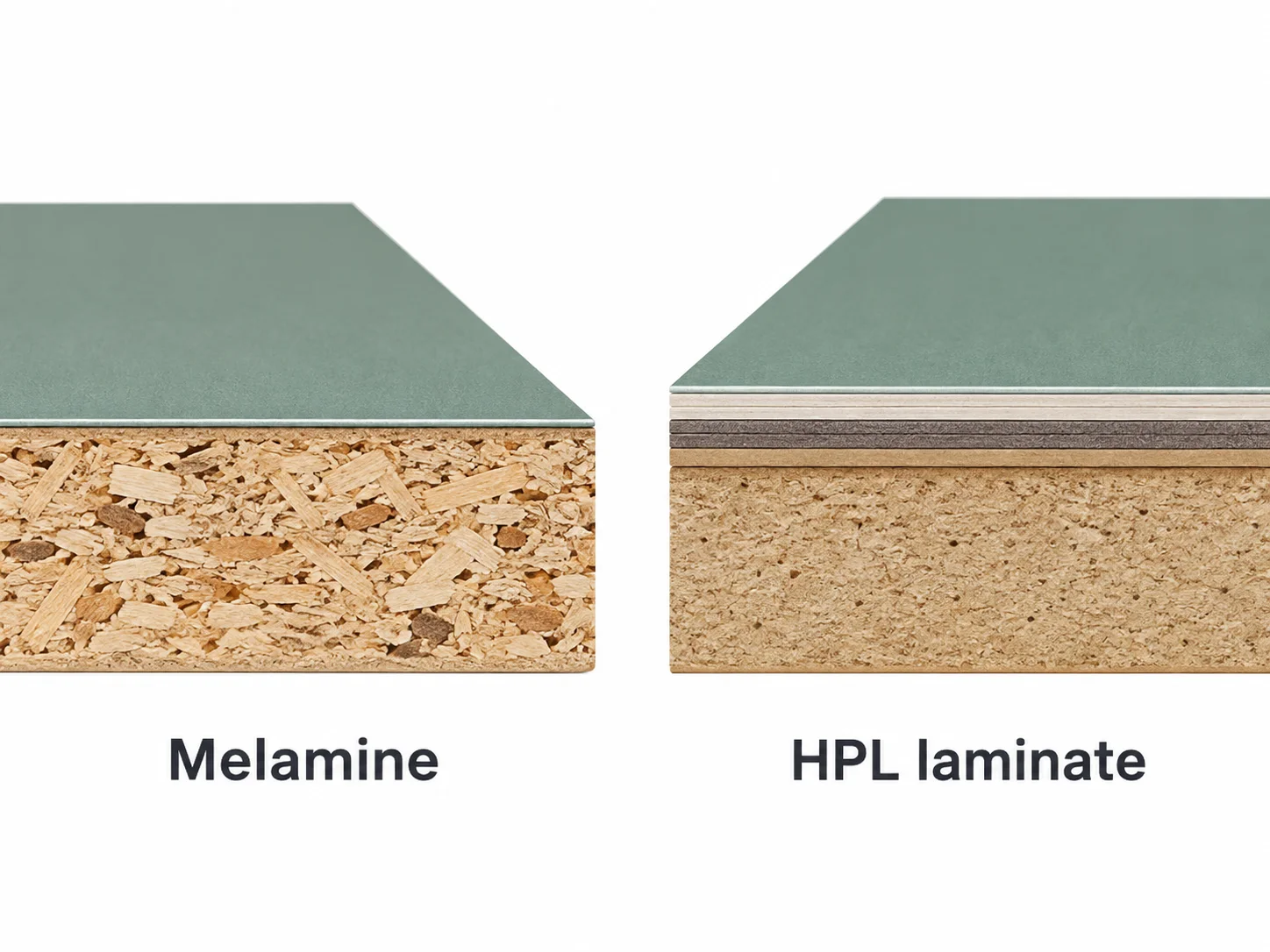
Melamine is not a separate sheet. A decorative paper soaked in melamine resin is pressed straight onto particleboard or MDF at the factory, so the board arrives at the carpenter already finished. That’s why it’s cheap: the carpenter only cuts, edges and drills.
The surface wipes clean and handles light use well. The weak points are the thin face and the edges. A hard knock can chip through the face to the board underneath, and there’s no good way to patch it, so the door gets replaced. The edges are sealed only by an edge band, and if steam or water gets behind it, the board underneath can swell.
- Use it for — wall cabinets, pantry doors, dry kitchen cabinets away from the hob and sink
- Avoid it for — the cabinet directly above the rice cooker or kettle, and doors beside the hob
- Check — that every edge is banded, including the top edge of wall cabinet doors, which you’ll never see but steam will find
Laminate: The Hard-Wearing All-Rounder
Laminate, usually called HPL (high-pressure laminate) on quotations, is a thicker sheet of layered resin papers pressed under high heat and pressure, then glued onto the door board by the carpenter. One Malaysian cabinet guide puts the wear layer at about 0.7–1.0 mm, much thicker than a melamine face. It stands up to scratches, heat and daily knocks better, and it’s the most common door finish in mid-range Malaysian kitchens.
It also gives you the widest range of looks: realistic woodgrains, stone and concrete patterns, textured surfaces and matt anti-fingerprint sheets that hide smudges well.
Two things to know:
- “Laminate” is used loosely. Some quotations say laminate when they mean melamine board. Ask directly: “Is this melamine board or HPL laminate pressed on?” The price difference is real, and so is the durability gap.
- Edges need care. Standard HPL has a dark core that shows as a thin line on cut edges. Most carpenters cover the edges with a matching edge band, so ask how the edges will be finished and look at a sample door.
4G Glass: Glossy and Easy to Wipe
4G glass is a Malaysian trade name for cabinet doors with a glass facing set in a slim aluminium frame, with the colour applied behind the glass. Sellers use 3G, 4G, 5G and 7G as product generation names, not a technical standard. Broadly, 3G doors have a visible frame around the glass, while later generations move towards slimmer or hidden frames. What each number includes varies between makers, so compare the actual door, not the label.
Glass is a good fit for Malaysian cooking in one way: oil splatter and curry stains wipe off a glass face without soaking in or staining. It doesn’t absorb moisture, and termites have nothing to eat in the door itself.
Its weaknesses are honest ones:
- Fingerprints — a glossy dark glass door shows every handprint, especially at child height
- Weight — glass doors are heavier, so the hinges need to be up to the job
- Corners — a hard knock on a corner or edge can chip the glass, and a chipped panel has to be replaced
- Look — the high-gloss finish suits modern kitchens; it can feel cold in a warm, timber-toned home
Ask whether the glass is toughened, what the colour backing is made of, and what frame profile you’re getting. A sample door in your hand tells you more than a brochure photo.
Spray Paint: Seamless, Any Colour
Spray-painted doors are usually MDF, cut and shaped first, then sprayed with several coats of a hard-wearing two-part or polyurethane paint in a spray booth. These cure much harder than ordinary wall paint; quotations often shorten them to “2K” or “PU”. Because every face is painted, including the edges, there’s no edge band to lift. You get a smooth, seamless finish in almost any colour, which is why it’s popular for handleless kitchens with a routed finger groove and for exact colour matches, such as a sage green taken from a paint chart.
The trade-offs:
- Edge chips — painted edges and corners can chip under knocks from pots or a vacuum cleaner
- Touch-ups — a small chip can be touched up, but matching the sheen is hard; a full respray is the clean fix
- Colour shift — one Malaysian guide notes that white painted finishes can drift towards cream under strong sun, so think twice about bright white doors beside a west-facing window
- Time and cost — spraying and curing usually takes longer than fitting laminate, and it costs more
Cabinet Door Finish Prices in Malaysia
Malaysian carpenters rarely price a door on its own. They quote the whole cabinet per foot run (the length along the wall), and the door finish is one of several things that move that rate.
The only published Malaysian rates we found that list these finishes side by side come from one Klang Valley estimate. Each rate covers a foot run of cabinet with its carcass, doors and basic hardware, installed, with the countertop excluded. The source doesn’t say whether a rate is for base cabinets, wall cabinets or a combined run, or which hinges and drawer runners “basic hardware” means.
| Door finish | Carcass stated by the source | Rate per foot run (carcass, doors, basic hardware, installed) |
|---|---|---|
| Melamine | Particleboard or MDF | RM180 – RM300 |
| Laminate (HPL) | MDF or plywood | RM280 – RM420 |
| Spray paint (priced together with acrylic) | Not stated | RM380 – RM600 |
| 4G glass | — | No comparable published rate found |
Read these as a rough ranking, not a budget. Each row assumes a different carcass, and the cabinet layout behind each figure isn’t stated, so the gap between two rows is not the cost of the door finish alone. For 4G glass, ask your carpenter to price the same cabinet run with 4G doors as a separate line, so you can compare it directly with a laminate or spray paint option.
How the carcass and the workshop change the figure
The same estimate shows the carcass moving the price as much as the door: laminate doors on a moisture-resistant plywood carcass are listed at RM350 – RM600 per foot run, against RM280 – RM420 for laminate on MDF or standard plywood.
Workshops also differ widely. Another Malaysian guide puts basic laminate at RM250 – RM450 per linear foot and groups acrylic, lacquer and wood veneer as premium finishes at RM700 – RM1,200 or more, roughly double the spray paint figure above. It doesn’t say what cabinet configuration those rates cover either.
Prices are for reference only, as of October 2026, drawn from published Malaysian cabinet maker estimates. Carcass, door core, cabinet height, hardware, layout and your carpenter’s location all change the final figure. Get at least two itemised quotes that price the same cabinet run with each finish you’re considering.
Also on the quote: acrylic
Acrylic doors are a glossy sheet of acrylic bonded to a board. They look similar to glass from across the room and cost less than many glass options. They’re lighter than glass and don’t shatter, but they show fine swirl marks over time and can only be polished, not refinished. If a quote offers “high-gloss doors”, ask whether that means acrylic, glass or gloss spray paint.
Choosing a Cabinet Door Finish in Malaysia, Zone by Zone
You don’t need one finish for the whole kitchen. Many Malaysian kitchens mix two, spending where the doors work hardest and saving where they’re mostly looked at.
| Area | What it faces | Sensible finish |
|---|---|---|
| Wet kitchen base cabinets | Splashes, mopping, kicks, heat from the wok | Laminate or 4G glass |
| Cabinet above the rice cooker or kettle | Daily steam on the bottom and top edges | Laminate with sealed edges, or glass |
| Doors beside the hob or oven | Heat and oil splatter | Laminate or glass |
| Dry kitchen and island | Light use, on show to guests | Laminate, spray paint or glass, by taste |
| Wall cabinets away from steam | Little wear | Melamine or laminate |
| Pantry and storeroom doors | Light use, often out of sight | Melamine |
A common, sensible split: hard-wearing woodgrain laminate in the wet kitchen, a feature finish such as spray paint or glass on the dry kitchen and island, and melamine inside the pantry. If you’re still deciding how to divide the two zones, see open kitchen vs closed kitchen in Malaysia.
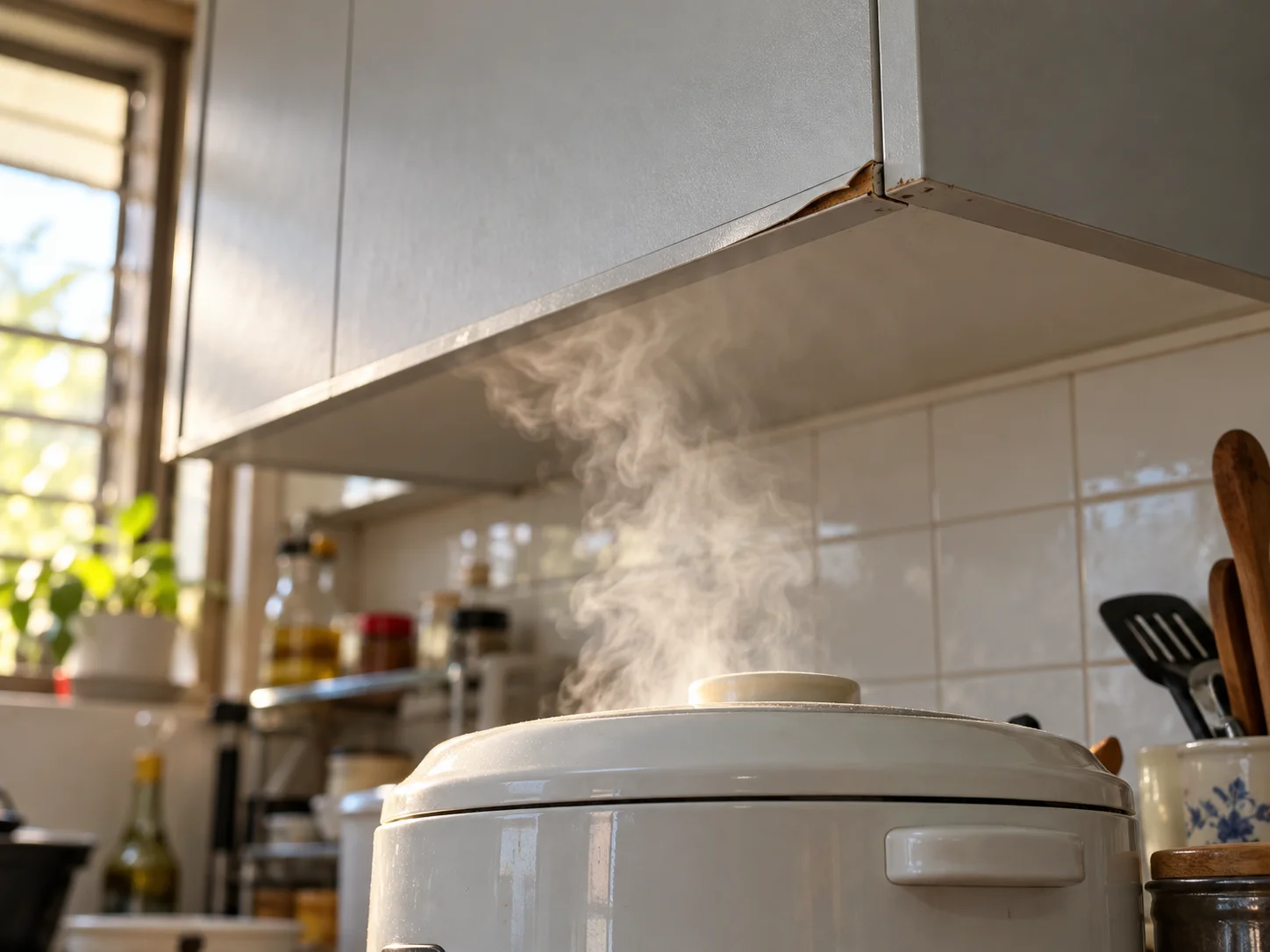
The rice cooker point deserves its own line. In a Malaysian kitchen, the cabinet above the rice cooker takes steam every day for years. Edge bands fixed with ordinary hot-melt glue can soften in heat and humidity and let moisture in. Either move the rice cooker out from under the wall cabinet or make sure that door’s edges are sealed well.
Condo vs Landed: Does It Change the Finish?
- Condo with an open kitchen — The doors are part of the living room view, so finish matters more. A matt anti-fingerprint laminate or spray paint keeps a cleaner look than high-gloss glass under living room lights. Ask for the doors to be sprayed in the carpenter’s workshop rather than on site, so paint fumes and overspray stay out of your unit and the shared corridors your building management looks after.
- Landed home with a separate wet kitchen — The wet kitchen does the heavy cooking, so durable laminate or glass belongs there. Save the feature finish for the dry kitchen.
- Homes with young children — Glossy glass and gloss spray paint show every handprint at toddler height. A textured or matt laminate hides them better on the lower doors.
For Carpenters and Renovators: Where Door Finishes Fail
- Unbanded top edges — the top edge of a wall cabinet door isn’t seen at handover, but steam reaches it. Band every edge.
- Ordinary hot-melt edge glue near steam — standard EVA hot-melt glue can soften again in Malaysian heat and humidity. PUR glue cures with moisture and doesn’t re-soften once set, so it’s worth the extra cost on doors near the hob and rice cooker.
- Glass doors on too few hinges — choose the hinge type and the number of hinges to suit each door’s height, width and weight. Tall or heavy glass doors usually need an extra hinge, or they start to sag.
- Spray finishes scuffed in transit — wrap and protect painted doors until the final fix; chips on delivery are a common callback.
- Finish names on the quote — write “melamine board” or “HPL laminate”, not just “laminate”, so there’s no argument later about what was promised.
Questions to Ask Before You Choose a Door Finish
- Is the door finish written separately from the carcass material on the quotation?
- What is the door core made of: particleboard, MDF or plywood?
- Is it melamine board or HPL laminate pressed onto the door?
- How are the door edges finished, and are the top edges banded too?
- For 4G glass: is the glass toughened, what is the colour backing, and is the frame visible?
- For spray paint: what type of paint, how many coats, and is it sprayed in a workshop?
- Can I see and handle a sample door in the actual finish, not just a chip?
- Do the number and type of hinges suit each door’s size and weight, and are they soft-close?
- What does the warranty cover: peeling, edge lifting, chipping or colour change?
- Is there a separate price for the door above the rice cooker and beside the hob if they need a tougher finish?
Lay these answers side by side across two or three quotes using our guide to comparing renovation quotations in Malaysia. For the rest of the kitchen, from layout to countertop, start with our complete kitchen renovation guide.
Pick the finish for the job each door does, not for how it looks on the sample board. Five years on, the doors you open twenty times a day should still close on a clean, unchipped edge.