 rumaruma
Fluted Panels in Malaysia: WPC vs PVC vs PS vs Solid Wood — Which Suits Your Home?
What WPC, PVC, PS and solid wood fluted panels cost in Malaysia, how each copes with humidity and termites, and which one suits your wall.
On this page
- What a Fluted Panel Is, and Why Everyone Wants One
- The Four Main Fluted Panel Materials in Malaysia
- Fluted Panel Comparison: WPC vs PVC vs PS vs Solid Wood
- Fluted Panel Prices in Malaysia (October 2026)
- What About Aluminium and MDF Fluted Panels?
- How Malaysian Humidity Affects Your Choice
- Condo Rules and Installation Basics
- Which Fluted Panel Should You Choose?
- For Carpenters and Renovators
- Before You Sign the Fluted Panel Quotation
You’ve saved a dozen photos of ribbed TV walls and slatted headboards, and your ID has now sent three quotations that all say “fluted panel” but differ by a factor of five. One says WPC, one says PVC, one just says “feature wall, fluted design”. They look almost the same in the render. They won’t perform the same in your living room.
A fluted panel in Malaysia can be made of plastic, a wood-plastic blend, or real timber, with solid, hollow or foamed profiles depending on the product. Its performance depends on the material, finish, installation and condition of the wall behind it. This guide compares four options you may be offered, with prices, practical weaknesses and the specifications to check before choosing.
What a Fluted Panel Is, and Why Everyone Wants One
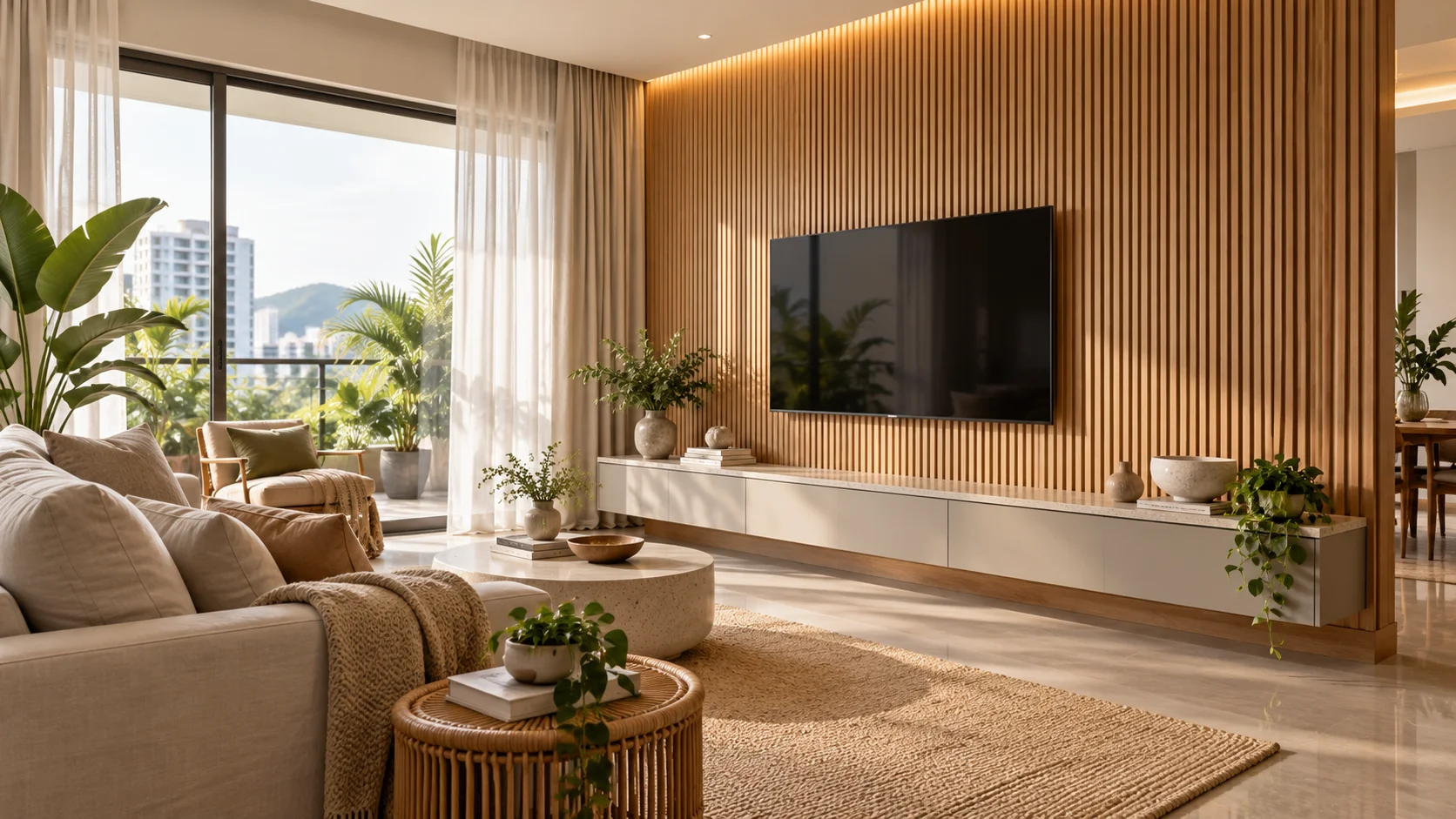
A fluted panel is a wall cladding with vertical grooves (flutes) or raised ribs running along its length. The grooves catch light and throw thin shadow lines, so a plain wall gets depth and rhythm without any decoration. That’s why it’s become the default upgrade for TV walls, headboards, foyer walls and kitchen island fronts.
It also hides things. Slightly wavy plaster, a patched hacking scar, or a cable chase behind the TV disappears behind a row of flutes. That practical side is a big part of why contractors suggest it.
The catch is that “fluted” describes the shape, not the material. Suppliers sell the same profile in very different materials, and the product names don’t always tell you which one you’re getting.
The Four Main Fluted Panel Materials in Malaysia
WPC (Wood-Plastic Composite)
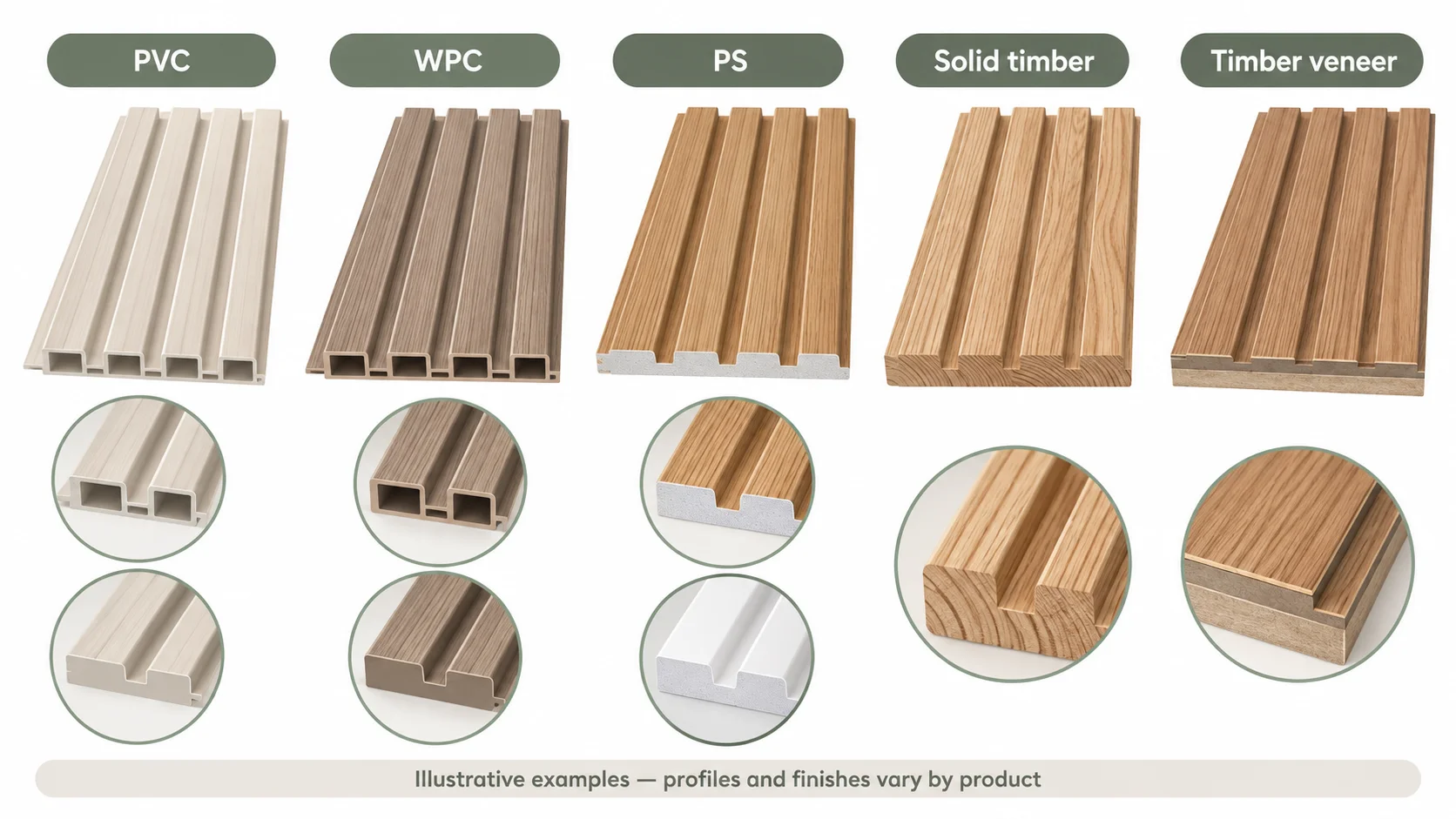
WPC is a mix of wood fibre or powder and plastic, such as PVC or PE. Suppliers in Malaysia offer extruded fluted boards in various lengths, including around 2.9m, with wood-look or solid-colour finishes. Check the product specification for the composition, core and surface finish.
- Strengths — Products marketed for moisture and termite resistance can suit dry interior feature walls, and many finishes are easy to wipe down. Compare physical samples: weight and rigidity depend on the profile and formulation, not just the WPC label.
- Weaknesses — The wood-to-plastic ratio varies, and a printed finish won’t have the grain variation of real timber. Hollow and solid profiles are both available; wall thickness and construction affect dent resistance. Check the warranty for moisture, heat and surface-film damage rather than assuming WPC cannot swell or deteriorate.
- Best for — Living room and bedroom feature walls, TV walls, and dry kitchen walls away from the stove.
PVC
PVC fluted panels are available in lightweight profiles with a range of colours and finishes. Some listings say only “fluted wall panel”, so ask the supplier to confirm the material and intended application.
- Strengths — PVC does not absorb water like untreated timber, and suitable finishes are easy to wipe down. A waterproof panel does not make the installed wall waterproof: joints, edges, penetrations and the substrate still need the specified detailing. Dumaplast’s guidance, for example, distinguishes panel waterproofness from the installer’s responsibility to seal the joints.
- Weaknesses — Glossy finishes can look distinctly plastic. Heat expansion and UV resistance depend on the product, so check its temperature limits and sun-exposure restrictions. Mould can still grow on surface dirt or damp materials behind the cladding.
- Best for — Rental units and utility areas where the finish and maintenance requirements suit the room. For bathrooms, choose a system explicitly approved by its manufacturer for that use; ordinary decorative fluted panels should not be assumed suitable for shower walls.
PS (Polystyrene)
PS means polystyrene, but the label alone does not tell you the profile’s density, construction or finish. Products include finished wood-look panels as well as paintable decorative profiles. HomePro Malaysia lists a PREMO PS fluted panel with a wood-look finish, so PS should not be treated as a synonym for primed, paintable foam.
- Strengths — Lightweight products can be convenient for interior feature walls. If you want a painted finish, choose a profile explicitly sold as paintable and follow its primer and paint instructions. Factory-finished wood-look panels offer a different appearance and may not be suitable for repainting.
- Weaknesses — Impact resistance varies with density and profile; handle samples and check the manufacturer’s cutting and fixing instructions. Keep polystyrene panels away from cooking heat and check the specific product’s fire-performance documentation. Decorative cladding should not carry a TV bracket or other heavy fitting.
- Best for — Bedroom and living room feature walls, using a paintable product for a colour-matched look or a factory-finished product for a wood look.
Solid Wood and Timber Veneer
Solid timber fluting and timber-veneer panels are different products. Solid timber can be machined into fluted profiles, including custom joinery. Veneer panels have a thin timber face over a backing board and may be supplied in standard sizes or made to order. N Veneer lists fluted panels in three standard dimensions, so a veneer wall does not necessarily require a fully custom fabrication.
- Strengths — Genuine timber surfaces bring natural grain variation to a Japandi living room. Solid timber may allow sanding and refinishing, subject to the profile and finish. Veneer needs more care: confirm its thickness and permitted maintenance before sanding, which can cut through a thin face.
- Weaknesses — Timber movement and backing-board moisture resistance need attention in humid conditions. Ask about sealing, termite protection and the intended indoor environment. Custom solid timber may take longer to fabricate; standard-size veneer panels have a different lead time, depending on stock.
- Best for — A dry interior wall where natural timber is part of the design. Ask for the backing-board specification and sealed edges; moisture-resistant plywood is one option to discuss where humidity is a concern. Our dark moody dining room guide also discusses backing materials for timber feature walls.
Fluted Panel Comparison: WPC vs PVC vs PS vs Solid Wood
| WPC | PVC | PS | Solid wood / veneer | |
|---|---|---|---|---|
| Looks like | Wood-look or solid colour | Various factory finishes | Wood-look or paintable finish | Natural timber, if genuine wood-faced |
| Humidity and water | Check product rating and core | Check system’s wet-area approval and seals | Check product rating; keep substrate dry | Check backing, finish and moisture limits |
| Termites | Check manufacturer’s resistance claim | Plastic core is not timber; check backing and battens | Plastic core is not timber; check backing and battens | Check timber and backing protection |
| Direct sun and heat | Check temperature and UV limits | Check temperature and UV limits | Check temperature and UV limits | Sealing alone does not establish outdoor suitability |
| Dent resistance | Depends on profile and wall thickness | Depends on profile and wall thickness | Depends on density and profile | Depends on timber, veneer and backing |
| Can be repainted or refinished | Only if manufacturer permits | Only if manufacturer permits | Paintable versions only; check finish | Solid timber may be refinished; veneer has limits |
| Typical lead time | Check stock | Check stock | Check stock | Standard-size veneer or custom joinery; confirm lead time |
| Avoid unless specifically rated | Cooking heat, shower spray or outdoor exposure | Cooking heat, shower spray or direct sun | Cooking heat, frequent impacts or outdoor exposure | Wet areas or outdoor exposure |
Use this table to identify questions for the supplier, rather than treating each material name as a performance guarantee. The core, surface finish, backing and installation system all affect the result.
Fluted Panel Prices in Malaysia (October 2026)
The fluted panel price in Malaysia depends far more on the material and who installs it than on the profile. Here’s what the market looks like for a typical feature wall.
| Material | Supply only | Supply and install |
|---|---|---|
| PVC | About RM8–25 per sq ft | RM18–35 per sq ft |
| WPC | About RM2–5 per sq ft for marketplace boards; more for thicker, solid-core boards from suppliers | RM20–45 per sq ft |
| PS | No reliable public price; usually similar to PVC | Quoted per job |
| Solid wood / timber veneer | Veneer fluted panels from around RM75 per sq ft | Custom quote, usually several times WPC |
These prices are for reference only, as of October 2026. Your final price depends on panel thickness, solid versus hollow core, finish, the number of corners and cut-outs, wall height, your location and whether trims and lighting are included.
A few things push the installed price up that the per-sq ft rate won’t show:
- Trims and end caps — L-profiles and end caps are sold separately and add up quickly on a wall with several edges.
- Small walls — A single 8ft-wide TV wall often costs more per sq ft than a full room, because the installer’s minimum charge is spread over less area.
- Battens and levelling — Uneven walls need a timber or aluminium frame before panels go up, which adds labour and material.
- Cut-outs — Every power point, TV bracket and switch on the wall needs a clean cut.
- LED strips — A recessed light strip in the flutes or at the edge adds an electrician’s charge and a driver to hide somewhere.
Marketplace boards look cheap, but check the thickness and whether the core is solid before comparing them with a supplier’s installed price. For more on the line items that surprise people at the end of a job, see hidden renovation costs in Malaysia.
What About Aluminium and MDF Fluted Panels?
These two come up less often in homes, but you may still see them on a quotation.
- Aluminium — Extruded aluminium profiles are available with powder-coat or wood-look finishes. The metal does not absorb water like timber, but coatings, fixings, joints and backing still determine the system’s suitability. For a balcony, covered porch or wet area, ask for an explicitly rated product. Do not infer the complete assembly’s fire performance from the metal alone; check its documentation and get a project-specific quote.
- MDF — Some carpenters CNC-cut flutes into MDF board and spray-paint it as part of the built-ins. It’s affordable and gives a crisp painted finish, but standard MDF swells when it absorbs moisture. If your carpenter suggests it, ask for moisture-resistant board, and keep it out of kitchens, bathrooms and any wall that’s ever been damp.
How Malaysian Humidity Affects Your Choice
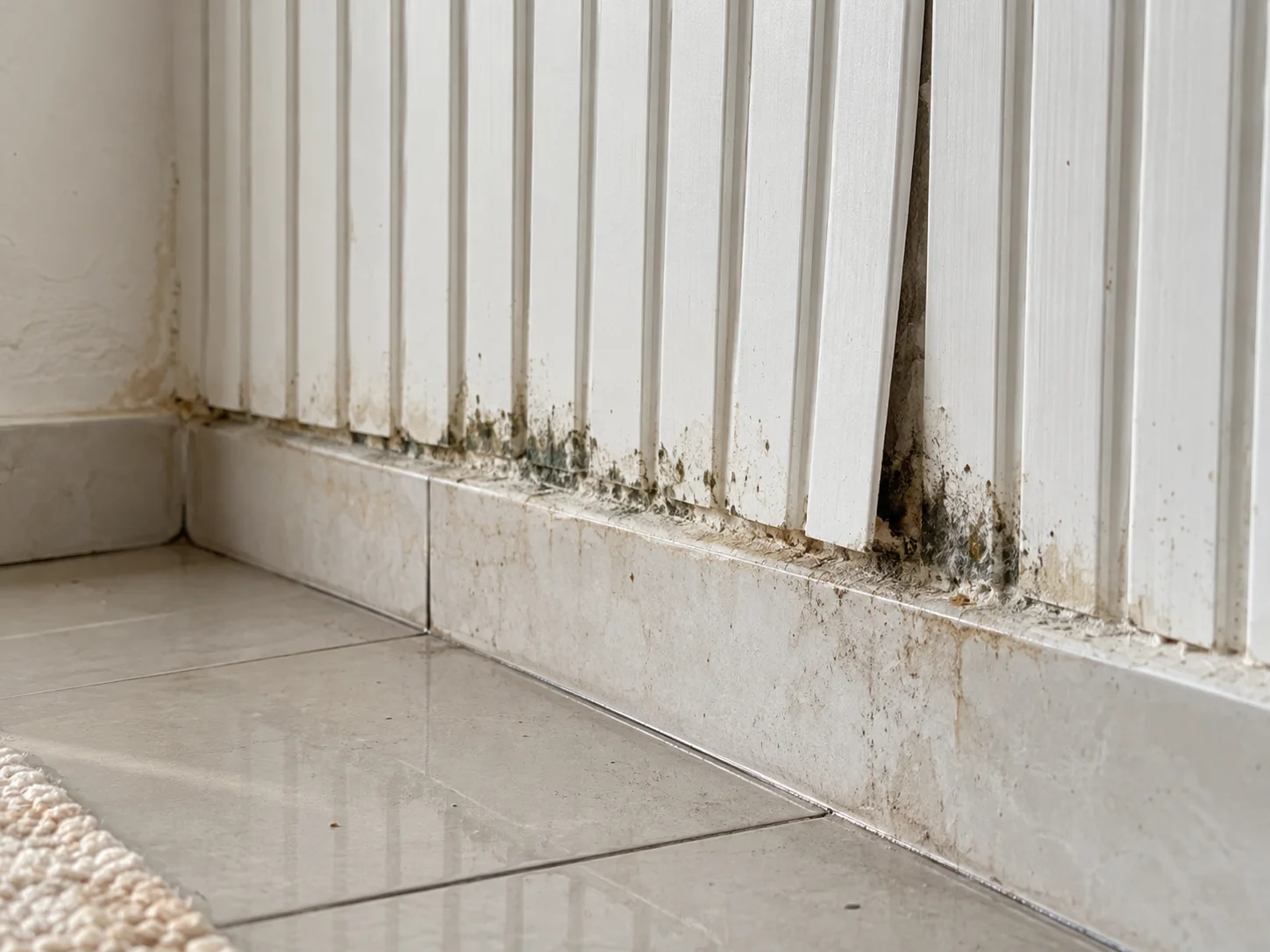
Humidity can affect timber, backing boards and adhesives as well as the wall behind the panels. Cladding over rising damp or a slow pipe leak can conceal the problem and restrict drying. Mould or lifting panels may only become visible after moisture has built up behind them.
Before any panel goes up, make sure:
- The wall is dry and free of seepage, especially external walls that take monsoon rain and walls shared with a bathroom.
- Any existing damp patch has been traced and fixed, not just painted over.
- There’s a small gap and a skirting or trim at the floor so mopping water doesn’t wick behind the panels.
Cleaning is the other daily-life point. Flutes collect dust, and in a home with the windows open to traffic or construction dust, the grooves turn grey faster than a flat wall. A soft brush attachment on the vacuum every couple of weeks keeps them clean, and wider, shallower flutes are easier to clean than narrow, deep ones.
Condo Rules and Installation Basics
Before installing cladding in a condo, confirm the approval process with your joint management body (JMB) or management corporation (MC). Under Third Schedule by-law 27(1) of the Strata Management (Maintenance and Management) Regulations 2015, renovation works require prior written management approval and, where necessary, approval from the appropriate authority. These regulations apply in Peninsular Malaysia and Labuan; check the applicable rules locally for Sabah and Sarawak. Do not assume a decorative or non-structural wall installation is exempt. Ask about the renovation form, permitted drilling hours and any deposit before booking the installer.
There are two common installation methods:
- Glued direct to the wall — An option for products whose instructions permit it, using a compatible adhesive on a flat, dry substrate. Removing glued panels can damage the plaster.
- Clipped or screwed onto battens — A compatible batten system can accommodate uneven walls and leave space for cables. Check the panel’s fixing instructions, batten spacing and how the trims are secured; battens alone do not guarantee that individual panels can be removed for repairs.
If you expect to change the look later, ask the installer to explain how the proposed system can be dismantled and what damage removal may leave behind.
Which Fluted Panel Should You Choose?
Start with the room, then the budget.
- TV or living room feature wall — Compare WPC and finished PS or PVC samples for the appearance you want. Solid timber or genuine timber veneer suits a wall where natural grain is a priority.
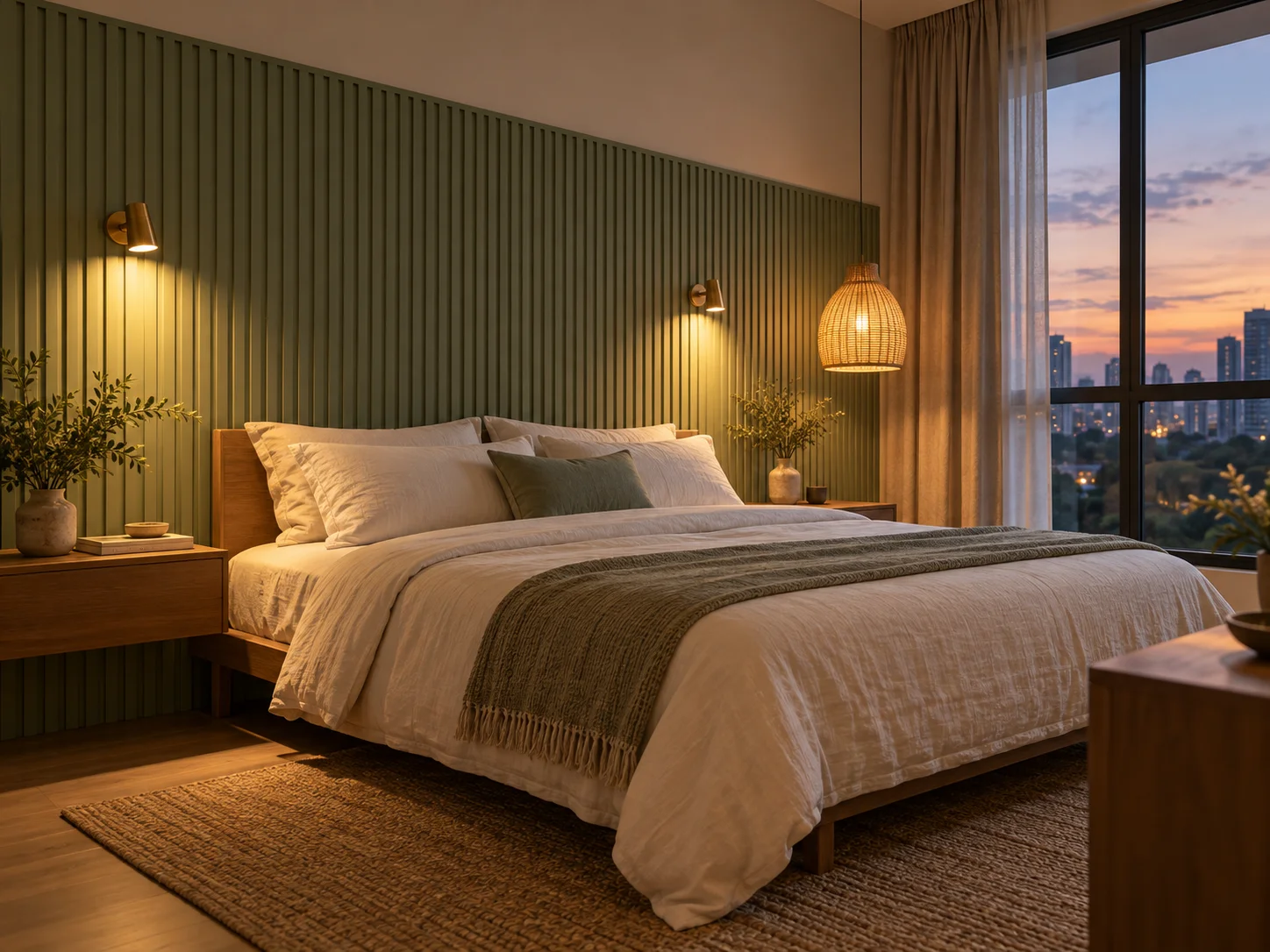
- Bedroom headboard wall — A PS profile explicitly sold as paintable if you want a colour-matched finish. WPC or finished PS can offer a wood look.
- Bathroom or utility area — Choose a PVC or aluminium system explicitly approved for the intended wet-area application, with the specified joint and edge detailing. Keep ordinary decorative fluted panels out of direct shower spray.
- Kitchen — WPC or PVC on walls away from the hob. Nothing combustible near the stove; a stone or tiled backsplash belongs there.
- Balcony or covered outdoor wall — An outdoor-rated aluminium or WPC system, with suitable finishes and fixings. Do not use indoor PVC or PS products outside unless the manufacturer explicitly approves the exposure.
Fluted panels also pair well with stone. A fluted wall with a sintered stone TV console or dining table gives you a ribbed texture against a smooth one, which is the kind of contrast covered in our guide to layering textures in a small condo.
For Carpenters and Renovators
Check the substrate as carefully as the panel specification. Use moisture checks appropriate to the wall material and investigate damp before installation; a single meter reading does not identify the cause of moisture. Record any required damp repairs in the quotation for external and wet-shared walls. Follow the manufacturer’s expansion-gap, adhesive and fixing requirements for the selected product. For timber veneer, confirm the backing-board grade and required sealing of faces, backs and edges. Secure TV brackets and other heavy fittings to a suitable wall or designed support, rather than relying on decorative cladding.
Before You Sign the Fluted Panel Quotation
- The quotation names the material (WPC, PVC, PS, timber veneer or solid wood), not just “fluted panel”
- It states the panel thickness and whether the core is solid or hollow
- You’ve seen and handled a physical sample, not only a photo
- Trims, end caps and corner pieces are included and itemised
- The installation method (glue or battens) is written down
- Cut-outs for power points, switches and the TV bracket are included
- The wall has been checked for damp, and who fixes it if damp is found
- LED strip, driver and electrician’s work are priced separately if you want lighting
- Your condo’s JMB or MC approval process has been confirmed, required written approval obtained, and working hours checked
- The supplier has confirmed suitability for any wet-area, direct-sun or outdoor exposure
- There’s a warranty on both the panel and the installation, in writing
Done well, a fluted wall is the kind of detail you notice every evening: the TV switched off, a warm strip light grazing the ribs, and a living room that feels finished rather than furnished. Get the material and the wall behind it right, and it’ll still look that way long after the trend has moved on.