Our Location
304 North Cardinal St.
Dorchester Center, MA 02124

A full design breakdown of the dark moody dining room — deep tones, dramatic lighting, and humidity-resistant materials for Malaysian homes.
A full design breakdown of the dark moody dining room — deep tones, dramatic lighting, and humidity-resistant materials for Malaysian homes.
Most Malaysian dining rooms tell the same story. A basic timber table, four matching chairs, a recessed panel LED on the ceiling, and walls that are some variation of white or cream. It functions — but the dining room ends up being the most overlooked room in the home, the one that gets the least design attention and delivers the least atmosphere.
Dark moody changes that. Instead of defaulting to bright and airy — the standard setting of most Malaysian interiors — dark moody dining rooms lean into deep tones, controlled light, and layered texture to create a space that genuinely feels worth eating in. Not a backdrop for food. The destination.
The fear most Malaysian homeowners have about going dark is understandable: what if it shrinks the room, what if it feels oppressive, what if the artificial lighting makes it worse rather than better? This article addresses all of it — the wall finishes, the materials, the lighting approach that transforms even a windowless condo dining area, and the Malaysian-specific adaptations that separate a dark moody dining room that works from one that just feels gloomy.
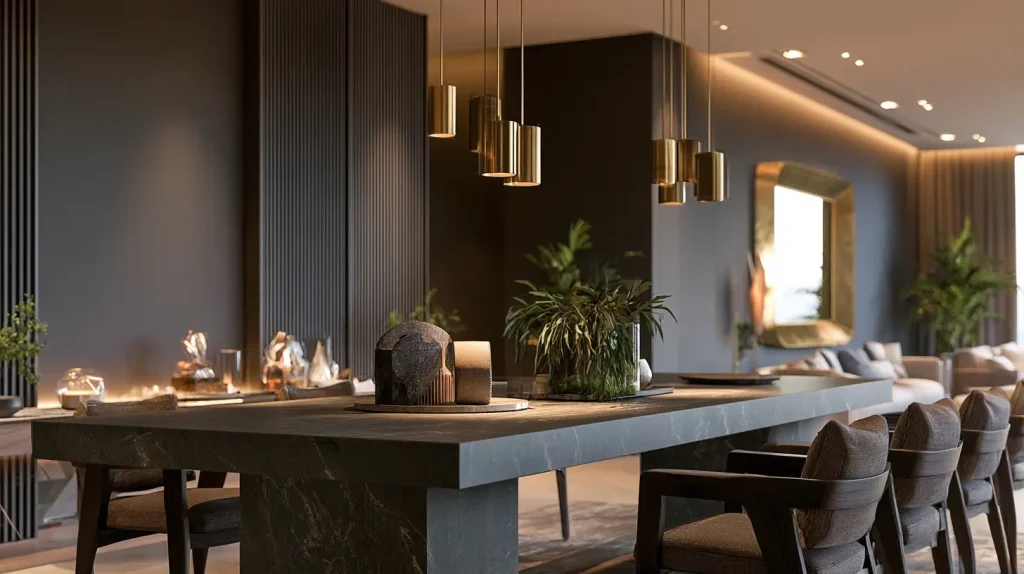
Dark moody is not a single colour. It is an approach — the deliberate layering of deep, saturated tones, warm controlled light sources, and natural textures to create a dining environment that feels intimate and considered, regardless of room size.
The design vocabulary includes near-blacks, charcoal greys, forest greens, deep navy, and oxblood reds. What these colours share is weight — they absorb light rather than scattering it, which changes the quality of the space entirely. Where a white or pale dining room disperses light evenly, a dark room concentrates it at the points where you have placed it — usually above the table, where the food and conversation actually happen. The result is the same atmospheric quality you find in high-end restaurant dining rooms, which is not a coincidence: dark moody residential design borrows directly from hospitality interiors that have been engineering dining atmosphere for decades.
For Malaysian homes specifically, this style is more practical than it first appears. Many Malaysian condo dining rooms are interior spaces — no windows, or windows facing a covered corridor — which means natural light is never part of the equation. Artificial light is the only light. That is actually an advantage in this style: you control the entire lighting environment from the start, and when you get the fixture type and bulb colour temperature right, a dark moody dining room under warm artificial light comes alive in a way that a pale, flatly lit room never can.
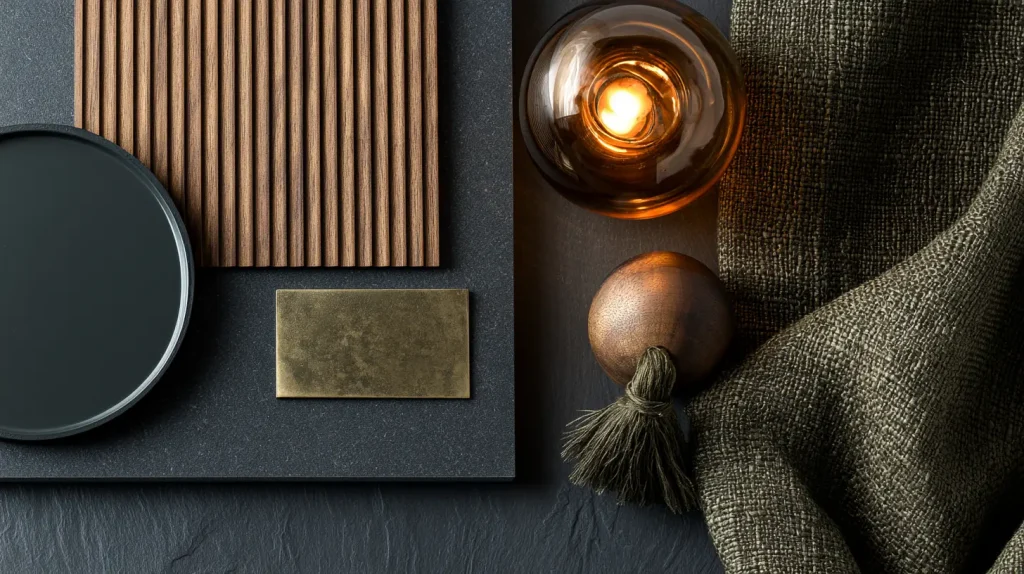
Here is what makes this look work — element by element.
The wall treatment is the room’s foundation. Everything else layers on top of it.
The most accessible route is paint — a deep charcoal, forest green, or near-black in a matte or eggshell finish. Nippon Paint’s Momento series includes textured finishes in deep tones that add dimension beyond flat paint: the slight surface relief creates subtle shadow play under directional light that standard emulsion cannot replicate. For forest greens, Nippon Paint’s Botanica range and Dulux’s Midnight Forest are strong local options available at any major hardware store. For charcoal and near-black, Nippon Paint’s Graphite and Obsidian offer the depth needed without the flat, one-dimensional read of a basic black.
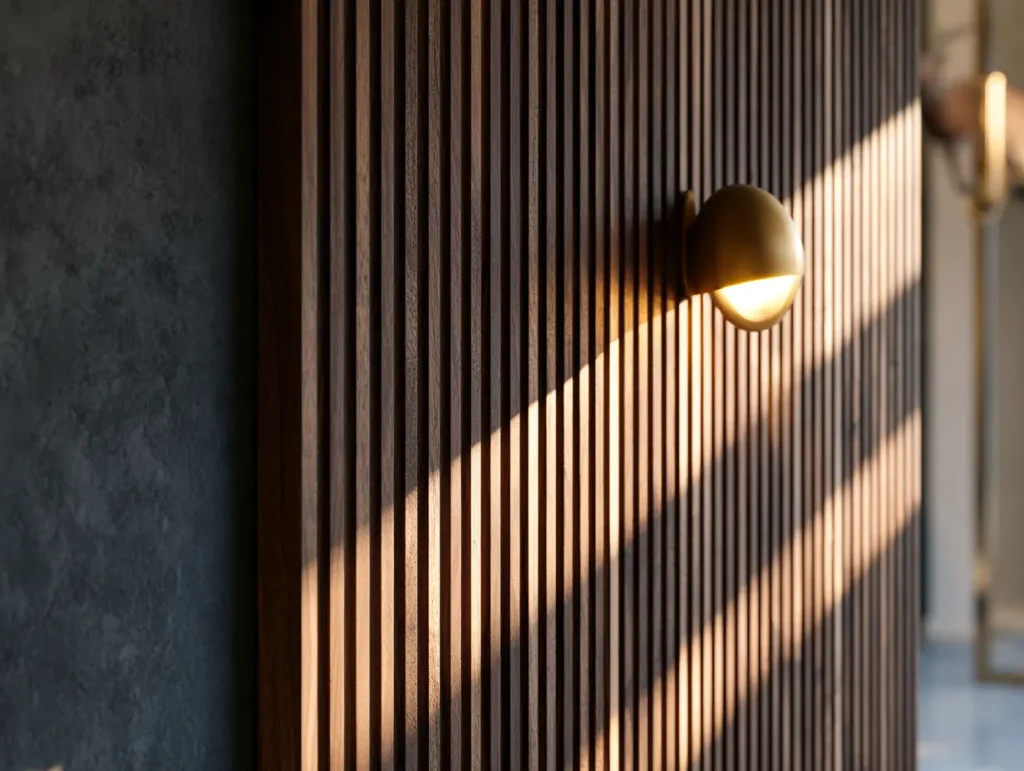
Beyond paint, two feature wall treatments work especially well in moody dining rooms:
In a standard Malaysian condo dining area with a 2.7–3m ceiling, limit the dark treatment to one feature wall behind the sideboard or console, or wrap the full room if ceiling heights are above 3m. Going full-room dark in a low-ceiling space works — but only if the lighting is right.
If the wall sets the tone, the dining table is the centrepiece the room organises around.
A sintered stone table top in a deep-toned finish — charcoal, dark Calacatta Nero, or a matte black with subtle veining — is the material that bridges the dark moody aesthetic with Malaysian practicality. Sinno Stone’s sintered stone slabs can be fabricated into dining table tops in standard sizes (typically 1.6m×0.9m for a 6-seater, 2.0m×0.9m for an 8-seater) with an edge profile to suit the style — a pencil edge for a refined look, a square chamfer for something more architectural.
The material performs exactly as a Malaysian dining table needs to: completely non-porous, resistant to heat from hot serving dishes, immune to staining from soy sauce, curry, or coffee, and requiring zero sealing in Malaysia’s year-round humidity. In a household that actually uses the dining table daily — not just for guests — these properties matter more than any aesthetic consideration.
The contrast between a deep matte stone surface and the surrounding dark wall tones is subtle but important. Sintered stone has a quiet surface reflectivity under pendant light that differs from a painted wall — it gives the table its own presence in the room without competing with the overall dark palette. Avoid high-gloss table finishes in a moody dining room. Gloss reads as cool and clinical — the opposite of the warmth this style is after. Matte or honed is always the right specification here.
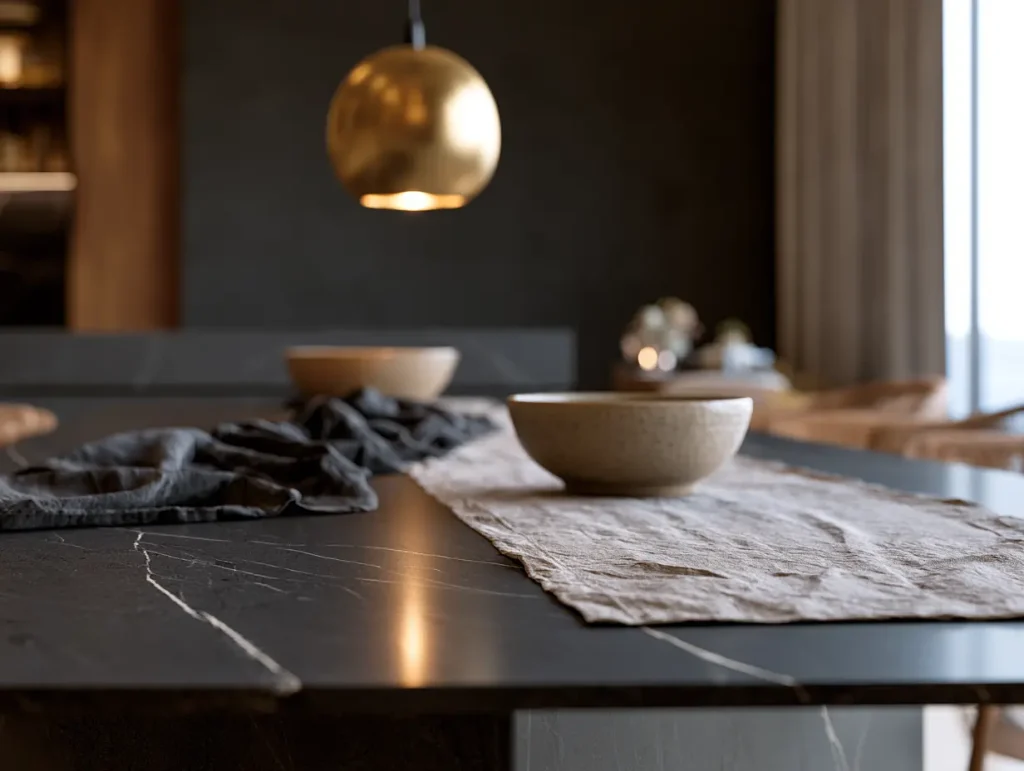
This is where Malaysian dark moody dining rooms succeed or fail — and where most homeowners make the mistake that undoes everything else.
The single most common error is a recessed downlight directly above the table, or a panel LED on the ceiling. Both produce flat, overhead illumination that washes out the room’s depth and makes food look cold and unappetising. In a dark room, flat overhead light defeats the entire purpose. You have gone to the effort of creating a dramatic, intimate atmosphere — and then flooded it with the same light you would use in a carpark.
The approach that works: a pendant light or cluster of pendants hung 70–85cm above the table surface. This brings the light source down to human field of view, creating a warm pool of illumination over the table while leaving the deeper tones of the walls and ceiling in intentional shadow. The table is lit. The room breathes around it.
Bulb colour temperature is non-negotiable. Use warm white LEDs at 2,700K–3,000K only. Anything cooler — 4,000K neutral white, or 6,500K cool daylight — will turn a warm moody dining room into a clinical, unpleasant space. Most bulbs available at Mr. DIY and electrical supply shops carry the colour temperature rating on the packaging. Check before you buy, and replace every existing bulb in the space when you repaint — one 6,500K holdover bulb ruins the entire atmosphere.
Pendant options available locally: brass or aged-bronze shades from IKEA and Shopee local homeware sellers, rattan globe pendants from local craft shops and Lazada, and smoked or amber glass pendants from specialist lighting shops in KL concentrated along Jalan Ipoh and Klang Lama. Budget RM 80–600 per pendant depending on material and scale.
To layer the lighting further — which always reads better in a moody space — add a floor lamp or wall sconce at the dining room perimeter to introduce secondary ambient light at eye level. This eliminates the hard visual cut between the lit table zone and the dark walls beyond it, creating depth rather than contrast.
The dark moody dining room palette operates across four tones:
Avoid introducing bright accent colours into a moody dining room. Vivid cushions, a patterned rug in light tones, or curtains that fight the palette will undercut the atmosphere immediately. If you want warmth, layer in more texture — a second timber element, woven placemats, a ceramic bowl — not more colour.
The most common objection to dark dining rooms in Malaysian homes is that they will feel smaller. The layout fix is a well-positioned mirror — but placement is everything.
Position a full-height or oversized mirror on the wall directly opposite the pendant light. This reflects the pendant’s warm illumination back into the room, doubling the apparent depth of the space and giving the light somewhere to travel rather than dissipating straight down into the floor. In a standard Malaysian dining room footprint of 10×12 ft, a mirror spanning 60–70% of the opposite wall makes the room read significantly larger than its actual dimensions.
Frame the mirror in brass, dark timber, or aged bronze to keep it within the palette. A chrome or bright-silver frame reads as a foreign element in a warm dark moody space — the cool metallic pulls the eye out of the mood rather than deepening it.
Dark paint colours reveal water damage and mildew far more visibly than pale ones — the contrast between a near-black wall and any moisture staining, efflorescence, or mould trace is immediately apparent. In Malaysia’s year-round ambient humidity of 70–90%, paint selection is critical.
Use only high-quality interior paint with moisture resistance: Nippon Paint’s Odour-less Easywash or Dulux’s EasyCare Washable in your chosen dark tone. Both offer washable, scrubbable finishes that resist moisture-related staining. For dining areas with limited ventilation or no windows, pair the right paint with a portable dehumidifier — this is more effective than any paint specification alone in controlling the moisture that causes long-term surface degradation.
For fluted timber feature walls, specify only moisture-resistant plywood backing with sealed timber veneer. MDF backing swells at panel joints in high-humidity conditions — a common failure mode in Malaysian feature walls that is entirely avoidable with the correct substrate.
A dark moody dining room makeover — repainting walls, replacing the ceiling light with a pendant, adding a new dining table and chairs, and mounting a mirror — does not require JMB approval. These are non-structural, non-wet changes that fall entirely within homeowner discretion.
If your renovation includes a feature wall built from lightweight steel framing and plasterboard (common for fluted panel installations), most JMBs classify this as minor internal works and do not require a formal application — but check your building’s house rules directly, as some buildings in Kuala Lumpur require written notification for any wall construction regardless of whether it is structural.
Wet works in the dining area — such as hacking and retiling the floor — do require a JMB renovation application, refundable deposit, and restricted working hours. For full timelines and what to expect from the JMB approval and renovation process, our guide on how long home renovation takes in Malaysia covers this in detail.
| Element | Local Source | Estimated Cost |
|---|---|---|
| Dark matte wall paint (Charcoal / Forest Green / Near-Black) | Nippon Paint, Dulux stockists | RM 80–150 per 5L tin |
| Nippon Paint Momento textured finish (dark tones) | Nippon Paint authorised applicators | RM 6–12 per sq ft applied |
| Sintered stone dining table top | Sinno Stone | RM 1,200–3,500 depending on size and edge profile |
| Fluted timber feature wall panels | Local joinery workshops, carpentry contractors | RM 120–250 per sq ft installed |
| Brass / aged-bronze pendant lights | IKEA, Shopee local sellers, KL lighting shops (Jalan Ipoh, Klang Lama) | RM 80–600 per pendant |
| Rattan globe pendant | Mr. DIY, local craft shops, Lazada | RM 80–200 |
| Full-height framed mirror | IKEA, Shopee, local homeware shops | RM 150–800 |
| Dark timber dining chairs | Local furniture shops, IKEA, Shopee local sellers | RM 200–600 per chair |
Prices above are indicative estimates for reference only. Actual costs will vary depending on your interior designer, contractor, material choices, and project scope.
For a standard Malaysian condo dining area:
| Scope | Budget Range |
|---|---|
| Cosmetic refresh only (paint walls + new pendant + accessories) | RM 800–2,500 |
| Mid-range (feature wall + stone table top + pendant + mirror + chairs) | RM 6,000–15,000 |
| Full renovation (all of the above + floor retile + custom joinery sideboard) | RM 20,000–40,000 |
Prices above are indicative estimates for reference only. Actual costs will vary depending on your interior designer, contractor, material choices, and project scope.
For a full breakdown of where dining room and whole-home renovation costs go in Malaysia, see our 2026 renovation cost guide.
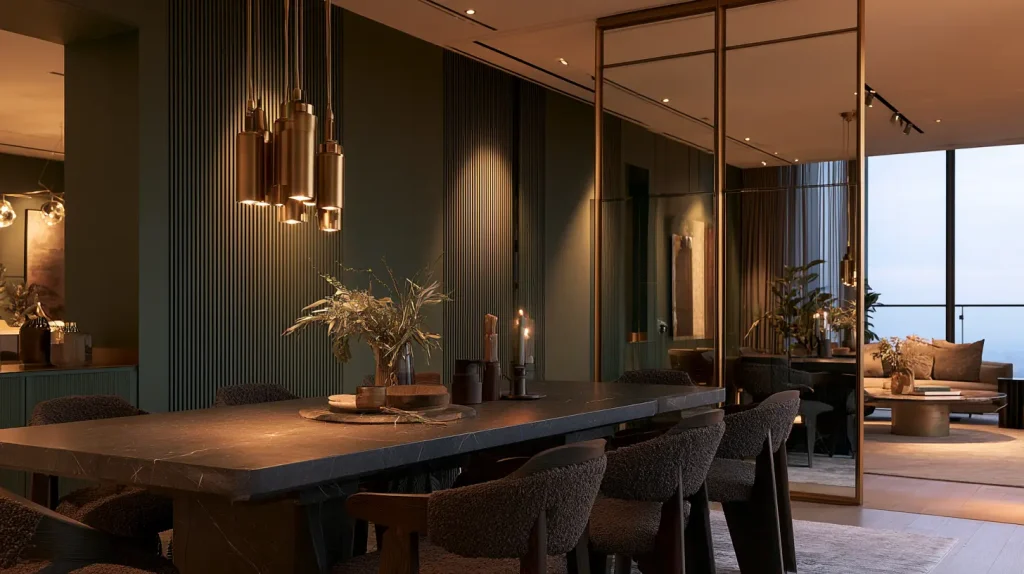
Most Malaysian dining rooms are functional afterthoughts — positioned between the kitchen and the living room, doing a job, adding nothing to the experience of being at home.
Dark moody design fixes that by giving the dining room a character of its own. Deep tones and controlled warm light change how long people linger at the table, how food looks when it arrives, and how the room feels at 8pm on a weekday versus at midday on a Sunday. The atmosphere is not incidental — it is the point. And it is created entirely through material and lighting choices that are well within reach for Malaysian homeowners at most budget levels.
The practical objections — humidity concerns, limited natural light, compact room footprints — are all solvable. A Malaysian condo dining room with no windows is, in fact, one of the best possible canvases for this style: no natural light to compete with, and full control over every lumen in the space. Rumaruma is built for homeowners who want to make design decisions grounded in how local homes actually work — not borrowed from interiors that face completely different climate and construction realities. This breakdown is where to start.
Pick one wall, choose a deep tone from the Nippon Paint Momento range, and see how completely the dining room transforms around it.
