Our Location
304 North Cardinal St.
Dorchester Center, MA 02124

The quotation you signed isn't the final bill — here's every hidden renovation cost Malaysian homeowners forget to budget for.
The quotation you signed isn’t the final bill — here’s every hidden renovation cost Malaysian homeowners forget to budget for.
You got three quotations, picked the one that fit your budget, and felt good about the number. Then the invoices started coming — a JMB deposit here, a “minor” variation order there, an unexpected RM3,000 to fix pipework nobody knew was rotted through. By the time the dust settled, you’d spent 20–30% more than the figure on that first quotation.
This is one of the most common — and most avoidable — sources of renovation stress in Malaysia. Hidden renovation costs aren’t usually hidden out of bad faith; they’re the parts of a project that are genuinely hard to price until the contractor opens up your walls or floor. This guide walks through exactly where these costs come from, roughly how much to set aside for each, and how to protect your budget before you sign anything.

Most renovation quotations are priced on what’s visible and assumed — not on what’s actually behind your walls, floor, and ceiling. The gap between the two is where hidden renovation costs come from most often.
Older landed homes and pre-2010 condo units are the biggest risk here. Once hacking work starts, contractors regularly find termite-damaged timber, cracked screed, or uneven flooring that needs levelling before new tiles can go down.
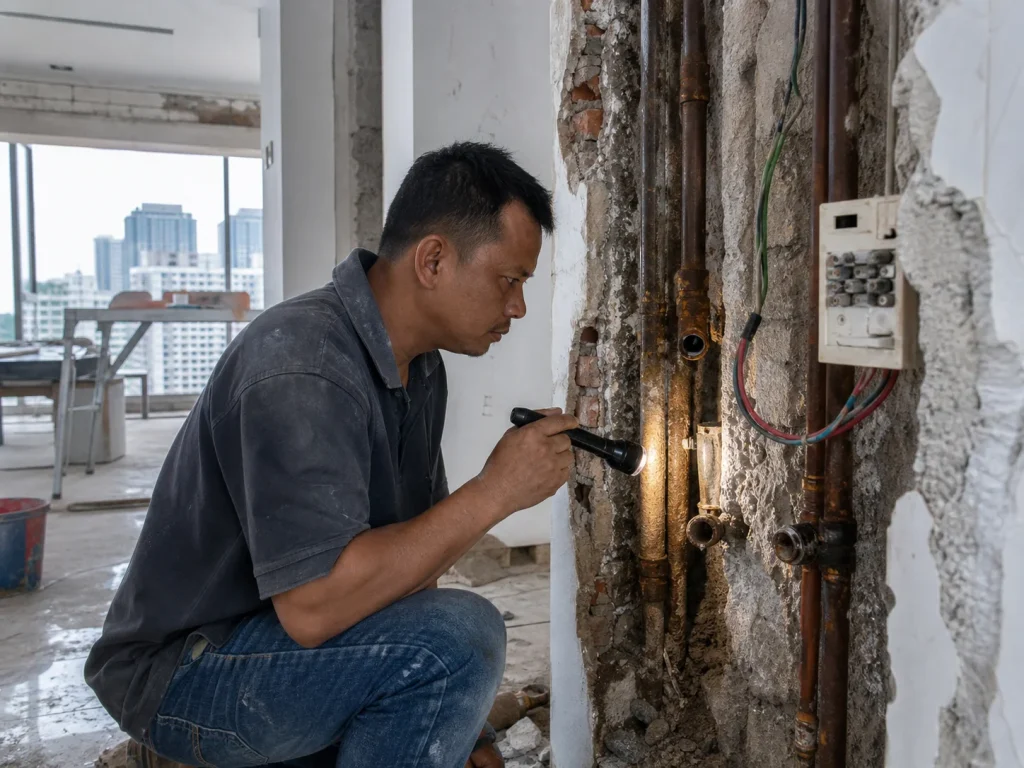
Once walls are opened, it’s common to discover wiring that doesn’t meet current safety standards or pipework that’s corroded from age. Malaysia’s humidity accelerates this kind of deterioration, especially in units over 15 years old.
Any renovation touching a wet area — kitchen, bathroom, balcony — should include waterproofing, but the extent needed often isn’t clear until the old waterproofing membrane is exposed and inspected.
If you’re still finalising your numbers, our guide on setting a realistic renovation budget walks through how much contingency to build in before these surprises even show up.
Beyond the physical work, Malaysian renovations come with a layer of paperwork and deposits that first-time homeowners rarely factor into their budget at all.
If you live in a condo or apartment, your Joint Management Body (JMB) or Management Corporation (MC) will almost always require a refundable renovation deposit, plus non-refundable administrative fees, before work can begin.
| Item | Typical Cost (RM) |
|---|---|
| JMB/MC renovation deposit (refundable) | RM1,000 – RM5,000 |
| Renovation application/admin fee | RM100 – RM500 |
| Lift usage / goods lift booking fee | RM50 – RM300 |
| Late renovation completion penalty | RM50 – RM200 per day |
Prices above are indicative estimates for reference only. Actual costs will vary depending on your interior designer, contractor, material choices, and project scope.
Structural work — hacking load-bearing elements, adding a mezzanine, or major additions to a landed home — may require submission to your local council (PBT), such as DBKL or MBPJ, and confirmation that your contractor is CIDB-registered.
Even after handover, minor works — resealing a gap, fixing a squeaky cabinet hinge, touching up paint — are usually covered under your defect liability period. But cosmetic issues you raise late, or work outside the agreed scope, often come with a small callback fee once that period ends.
Not every hidden cost comes from something broken behind a wall. A large share comes from decisions made after work has already started — and Malaysian contractors have a specific term for this.
A variation order (VO) is any change to the original agreed scope — swapping a tile brand, moving a light switch, adding a feature wall that wasn’t in the plan. Each VO typically comes with its own cost and, often, a short delay to the timeline.
Our piece on the questions to ask your interior designer before signing the contract covers how to pin down VO terms upfront, which is the single best way to avoid this cost blowing out.
Swapping your countertop material after the carpenter has already measured, or deciding on a different kitchen layout after cabinets are ordered, doesn’t just cost more materials — it often means redoing labour that’s already been paid for. Lock in material choices, including surfaces like Sinno Stone countertops, before installation begins to avoid paying for the same work twice.

Homeowners tend to budget right up to handover day and stop there — but several real costs land after the contractor has packed up and left.
Post-renovation cleaning is rarely included in a standard quotation, and construction dust settles into places you won’t find until weeks later.
If you’re renovating a home you currently live in, factor in the cost of staying elsewhere or storing furniture during the noisiest, dustiest phases — usually hacking and painting.
A renovation quotation covers built-ins and finishes — it rarely includes loose furniture, curtains, or new appliances. Many first-time homeowners mentally lump these into the “renovation budget” and are caught off guard when the real total is 15–25% higher than the contractor’s invoice alone.
The simplest way to protect yourself isn’t predicting every possible surprise — it’s building a contingency fund sized to your project’s risk level.
| Project Type | Recommended Contingency |
|---|---|
| New condo unit (minimal hacking) | 10% of total budget |
| Resale condo (10–20 years old) | 15% of total budget |
| Landed home, partial renovation | 15–20% of total budget |
| Landed home, full renovation or old property | 20–25% of total budget |
Prices above are indicative estimates for reference only. Actual costs will vary depending on your interior designer, contractor, material choices, and project scope.
For a full breakdown of where your base budget should go before contingency, see our guide to how much home renovation costs in Malaysia.
Hidden renovation costs aren’t a sign you did something wrong — they’re a predictable part of working with an older building, a layered approval process, and a project that changes shape once walls come down. The homeowners who come out ahead aren’t the ones who avoid every surprise; they’re the ones who budgeted for surprises in the first place.
Treat your quotation as the starting line, not the finish line, and pad it with a contingency fund sized to your property’s age and scope. That single habit does more to protect your peace of mind than any amount of negotiating over the final invoice.
RumaRuma exists to help you plan for the renovation you’ll actually have, not just the one on paper — browse our budgeting guides before you sign anything.
Build your contingency fund before you sign a single contract — your future self will thank you.
