 rumaruma
Sintered Stone vs Quartz: Which Countertop Suits a Malaysian Kitchen?
How sintered stone and quartz compare on heat, sun, stains, chipping and price, and which one suits the way your kitchen actually cooks.
On this page
- The Short Version: What Each One Is
- Sintered Stone vs Quartz: Head-to-Head
- Heat and Sun: Where Sintered Stone Wins
- Edges and Knocks: Where Quartz Is Easier to Live With
- Stains, Humidity and Cleaning: Close to a Draw
- Look and Design Choice
- Price: Similar Entry Points, but Compare Real Quotes
- Which One Should You Choose?
- What to Settle Before You Confirm Either Stone
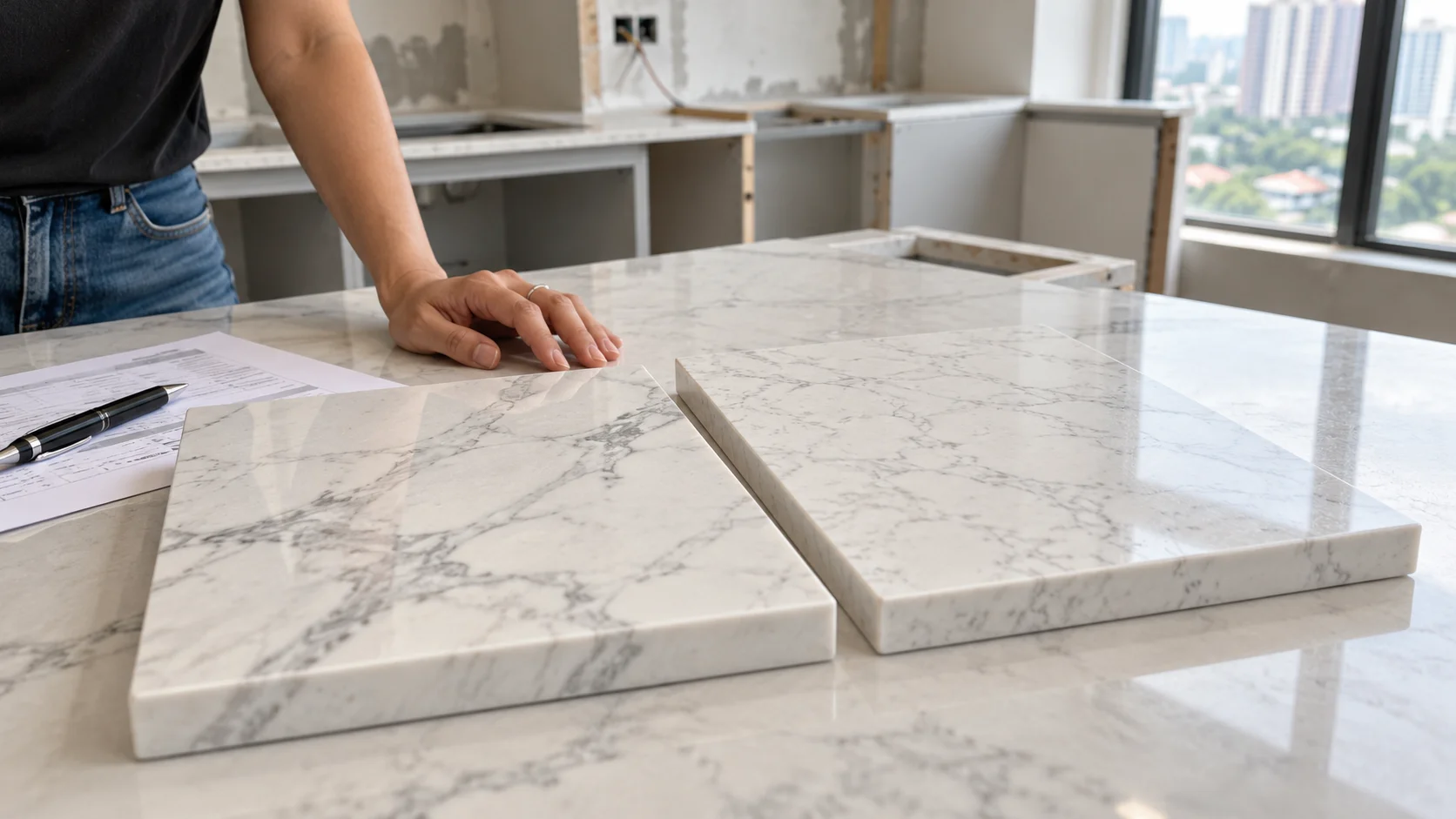
The showroom has put two samples in your hand. One is sintered stone, one is quartz, both are white with soft grey veins, and the salesperson says either will do. Your contractor has a favourite. Your sister-in-law swears by the other. And the price difference on the quotation is smaller than you expected.
Choosing between sintered stone vs quartz comes down to how you cook and where the counter sits, not which one is “better”. Both are non-porous, both shrug off curry stains, and neither needs sealing in our humidity. They differ on heat, sunlight and edges. This guide puts them side by side so you can match the stone to your kitchen rather than to the sales pitch.
The Short Version: What Each One Is
Sintered stone is natural minerals pressed and fired above 1,200°C into a dense slab with no resin. Firing is what gives it heat and UV resistance; it’s also what makes it hard and a little brittle. Our honest guide to sintered stone covers its collections, prices and downsides in detail.
Quartz is engineered stone: crushed natural quartz bound with polymer resin, usually described as about 90–94% quartz. The resin seals the surface and gives the slab a little give. It’s also the weak point under heat and sun. Our quartz countertop guide covers quality tiers, fake quartz and how to read a quote.
The single difference that explains most of this article: one has resin, the other doesn’t.
Sintered Stone vs Quartz: Head-to-Head
| What matters | Sintered stone | Quartz |
|---|---|---|
| Heat from hot cookware | High heat resistance, so an accidental hot set-down is less likely to mark it; still use a trivet | Resin can discolour or crack above about 150°C; a trivet is essential |
| Direct sunlight | UV-stable, won’t yellow | Can fade or yellow over years |
| Turmeric, kicap, coffee | Wipes off | Wipes off; wipe promptly on very light colours |
| Sealing | Never | Never |
| Knocks on edges and corners | Chips more easily, especially on sharp square edges | More forgiving, though a deep chip is still possible |
| Look of the cut edge | Pattern is often printed on the top face; the edge can show a plain body | Colour runs through, but marble-look veins often sit mainly on the surface |
| Chip repair | Filled with tinted resin; usually visible up close | Filled with tinted resin; usually visible up close |
| Common slab size | 3200 × 1600mm regular; 3200 × 1800mm jumbo | 3000 × 1400mm standard at one Johor supplier; longer jumbo slabs exist |
| Installed price from | About RM110 per sq ft | About RM110 per sq ft |
| Best spot | Wet kitchen, beside a west-facing window, balcony or outdoor counter | Dry kitchen, island, bathroom vanity |
Two rows in that table do most of the deciding: heat and edges. The rest is close to a draw.
Heat and Sun: Where Sintered Stone Wins
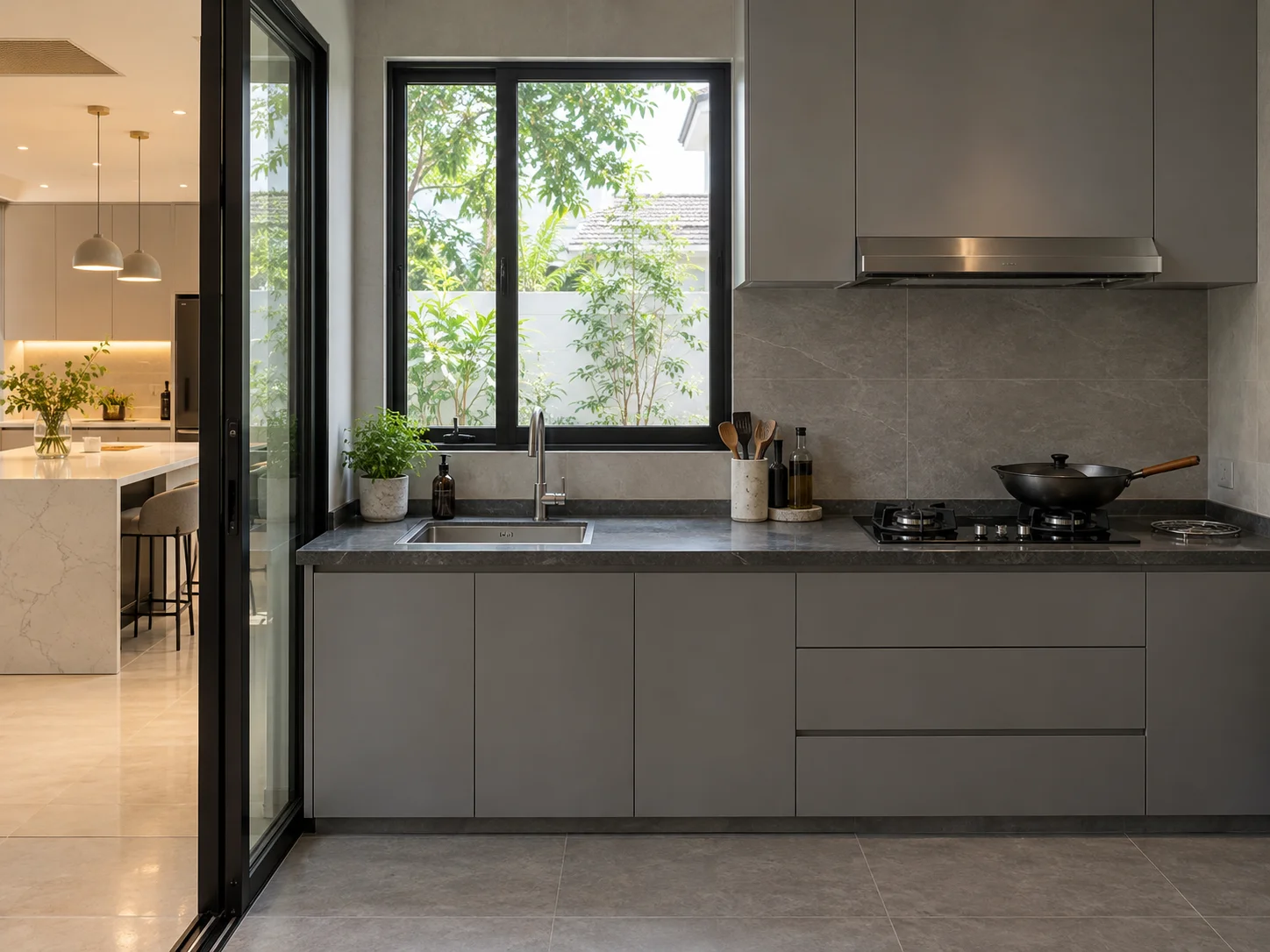
Malaysian cooking is hard on countertops in a way most showroom demos don’t show. A wok off a high flame, a claypot of rice or a pot of rendang left to rest can easily pass 150°C at the base. On quartz, a hot pot set down by mistake can leave a pale ring that won’t polish out. Sintered stone is far less likely to mark from the same slip.
Heat resistance is a safety margin, not an instruction to put hot cookware straight on the stone. Sudden, concentrated heat can still stress any slab, especially near cut-outs, so check whether your warranty covers heat damage at all. Use a trivet on both, and follow the care instructions for the exact product you buy. The difference is what happens on the day someone forgets.
Sunlight works the same way, just slowly. A quartz top under a west-facing kitchen window, on a balcony bar or at an outdoor BBQ counter in a landed home can yellow over the years as the resin breaks down. Sintered stone doesn’t change colour.
Don’t put quartz: right beside the hob in a busy wet kitchen where a hot pot will sooner or later miss the trivet, or anywhere that gets hours of direct sun.
Edges and Knocks: Where Quartz Is Easier to Live With
Sintered stone’s hardness cuts both ways. The flat surface resists scratches well, but a heavy cast-iron pot knocked against a sharp square edge can take a chip out of it. Quartz, with its resin binder, takes the same knock more calmly.
That shows up in fabrication too. Sintered stone needs a fabricator who works with it often: sink and hob cut-outs need rounded inside corners and careful handling, or hairline cracks can form later. Quartz is more forgiving to cut, so the fabricator’s experience matters less, though it still matters.
Don’t put sintered stone: with sharp square edges on a busy family island where children, trolleys and heavy pots bump the corners, unless you choose an eased (slightly rounded) edge and accept that a chip is possible.
Stains, Humidity and Cleaning: Close to a Draw
Neither absorbs liquid, so turmeric, soy sauce and coffee wipe off both. Neither needs sealing, which matters in a climate where anything that holds moisture grows mould. If the stone you’re replacing is a porous granite or marble that went yellow around the hob, either one is a big step up.
Quartz needs a little more care with cleaners: bleach, oven cleaner and scouring powder can dull the resin finish over time. Warm water, mild dishwashing liquid and a soft cloth suit both stones, so that’s the safe daily routine either way.
Both will dull your knives. Use a chopping board on either.
Look and Design Choice
Both come in marble looks, plain whites, concrete greys and warm beiges. The differences are in the details:
- Sintered stone — offers a textured matte “leather” finish that hides fingerprints, very large slabs for deep islands, and thinner panels that can extend the same stone to TV consoles and feature walls. The catch is the edge: on many slabs the pattern is printed on top, so a straight edge can look unfinished unless you choose full-body colour or pay for mitred edges.
- Quartz — known for even, consistent colour from slab to slab, so a long counter or an island built from two pieces matches well. Plain colours and fine speckles look especially clean. Marble-look veining can look less natural at the cut edge, so ask to see a cut sample here too.
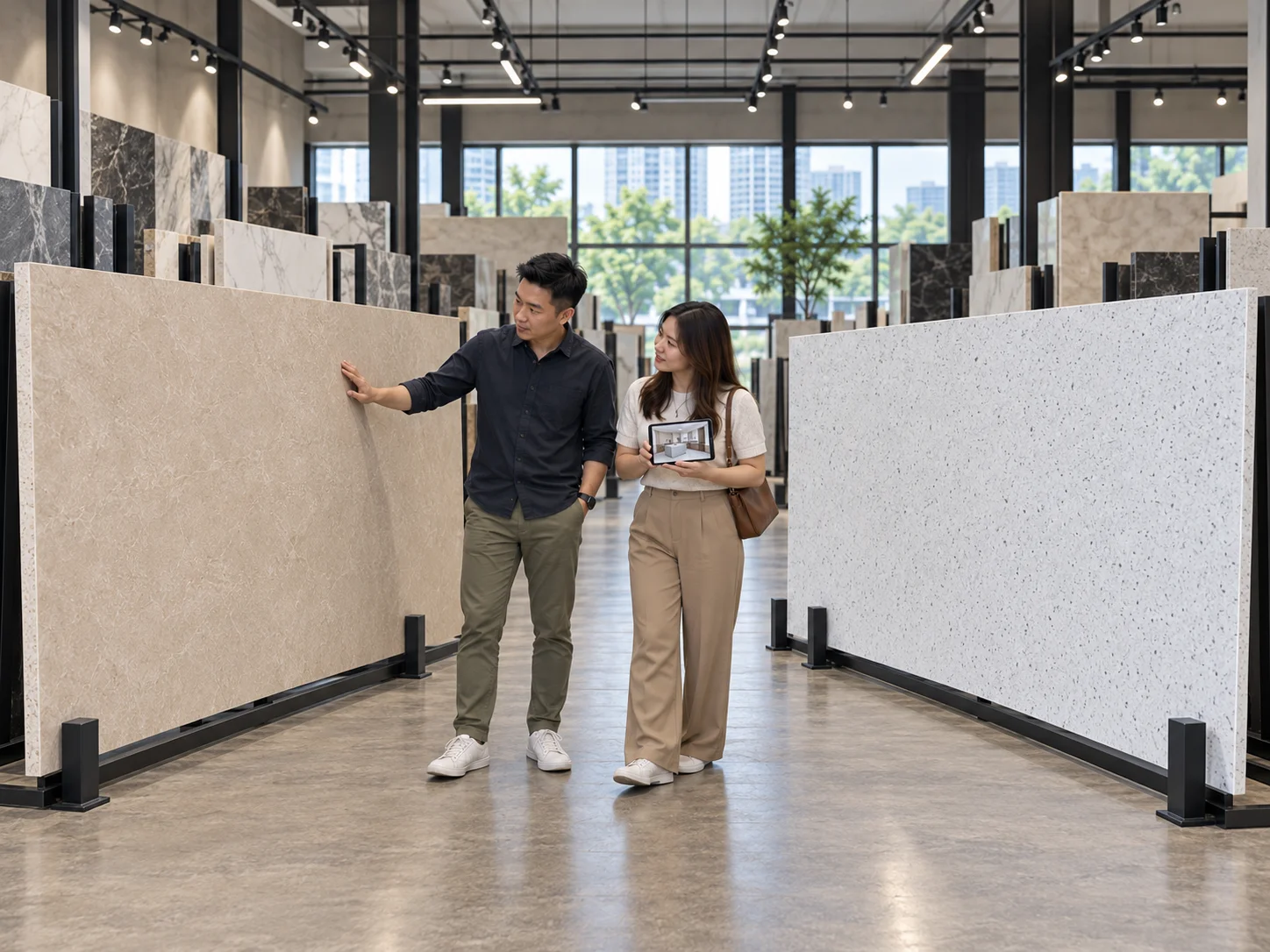
For either stone, look at the actual slab, not just a palm-sized sample, before you confirm.
Price: Similar Entry Points, but Compare Real Quotes
Published prices for both materials start at about RM110 per sq ft supplied and installed. Treat that as an indicative entry point, not proof that your options will cost the same. Above it, the price depends far more on brand, design, thickness and your layout than on which material you pick. The figures below come from the sources used in our two material guides. They’re not directly comparable, so they sit side by side rather than being blended.
| Range | Sintered stone (one supplier, 12mm, installed) | Quartz (published Malaysian ranges, installed) |
|---|---|---|
| Entry | RM110–150 per sq ft (China-made collections) | RM110–180 per sq ft |
| Mid | — | RM145–400 per sq ft |
| Premium imported | RM248–469 per sq ft (Dekton groups) | RM280–1,000+ per sq ft |
| Cut-outs | Extra: RM150 hob, RM150–200 sink | Sometimes included; one supplier charges about RM100 for a hob and RM100–280 for an undermount sink |
These prices are for reference only. Your final price depends on brand and colour, thickness, slab size, how many slabs your layout uses, edge work, cut-outs, lift and stair access, and the exchange rate when the slab is imported. The figure that counts is the one on your supplier’s quotation on the day you confirm.
What a 10 ft counter costs in each
A straight 10 ft counter at the standard 2 ft depth is 20 sq ft. Before cut-outs:
| Option | 20 sq ft countertop |
|---|---|
| Sintered stone, China-made Regular | RM2,200 |
| Sintered stone, China-made Full Body | RM3,000 |
| Quartz, entry-level | RM2,200–3,600 |
| Quartz, mid-range | RM2,900–8,000 |
| Sintered stone, Dekton Group 0 | RM4,960 |
| Quartz, premium imported | RM5,600–20,000+ |
Slab size can also move the number. A straight 10 ft run is 3,048mm. That fits on one 3200mm sintered slab, but it’s slightly longer than a 3,000mm standard quartz slab. Ask whether a quartz quote assumes a jumbo slab or a joint; the Johor supplier says running into a second slab can add 30–40%.
Compare like with like
The real price comparison is two installed quotations for your own layout, one in each material. They’re only comparable when they match on three things:
- Thickness — a thicker slab costs more per sq ft, so RM150 at one thickness and RM180 at another isn’t a fair comparison.
- Unit — per sq ft or per foot run. At a 2 ft depth, RM300 per foot run equals RM150 per sq ft.
- Cut-outs and edges — included or extra, and which edge profile.
Our guide to comparing renovation quotations shows how to line these up across contractors.
Which One Should You Choose?
Choose sintered stone if…
- You cook with high heat daily and the counter sits next to the hob in a wet kitchen.
- The counter gets direct sun: a west-facing window, a balcony bar or an outdoor kitchen.
- You want the same stone on a TV console or feature wall.
- You’re happy to choose an eased edge and treat corners with a little care.
Choose quartz if…
- The counter is in a dry kitchen, on an island or in a bathroom, away from hot pots and sun.
- You want even, consistent colour across a long counter or two-piece island.
- Your household is hard on edges: young children, heavy cookware, lots of bumping.
- You want a stone that’s more forgiving to cut and install.
If your kitchen fits both lists
A busy family wet kitchen often does: high heat every day, and heavy pots and small hands knocking the edges. Three questions break the tie.
- How disciplined is the household with trivets? If hot pots reliably go on a trivet, quartz’s heat weakness matters less, and its kinder edges win. If people set the wok down wherever there’s space, sintered stone is the safer bet.
- Can you choose the edge? An eased edge on sintered stone takes away much of its chipping risk, and keeping heavy cast-iron away from exposed corners does the rest. If the design calls for sharp square edges, quartz is the easier fit.
- How experienced is the fabricator? Sintered stone only makes sense with someone who cuts it often and can show you finished cut-outs. If your contractor’s stone installer mostly does quartz, don’t make them learn on your kitchen.
Or split them
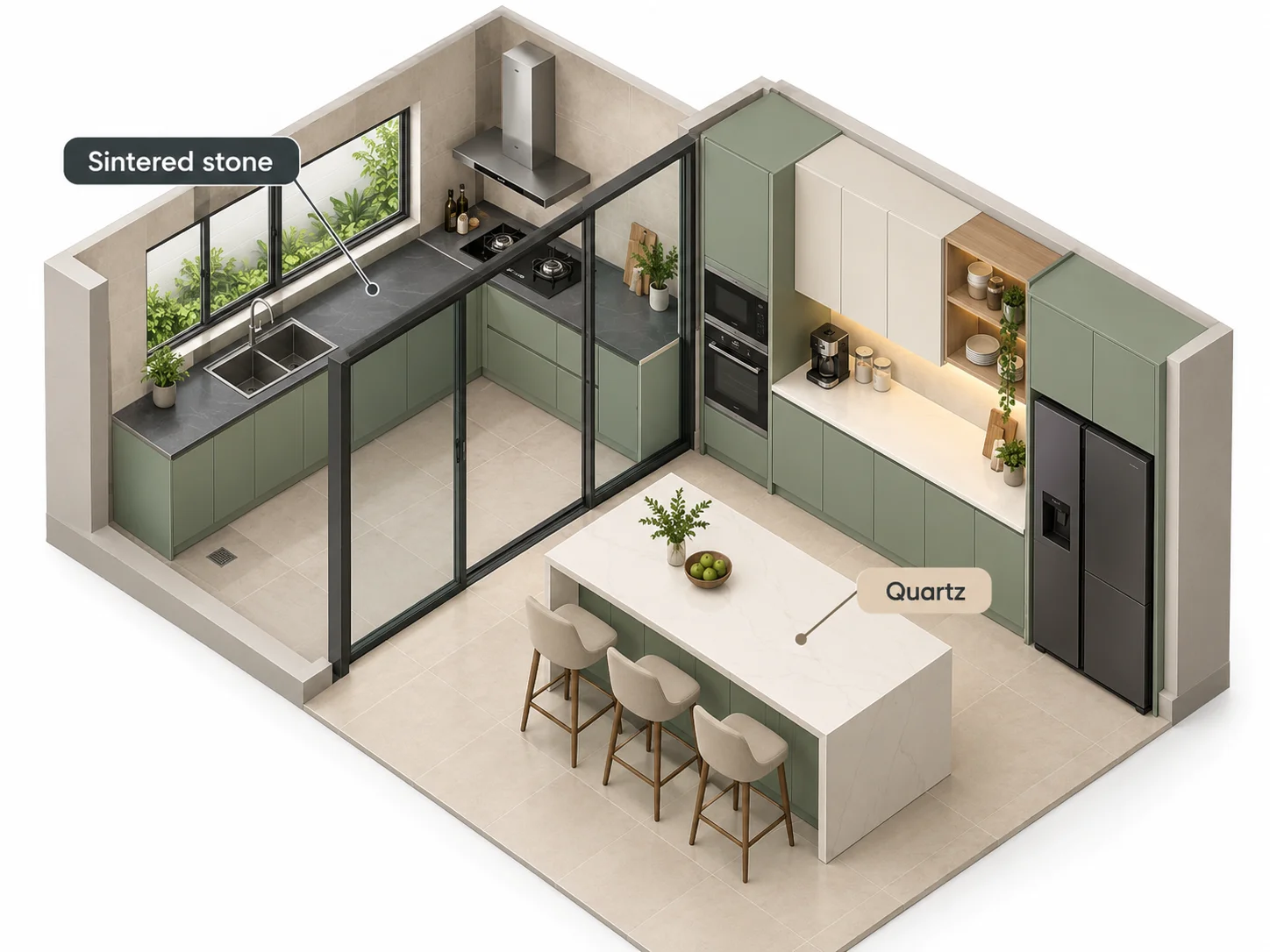
Many Malaysian homes already separate the wet and dry kitchen, and the countertop can follow. Sintered stone takes the heat in the wet kitchen; quartz gives the dry kitchen and island a softer, even look. If the two areas are visible from each other, choose colours that sit well together, since an exact match across two materials is unlikely. Our kitchen renovation guide shows how the countertop fits into the rest of the kitchen budget.
What to Settle Before You Confirm Either Stone
- You’ve decided where the counter sits: beside the hob, in sun, or in a dry area
- Brand, collection or colour code, and thickness are on the quotation
- Both quotes use the same unit and thickness, with the measured area shown
- Cut-outs and edge profile are listed or stated as included
- You’ve seen a cut sample of the edge, not just the top surface
- Joint positions are marked on the drawing, and long pieces fit the condo service lift
- The fabricator cuts in the workshop with water, not dry-cutting in your home; both stones release silica dust when cut
- The warranty is in writing, and you know whether chips are excluded
- You’ve read the care instructions for your exact product, and there’s a trivet spot beside the hob whichever stone you choose
Get the placement right and the choice almost makes itself. The counter beside the hob forgives the odd slip with a hot pot, the morning sun falls on a counter that won’t yellow, and the island where everyone gathers keeps its clean edge through years of homework, birthday cakes and late suppers.