 rumaruma
How to Protect Your Home From Haze in Malaysia: A Room-by-Room Guide
Haze slips in through every gap in your home — here’s how to seal one clean room, size an air purifier properly and run the aircon without a shock bill.
On this page
- Why Haze Gets Inside Your Home, and What It Does
- How to Protect Your Home From Haze in Malaysia: Start With One Clean Room
- Step 1: Seal the Gaps Haze Gets Through
- Step 2: Choose an Air Purifier for Haze That Fits the Room
- Does Your Aircon Filter Haze?
- Inverter Aircon and Your Electricity Bill During Haze Season
- Room-by-Room Haze Plan
- Habits That Undo Your Effort
- When to Open the Windows Again
- If You’re Renovating: Build Haze-Readiness In
- Haze Day Checklist
The windows are shut, the aircon has been running since dinner, and you can still smell smoke in the bedroom. Your child’s cough hasn’t settled in three days. You’ve been meaning to buy an air purifier, but there are forty models on Shopee and you don’t know whether the RM300 one does anything the RM1,700 one doesn’t.
This guide shows you how to protect your home from haze in Malaysia without turning the whole house into a construction project. Start by making one room properly clean. Then pick a purifier that matches that room, and understand what your aircon can and can’t do. The steps work in a KL condo and in a 30-year-old terrace house with louvre windows.
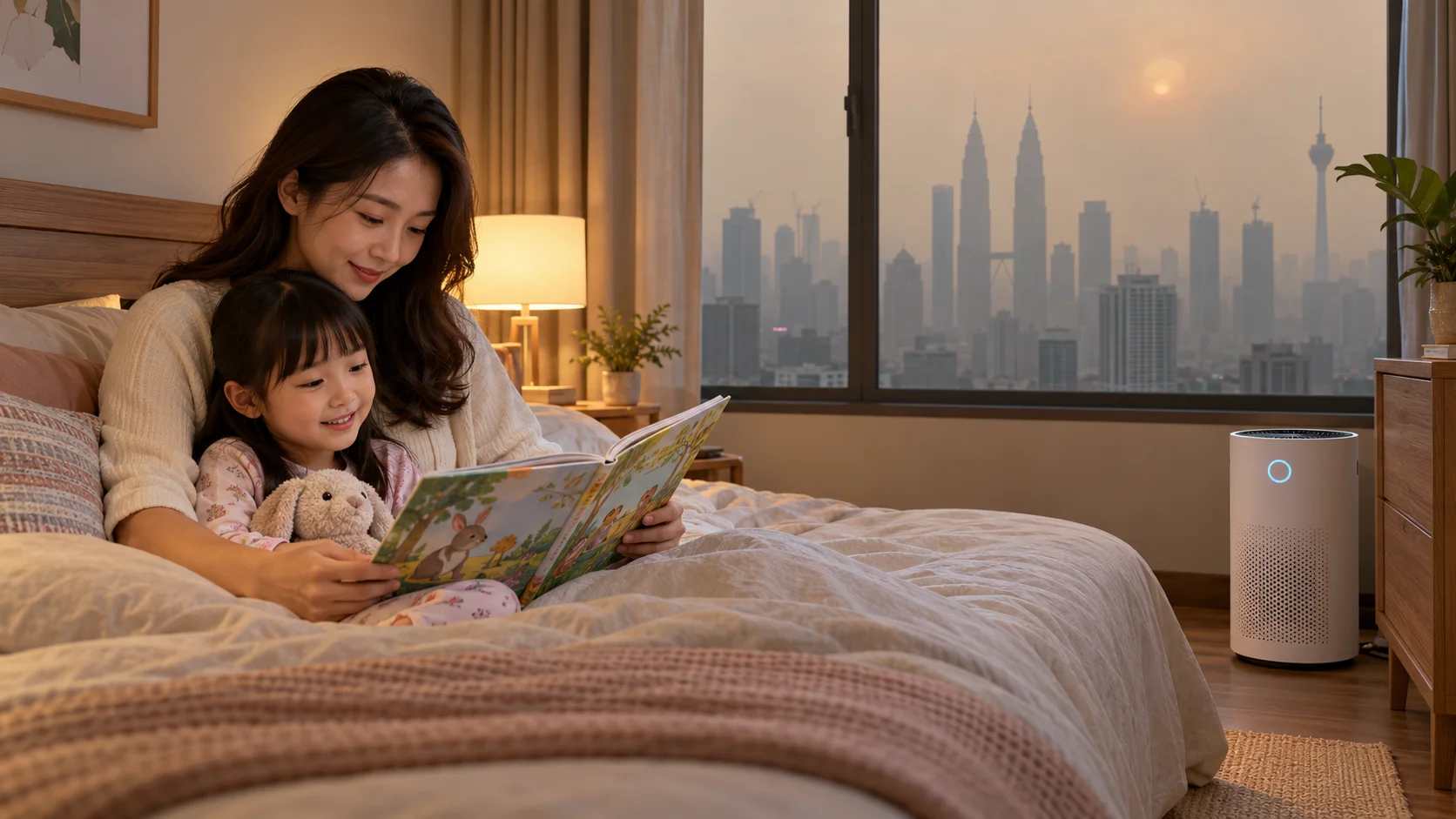
Why Haze Gets Inside Your Home, and What It Does
The haze that drifts over the Klang Valley and much of the peninsula is mostly smoke from forest and peat fires in Indonesia, carried in by the southwest monsoon winds between roughly June and October. The particles that matter are PM2.5: fine particles 2.5 microns or smaller, small enough to travel deep into the lungs. Children, older family members and anyone with asthma or a heart condition feel them first.
PM2.5 is also small enough to come through the gap under your front door. Closing the windows cuts what comes in. It doesn’t stop it. Experts quoted during the 2026 haze made the same point: staying indoors lowers your exposure, but it won’t make your home pollution-free on its own.
How to read the API
The Department of Environment (DOE) publishes the official Air Pollutant Index (API) for each monitoring station, updated hourly, at apims.doe.gov.my. During haze, PM2.5 is usually the pollutant that sets the reading.
| API reading | Status | What to do at home |
|---|---|---|
| 0–50 | Good | Open up and air the house |
| 51–100 | Moderate | Normal; sensitive family members limit long outdoor exposure |
| 101–200 | Unhealthy | Windows shut, purifier on in the clean room |
| 201–300 | Very unhealthy | Stay in the clean room as much as possible; N95 mask outdoors |
| Above 300 | Hazardous | Follow official advice; schools and outdoor work may stop |
The number in a weather or AQI app often won’t match the DOE figure. Many apps show a live PM2.5 reading or use a different index scale, while the API is calculated from averaged readings. Use the app to see what’s happening this hour and the API to compare with official advice.
How to Protect Your Home From Haze in Malaysia: Start With One Clean Room
Trying to protect every room at once usually ends with every room being half-protected. The better approach is the one health agencies such as the US EPA recommend for wildfire smoke: create one clean room, where the air is properly filtered, and make it the room where the most vulnerable person sleeps.
For most families that’s the master bedroom or the children’s room. It should be a room with:
- A door that closes — open-plan living areas are almost impossible to keep clean
- An aircon — so the windows can stay shut through a hot afternoon
- As few windows and outside walls as possible — fewer gaps to seal
- A power point near the middle of the room — for the purifier
Sleeping eight hours in clean air does more for your lungs than running a small purifier in a big living hall all day. Once the clean room works, extend the same steps to other rooms if your budget allows.
Step 1: Seal the Gaps Haze Gets Through
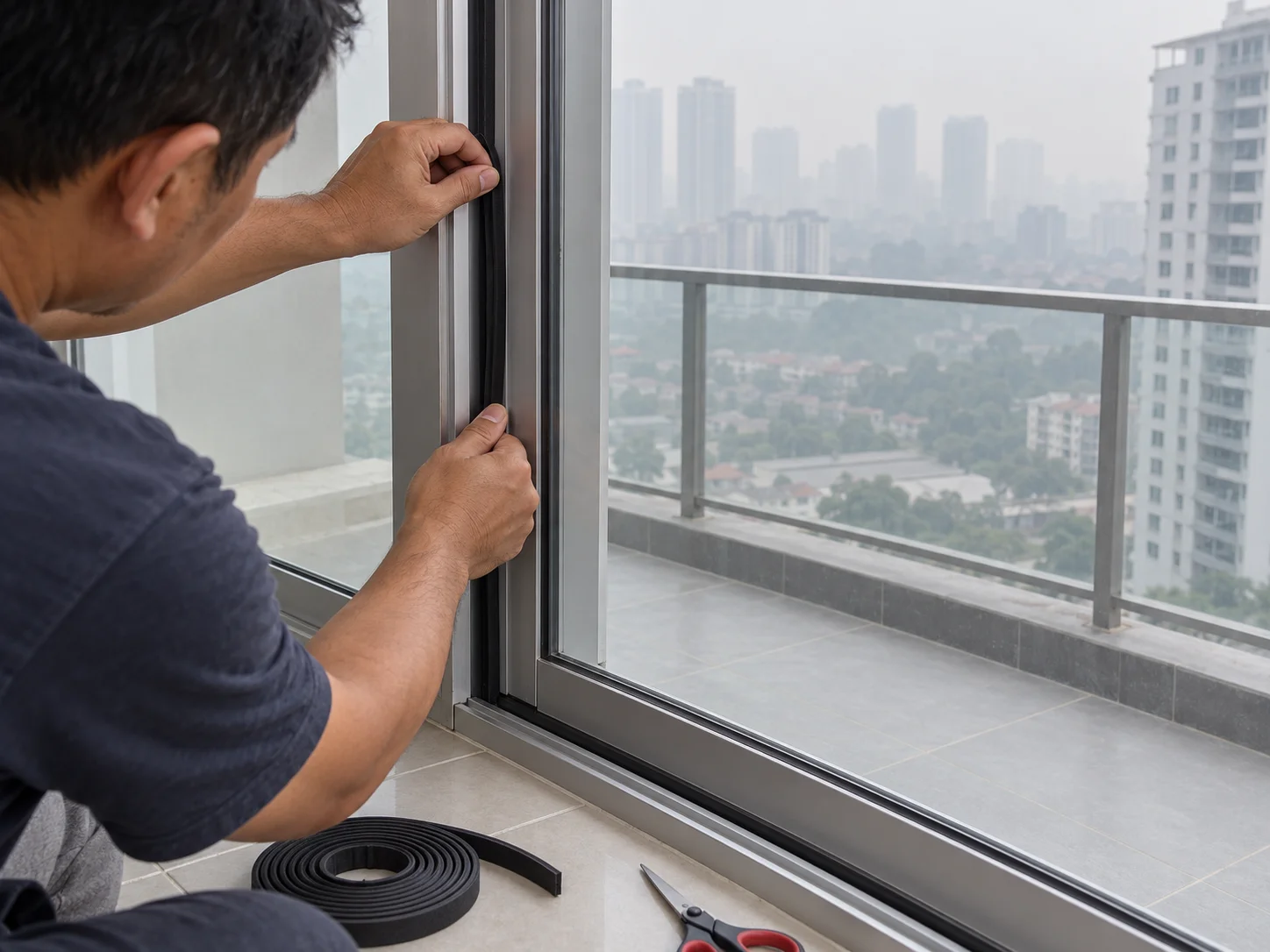
An air purifier can’t keep up if outside air keeps leaking in. Sealing comes first, and it’s the cheapest step.
In a condo or apartment
- Sliding balcony doors — the most common leak in Malaysian condos. Check the brush or rubber seal along the frame; if you can see daylight or feel air when the door is shut, add self-adhesive foam or rubber weatherstrip from Mr. DIY or a hardware shop.
- Gap under the room door — a door-bottom seal or a rolled towel stops air from the rest of the house coming in.
- Window locks — a sliding window that isn’t pushed fully into its lock leaves a gap along the whole height.
- Aircon pipe hole — the hole through the wall for the aircon piping is often packed loosely. Seal it from inside with putty or sealant.
Weatherstripping inside your unit doesn’t usually need approval. Changing windows or balcony doors is different: they’re part of the building’s facade, so check with your JMB or MC before replacing anything that faces outside.
In a landed home
Older terrace and semi-D houses leak far more than condos. The worst offender is the louvre (naco) window: its glass blades never seal tightly, even when closed. For haze season, cover the louvres in the clean room from inside with clear plastic sheeting or cling film taped to the frame. It isn’t pretty, but it works and it peels off when the haze clears.
Also check ventilation blocks (the decorative breeze blocks above doors and in stairwells), gaps around the back kitchen door, and the space between the roof and the walls in single-storey houses. You don’t have to seal all of them. Focus on the ones that open into your clean room.
Step 2: Choose an Air Purifier for Haze That Fits the Room
A good purifier is the single most effective thing you can buy for haze. “Good” here means two things: the right filter and the right size.
Get the filter right: True HEPA
Look for a True HEPA filter (often labelled H13). It captures at least 99.97% of particles at 0.3 microns, which covers PM2.5. Labels like “HEPA-type” or “HEPA-like” don’t promise that standard.
- Activated carbon layer — worth having, because it absorbs the smoky smell that HEPA doesn’t catch.
- Ionisers and “ozone” features — skip them or switch them off. Ozone irritates the lungs, which is the opposite of what you’re trying to do.
- UV lamps and plasma features — mostly marketing for haze purposes; they don’t remove particles.
Get the size right: CADR
Ignore the “suitable for up to X sq ft” label on the box. Look for the CADR (clean air delivery rate), measured in m³/h: how much clean air the purifier delivers each hour.
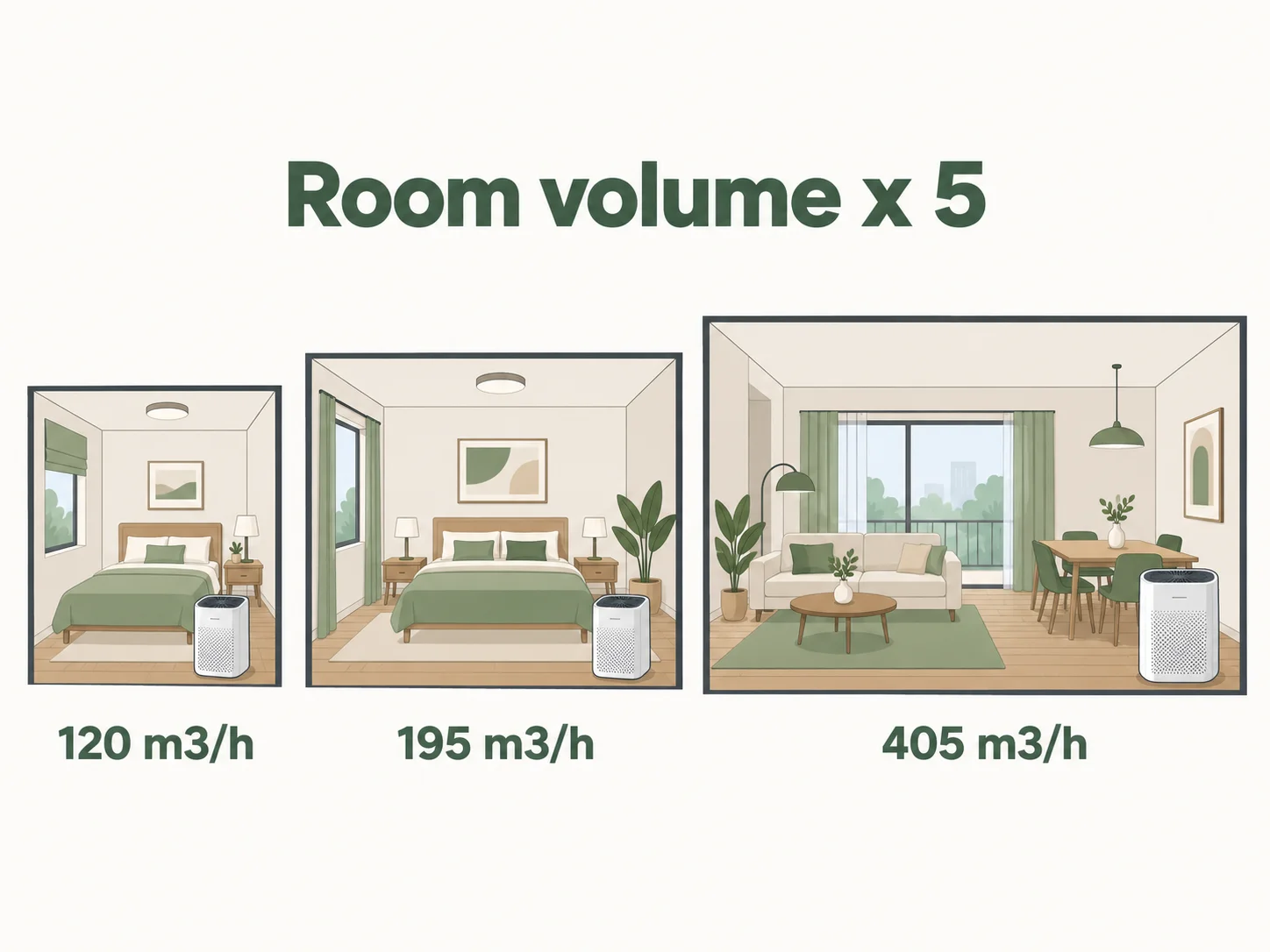
A simple rule for haze: CADR (m³/h) should be at least room volume × 5. That cleans the room’s air about five times an hour.
| Room | Size | Volume (2.7 m ceiling) | Minimum CADR |
|---|---|---|---|
| Small bedroom | 3 m × 3 m (9 m²) | about 24 m³ | about 120 m³/h |
| Master bedroom | 3.6 m × 4 m (14 m²) | about 39 m³ | about 195 m³/h |
| Condo living and dining | 5 m × 6 m (30 m²) | about 81 m³ | about 405 m³/h |
Then buy one size up. A purifier running on low is quiet enough to sleep beside; one running on high all night is not, and you’ll end up turning it down or off.
What a purifier costs in Malaysia
A compact True HEPA purifier for one bedroom starts at about RM300, a mid-size unit for a master bedroom or small living room costs about RM470–700, and large units for open-plan living areas run past RM1,000. Replacement filters are an ongoing cost on top. For specific models matched to each room size, see our guide on whether an air purifier really helps with haze.
Prices are for reference only, based on Malaysian listings checked in October 2026. They change with promotions, platform, model year and whether the seller is an official store.
Running costs are small. A purifier typically draws about 20–60 W, so even 10 hours a day adds only around RM5 a month to your TNB bill. The real ongoing cost is filters: heavy haze clogs them faster than the six to twelve months the box suggests, so budget for an extra one in a bad year. Buy genuine filters from the brand’s official store — a cheap copy that lets air leak around its edges defeats the purpose.
Where to put it
- Away from walls and corners — at least 30 cm of clear space around the intake
- Near where people breathe — beside the bed, not tucked behind a wardrobe
- Not directly under the aircon — the aircon’s airflow pushes the purifier’s clean air straight away from you
- Door closed, purifier on before bedtime — give it 30 minutes to clean the room before anyone sleeps
Does Your Aircon Filter Haze?
Not in any meaningful way. Most Malaysians assume the aircon is cleaning the air. It isn’t.
A wall-mounted split aircon, the type in nearly every Malaysian home, doesn’t bring in outside air. It pulls in the air already in the room, cools it and blows it back out. That’s helpful: running it doesn’t suck haze in. But its filter is a coarse mesh made to catch dust and hair. Most PM2.5 goes straight through. Built-in features like ionisers or “nano” filters help a little, but they don’t replace a True HEPA purifier.
What the aircon does do is make a sealed room bearable. Without it, someone in the family opens a window at 3pm because the room is stifling, and the haze comes in. So the setup that works is:
- Windows and doors shut
- Aircon on for comfort
- HEPA purifier on to clean the air
During haze season, wash the aircon’s mesh filters every two weeks rather than every month. They load up faster, and a clogged filter makes the aircon work harder for less cooling.
Inverter Aircon and Your Electricity Bill During Haze Season
Haze means the aircon runs longer than usual — through the night and often half the day. That’s where an inverter aircon earns back its higher price.
A non-inverter unit switches its compressor fully on until the room is cold, then fully off, then fully on again. An inverter slows its compressor down once the room reaches temperature and keeps running at low power. A Malaysian university study found inverter units use about 33% less electricity on average than non-inverter units. The saving is biggest on long, steady runtimes, which is exactly what haze season looks like.
Here’s a rough monthly comparison for a 1.0 hp bedroom unit running 10 hours a day.
| Non-inverter | Inverter (about 33% less) | |
|---|---|---|
| Assumed average draw | 0.8 kWh per hour | about 0.54 kWh per hour |
| Monthly use (300 hours) | 240 kWh | about 160 kWh |
| Monthly cost at 44.43 sen/kWh | about RM107 | about RM71 |
Rough estimate for reference only. 44.43 sen/kWh is the sum of TNB’s energy, capacity and network charges for homes using up to 1,500 kWh a month under the July 2025 tariff. It leaves out the monthly fuel adjustment (AFA), the retail charge, SST and any energy-efficiency rebate. Real usage depends on room size, insulation, how many people are in the room and the temperature you set.
That’s a saving of about RM36 a month for one room. It’s worth having, but probably not enough reason to throw out a working non-inverter aircon. Choose inverter when the old one needs replacing. When you do:
- Look for 5 stars on the Suruhanjaya Tenaga (Energy Commission) energy label.
- Get the horsepower right — an undersized unit runs flat out all the time and loses most of the inverter’s advantage.
- Set it to 24–25°C — every degree colder costs more, and with a purifier running you don’t need the room freezing to feel better.
Close the curtains on west-facing windows during the afternoon. Less heat coming in means less work for the aircon.
Room-by-Room Haze Plan
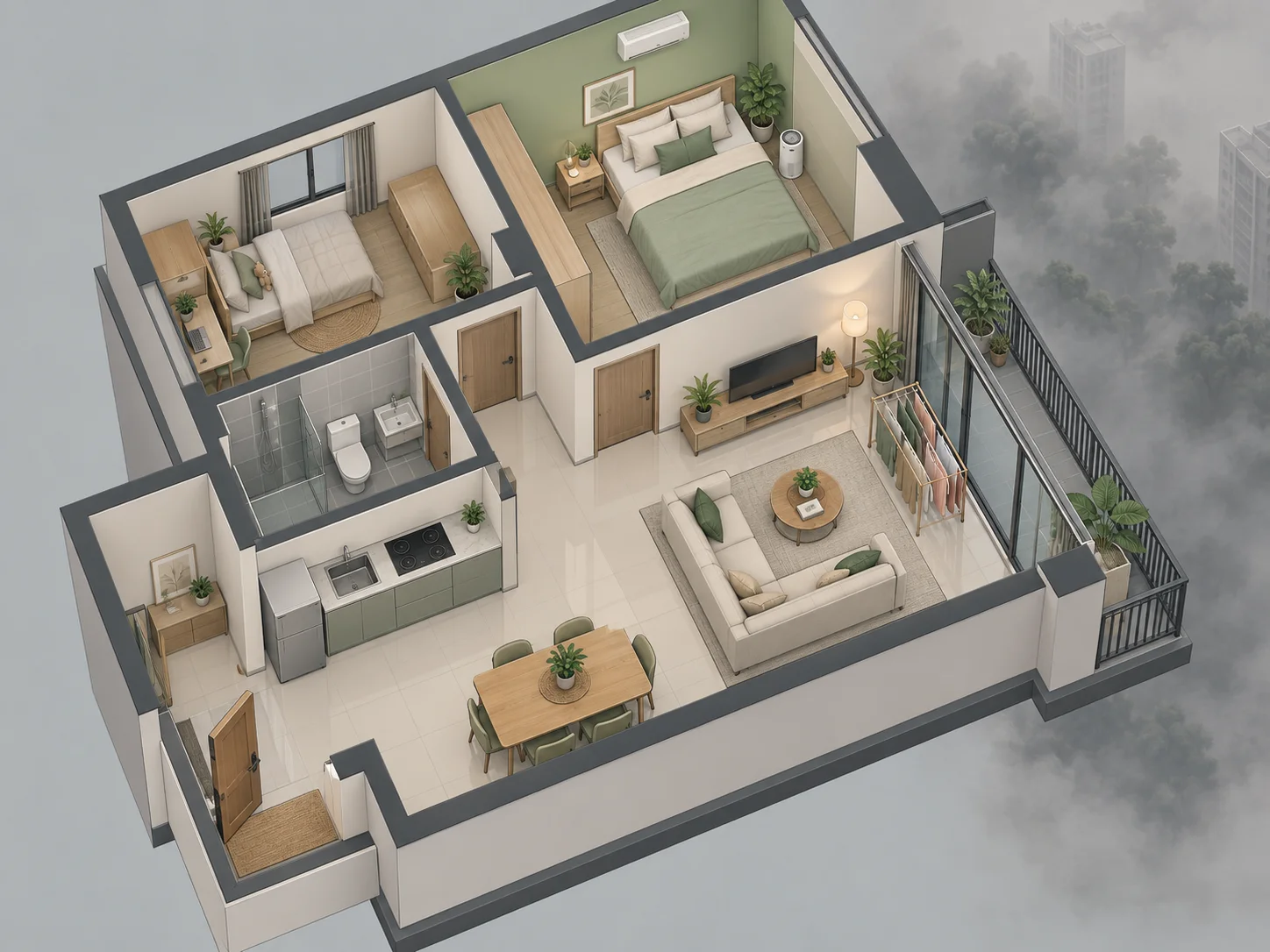
Bedroom (your clean room)
Seal it, close the door, run the aircon and a correctly sized purifier. Keep laundry, shoes and bags that have been outside in another room, because they carry particles in. If you have a PM2.5 meter, this is the room to check.
Living and dining room
Large, open and full of gaps, this is the hardest room to keep clean. If you only have one large purifier, put it here during the day when the family gathers and move it to the bedroom at night. Keep the main door closed and use the back door for deliveries if that’s an option.
Kitchen
Cooking produces its own PM2.5, especially frying and grilling, so the kitchen can be worse than outside during haze. Use the cooker hood whenever you cook, cut down on deep-frying while the haze lasts, and keep the kitchen door closed if you have one. A wet kitchen at the back of a terrace house is usually leaky; treat it as outside space and keep the door between it and the dry kitchen shut.
Bathroom
An exhaust fan pushes air out of the house, and that air has to be replaced from somewhere: through gaps in your windows and doors, straight from outside. During haze, run bathroom fans in short bursts after showers rather than leaving them on for hours.
Balcony and laundry area
Bring laundry indoors to dry. Clothes left on the balcony on a hazy day collect a film of fine dust and smell of smoke. A dryer, or drying racks in a room with the aircon running, solves both problems.
Habits That Undo Your Effort
A sealed room with a good purifier can still be polluted from inside. The biggest culprits:
- Joss sticks, incense and mosquito coils — all produce fine particles. During haze, move prayers to a well-ventilated spot or use electric alternatives for a few weeks.
- Smoking and vaping indoors — no purifier keeps up with this.
- Sweeping — it sends settled dust back into the air. Wet-mop instead, or use a vacuum with a HEPA filter. The same routine works for renovation dust if you’re living at home.
- Aerosol sprays and candles — small sources, but they add up in a closed room.
And one myth worth letting go: houseplants don’t clean the air in any way you’d notice. The idea comes from a 1989 NASA experiment in small sealed chambers. A 2019 review by Drexel University researchers worked out that you’d need 100 to 1,000 plants per square metre of floor to match the effect of normal ventilation. Plants are wonderful for a home. That’s why we love a biophilic kitchen. But during haze they’re decoration, not protection.
When to Open the Windows Again
A sealed room has its own problem: carbon dioxide from your breathing builds up overnight, which can leave you waking with a headache or feeling dull. Air quality specialists suggest ventilating the home at least once a day by opening the windows for about an hour, when outdoor air allows.
Check the API before you do. When your area drops back to the moderate band (100 or below), open the windows on opposite sides of the home for a cross-breeze, then close up again if the reading climbs. A PM2.5 meter takes out the guesswork: a standalone unit such as the UNI-T A25F costs about RM370, and many purifiers have a sensor built in that does a similar job.
Once the haze season is over, replace the purifier filter if it’s near the end of its life, and give the aircon a proper service. Both will have worked harder than usual.
If You’re Renovating: Build Haze-Readiness In
Haze comes back most years, so it’s worth planning for when you renovate. A few decisions that cost little at drawing stage:
- Window type — casement windows with rubber gaskets seal better than sliding windows. If your terrace house still has louvre windows, replacing them is one of the most useful upgrades you can make. Add it to your renovation checklist early.
- Inverter aircon, sized correctly — specify a 5-star inverter unit for every bedroom from the start.
- A power point for the purifier — near the bed, at a height that isn’t hidden behind furniture.
- A ducted kitchen hood — one that vents outside rather than recirculating, so cooking smoke actually leaves.
- Proper door seals on bedroom doors — a small item on the carpentry quotation.
If this is your first home, our first-time homeowner guide covers the rest of what to check before your contractor starts.
Haze Day Checklist
- Check the API for your area at apims.doe.gov.my
- Choose the clean room, usually where the most vulnerable person sleeps
- Shut and lock all windows and balcony doors
- Seal obvious gaps: door bottoms, sliding door edges, louvre windows, aircon pipe hole
- Run a True HEPA purifier sized at room volume × 5 or more
- Aircon on at 24–25°C, mesh filters washed
- No joss sticks, coils, smoking or deep-frying indoors
- Wet-mop instead of sweeping
- Bathroom and kitchen exhaust fans in short bursts only
- Laundry dried indoors
- Air the home for an hour when the API drops to 100 or below
- N95 mask for anyone going outside
Haze season is easier when you’ve prepared before it starts. A purifier humming quietly beside the bed, the door shut on the smoke, the aircon set to a sensible 25°C — and a child who sleeps through the night without coughing. That’s a room worth setting up now, before the next haze arrives.