 rumaruma
Plaster Bagworms in Your Bathroom? Fix the Bathroom Ventilation First (Malaysia Guide)
Those grey seed-shaped cases on your bathroom ceiling are plaster bagworms. Scraping them off helps for a week; fixing the damp air that feeds them stops them for good.
On this page
- What Are Those Grey Cases on the Ceiling?
- Why Your Bathroom Attracts Them
- Step 1: Clear Out the Cases and Their Food Today
- Step 2: Fix Bathroom Ventilation in Malaysia’s Humid Climate
- Step 3: Seal the Gaps Where They Hide
- How Much Better Bathroom Ventilation Costs in Malaysia
- Habits That Keep the Bathroom Dry
- For Contractors and Renovators
- Your Bathroom Ventilation Checklist
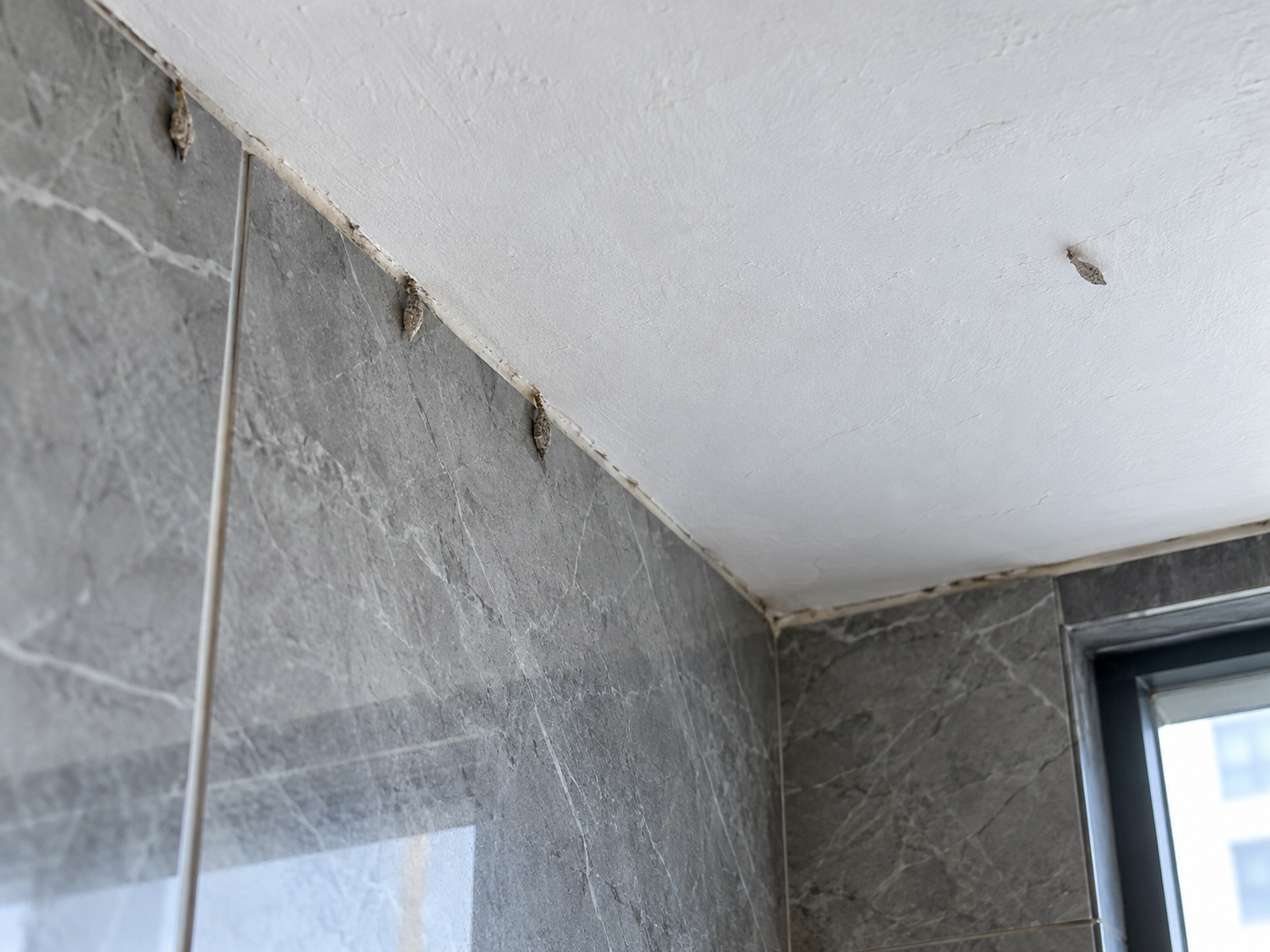
You look up mid-shower and notice them: small grey cases, shaped like watermelon seeds, stuck along the line where the wall tiles meet the ceiling. One is halfway across the ceiling. You scrape them off, and two weeks later they’re back in the same corner.
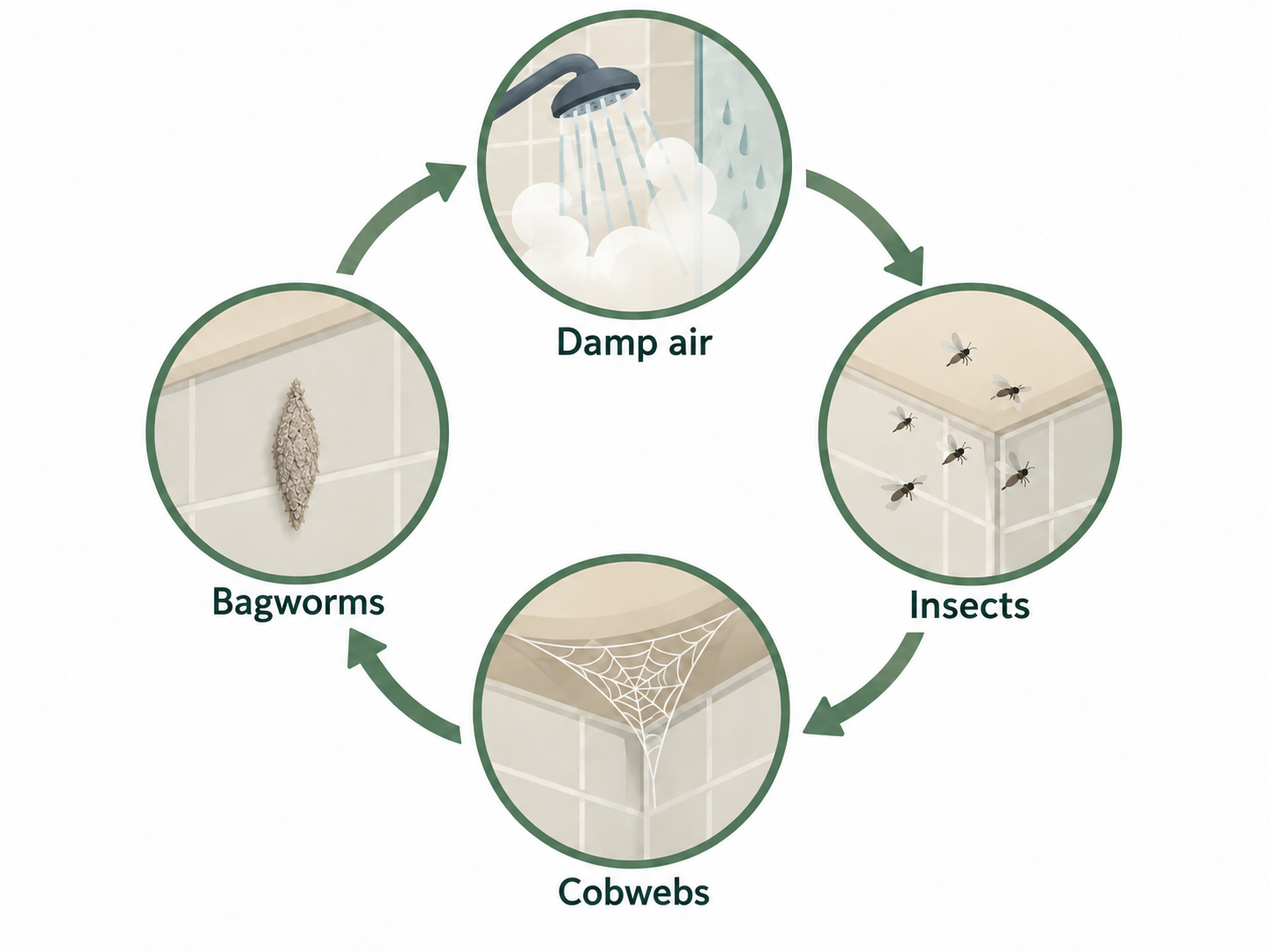
They’re plaster bagworms, and they’re not really the problem. They’re a sign that your bathroom stays damp long after everyone has showered, and that damp corners are collecting cobwebs and dust the larvae feed on. Good bathroom ventilation in Malaysia is what breaks that cycle. This guide covers what the cases are, why your bathroom attracts them, and the fixes in the order that works.
What Are Those Grey Cases on the Ceiling?
The cases belong to the plaster bagworm, also called the household casebearer (Phereoeca uterella), a small moth that’s common in Malaysian homes. What you see isn’t a cocoon in the usual sense. It’s a portable case of silk that the larva builds around itself and covers with dust, sand, paint flakes and bits of cobweb, which is why it blends into walls so well.
- Size and shape — flat, spindle-shaped, about 1–1.5 cm long, grey to light brown, open at both ends.
- Movement — the larva pokes its head out of either end and drags the case along walls and ceilings.
- Hanging still — when a case is fixed in place at a corner or joint, the larva is usually about to pupate. A small, dull grey moth comes out later and lays more eggs.
- Food — spider webs, dead insects, hair, lint and household dust.
They don’t bite, don’t carry disease and don’t damage plaster or tiles. Occasionally they nibble wool or other natural fibres. They’re a nuisance and a warning, not a danger.
Why Your Bathroom Attracts Them
Plaster bagworms do best where the air is humid, the corners are rarely disturbed and there’s food nearby. A poorly ventilated Malaysian bathroom offers all three.
- Humid air that never clears — outdoor humidity in Malaysia already sits around 70–90% for much of the year. Add a hot shower in a closed room and the air stays damp for hours, especially during the monsoon months.
- Spiders follow the damp — small insects gather in moist corners, spiders come to eat them, and their webs become food for bagworm larvae.
- Gaps and edges — the joint between tile and ceiling, cornices and ceiling boards give larvae sheltered spots to hang and pupate.
- Dust that sticks — damp surfaces hold dust and hair, which gives the larvae food and material for their cases.
The same damp air that brings bagworms also brings black mould on grout and silicone, peeling ceiling paint and a musty smell. Fix the airflow and you deal with all of them at once.
Step 1: Clear Out the Cases and Their Food Today
Start with the visible problem so you can tell whether new cases appear later.
- Vacuum or scrape off every case. Drop them into a sealed bag or crush them, because a larva can crawl back out of a loose case.
- Brush away cobwebs from ceiling corners, light fittings, the exhaust fan grille and behind the toilet cistern.
- Wipe the top edge of the wall tiles, the door frame and shelves, where dust settles.
- Check the rooms next door, especially wardrobes and storerooms, because larvae travel.
- If you keep finding many, spray a household insect spray along ceiling corners and skirting lines, then air the room out.
Spraying alone won’t keep them away. As long as the bathroom stays damp and spiders keep spinning webs, more moths will lay eggs there.
Step 2: Fix Bathroom Ventilation in Malaysia’s Humid Climate
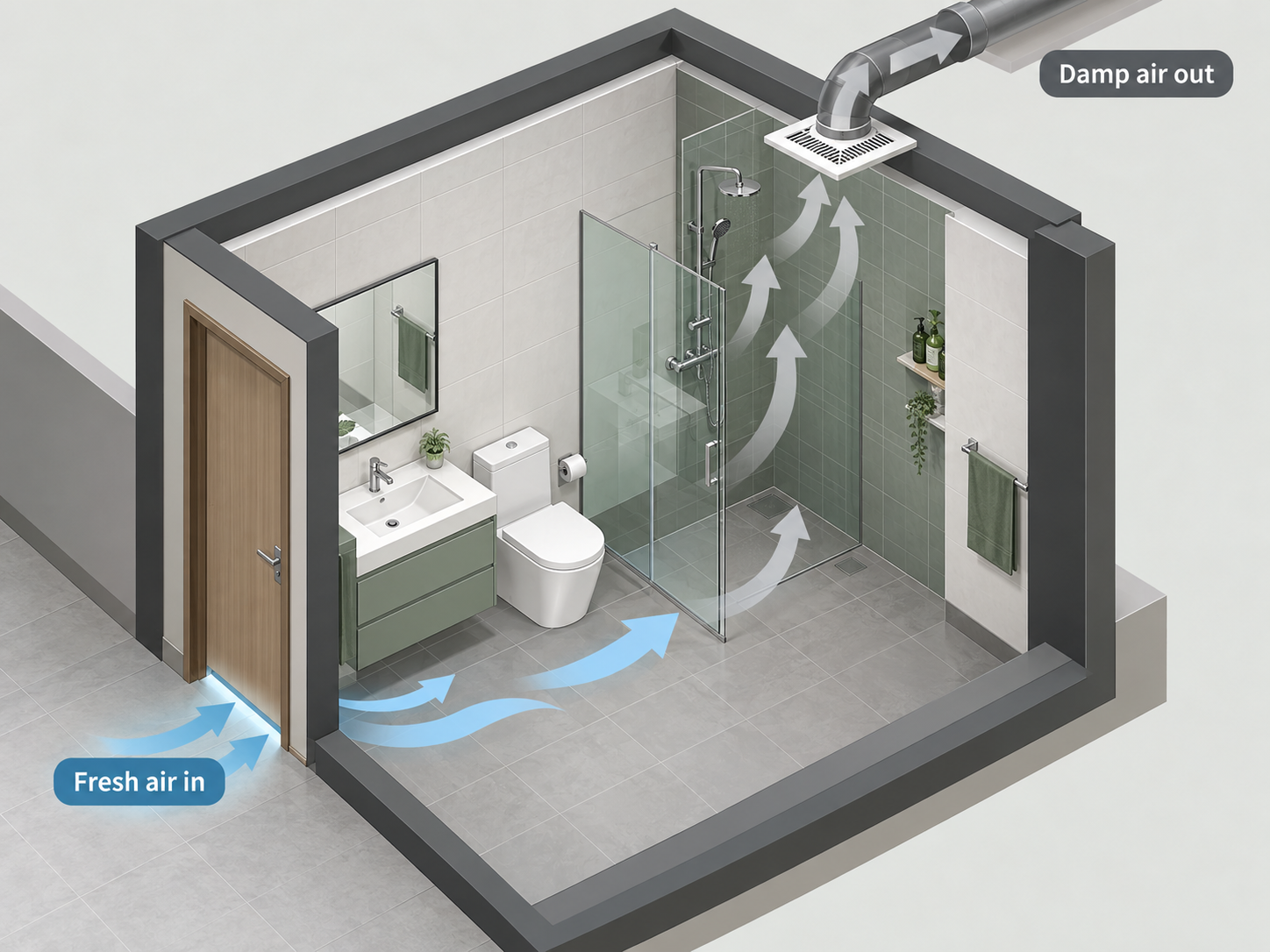
This is the step that stops the cases from coming back. The goal is simple: get the damp air from your shower out of the room within 20–30 minutes, and let drier air come in to replace it.
Check what you have now
Many bathrooms in Malaysian condos have no window, only a small ceiling exhaust fan ducted to a shaft. Older terrace houses often have a high louvre window and nothing else. Malaysia’s Uniform Building By-Laws (UBBL) require a bathroom to have either an opening to the outside or mechanical ventilation, but that minimum is often not enough for a family showering back to back.
Test yours with a sheet of toilet paper. Hold it against the exhaust fan grille while the fan is running. If it doesn’t stick firmly, the fan is too weak, the duct is blocked, or there’s no way for fresh air to get in.
Choose the right size exhaust fan
A bathroom needs roughly 8–10 complete air changes an hour. To size a fan, multiply the room volume (length × width × ceiling height in metres) by 10 to get the airflow needed in m³/h.
| Bathroom | Typical size | Room volume | Airflow needed |
|---|---|---|---|
| Small condo bathroom | 1.5 m × 2 m | about 8 m³ | about 80 m³/h |
| Common terrace bathroom | 2 m × 2.5 m | about 13.5 m³ | about 135 m³/h |
| Large master bathroom | 2.5 m × 3 m | about 20 m³ | about 200 m³/h |
Based on a 2.7 m ceiling. If the duct is long or has bends, choose a fan rated one size higher, because every metre of duct and every bend reduces the airflow you actually get.
For a fan near the shower, pick one rated IPX4 or higher, and have it wired by a competent electrician registered with Suruhanjaya Tenaga. Brands such as KDK, Panasonic and Fanco are widely available at hardware shops and online.
Run it long enough
Most people switch the fan off as they leave the bathroom, which is exactly when the room is most humid. Leave it running for 15–20 minutes after the last shower.
- Timer switch — the fan keeps running for a set time after you switch off the light.
- Humidity sensor switch — the fan turns on when humidity rises and off once the room is dry. This is the most reliable option for families with young children who won’t remember.
Let fresh air in
An exhaust fan can’t pull air out of a sealed room. If the door seals tightly at the floor, the fan just spins. A 1–2 cm gap under the door, or a small vent grille in the door, lets drier air from the rest of the house replace the damp air.
Use the window properly
If your bathroom has a window, open it during and after showering, not just when the room smells. In the monsoon season, when outdoor air is wet too, the exhaust fan does most of the work, so keep the window open only slightly and leave the fan running longer.
Condo rules for new ducting
Replacing an existing fan in the same spot is usually straightforward. Cutting a new hole through an external wall is not. In a strata property, the external wall is common property, so you need written approval from your JMB or MC before any core drilling. Ask management whether your bathroom has an existing duct to a ventilation shaft first, because connecting to that is cheaper and needs less approval.
Step 3: Seal the Gaps Where They Hide
Once the air is drier, take away the hiding places.
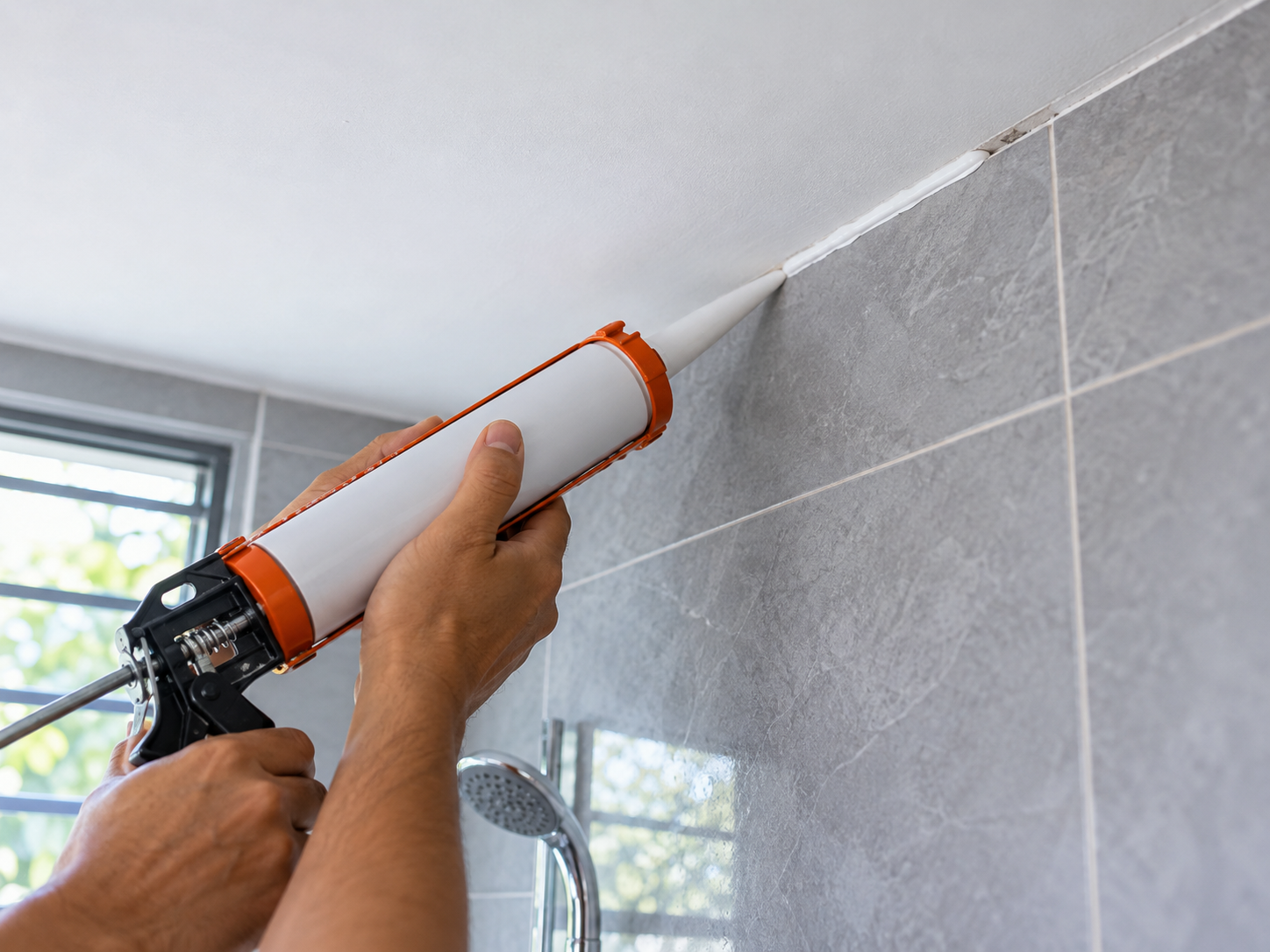
- Tile-to-ceiling joint — fill gaps with anti-fungal silicone sealant (sold at Mr. DIY and hardware shops), smoothed into a neat bead.
- Ceiling board edges and cornices — seal any cracks or open joints.
- Around pipes and the fan housing — gaps here let insects in from the ceiling space or shaft.
- Cracked tiles — a crack holds moisture and dust; small ones can often be fixed without hacking (see our guide to tile repair in Malaysia).
Remove old mouldy silicone completely before you apply new silicone. Sealing over mould traps it underneath, and it shows through within months.
How Much Better Bathroom Ventilation Costs in Malaysia
Most homes can fix the problem for a few hundred ringgit. Ducting is where the cost goes up.
| Item | Typical cost |
|---|---|
| Window or wall-mounted exhaust fan (unit only) | RM60–RM180 |
| Ceiling-mounted ducted exhaust fan (unit only) | RM90–RM400 |
| Replace an existing fan in the same position (labour) | RM80–RM200 |
| New ducted fan connected to an existing shaft or vent, installed | RM300–RM700 |
| New wall core hole for a duct (landed property) | RM200–RM500 |
| Timer or humidity sensor switch | RM40–RM150 |
| Door undercut or vent grille by a carpenter | RM50–RM120 |
| Anti-fungal silicone sealant (per tube) | RM15–RM35 |
Prices are for reference only (October 2026). Actual costs depend on the fan brand and airflow, the length of ducting, ceiling access, whether a new core hole needs JMB or MC approval, and where you live.
If you’re planning a bathroom renovation anyway, ask for a properly sized ducted fan and a humidity switch in the quotation. Leaving them out to save RM300 is one of the renovation mistakes Malaysians make that shows up later as mould and repainting.
Habits That Keep the Bathroom Dry
Equipment does most of the work, but a few habits help.
- Squeegee the walls and floor after showering, so less water evaporates into the air.
- Hang wet towels outside the bathroom where they can dry properly.
- Keep the door open when nobody is using the bathroom, if privacy allows.
- Clean the fan grille every month or two. A grille clogged with dust and lint can cut airflow noticeably.
- Brush the ceiling corners monthly, so spiders don’t settle and bagworms have nothing to feed on.
A bathroom you can walk into an hour after showering and find dry, with crisp white grout, bright ceiling paint and no musty smell, is the result to aim for. It also keeps the moisture away from your other rooms, part of the same indoor air quality that matters during haze season.
For Contractors and Renovators
If a client asks you to deal with recurring bagworms or mould, check the airflow before quoting for repainting.
- Measure the actual airflow, or at least test with a sheet of tissue, before suggesting a bigger fan. Blocked ducts and missing backdraft flaps are common in older condos.
- Size the fan for at least 8–10 air changes an hour, allowing for duct length and bends.
- Use anti-fungal paint on bathroom ceilings and anti-fungal sealant at joints, and seal the tile-to-ceiling line as standard.
- Plan an air inlet: a door undercut or grille, so the fan has replacement air.
- For new external penetrations in strata properties, include JMB or MC approval in your timeline and quotation.
Your Bathroom Ventilation Checklist
- All cases and cobwebs removed, including the rooms next door
- Exhaust fan passes the tissue test
- Fan airflow matches your room size (about 10 × room volume in m³/h)
- Fan runs 15–20 minutes after the last shower, ideally on a timer or humidity switch
- A gap under the door or a vent grille lets fresh air in
- Tile-to-ceiling joint and other gaps sealed with anti-fungal silicone
- Fan grille and ceiling corners on a monthly cleaning routine
- JMB or MC approval obtained before any new duct through an external wall
Scrape the cases today, but put your effort into the air. Once the bathroom dries out quickly after every shower, the spiders move on, the bagworms have nothing to eat, and that corner of the ceiling stays clean.