Our Location
304 North Cardinal St.
Dorchester Center, MA 02124

How to bring mid-century modern style into a Malaysian living room — walnut tones, tapered legs, and teak that actually suits the tropics.
How to bring mid-century modern style into a Malaysian living room — walnut tones, tapered legs, and teak that actually suits the tropics.
You’ve seen the look on enough Instagram reno accounts to recognise it instantly — a low walnut credenza, a tan leather sling chair on skinny brass legs, a starburst clock on the wall behind it. It reads warm and collected in a way most new-build condo living rooms don’t, and you want that same warmth without it tipping into a themed 1960s replica.
Mid-century modern living room design in Malaysia works by pairing the style’s signature warm wood tones, tapered furniture legs, and clean geometric lines with locally suited materials — teak instead of imported walnut where humidity is a concern, lacquered rather than raw brass, and a restrained retro colour accent rather than a full period palette. Done well, it gives a Malaysian living room a collected, lived-in warmth without needing an actual 1960s house to pull it off.
This breakdown walks through what makes mid-century modern work in a Malaysian living room, element by element — the furniture silhouette, the wood tone, the lighting, and the colour palette — plus the local adaptations, wood-warping prevention, and where to source the look, that keep it holding up through a full year of humidity and monsoon season.
Key Takeaways:
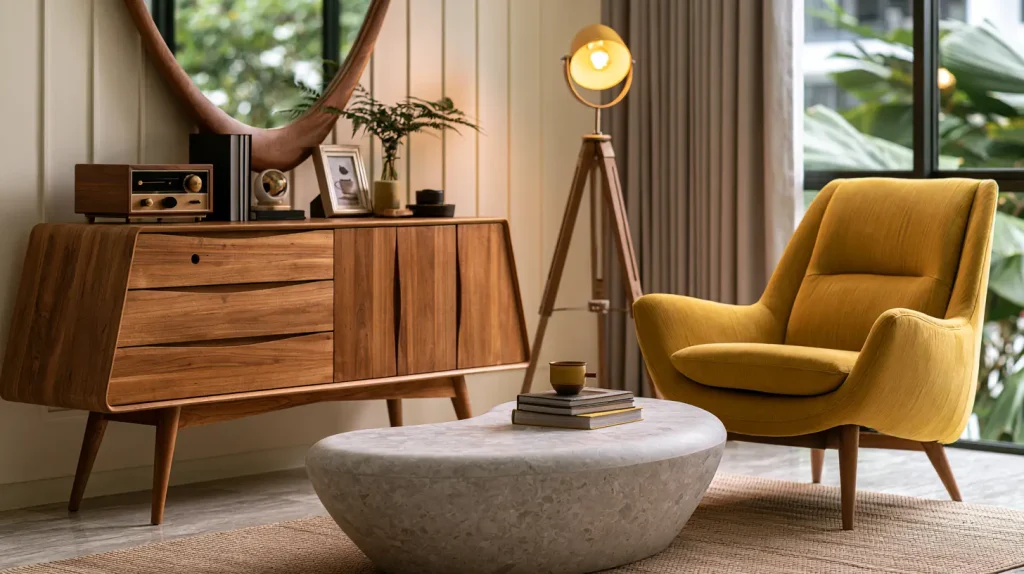
Mid-century modern grew out of post-war American and Scandinavian furniture design from roughly the 1940s to the 1960s — a reaction against ornate pre-war styles in favour of clean lines, functional forms, and an honest use of natural wood. Think Eames lounge chairs, tapered “peg” legs, and low-profile furniture designed to make small post-war homes feel more open.
That same low, open-plan instinct happens to suit a Malaysian condo living room unusually well. Mid-century furniture sits low to the ground and leaves visible floor space beneath it — tapered legs instead of solid skirted bases — which keeps a compact living-dining layout feeling larger than it is. The style’s love of warm, visible wood grain also overlaps with a material Malaysia already does well: teak, which was mid-century designers’ preferred hardwood decades before it became a staple of Malaysian furniture-making.
Here’s what makes this mid-century modern living room work — element by element.
The furniture silhouette is what a room reads as mid-century before any colour or lighting choice comes into play — it’s the single most identifiable element of the style.
Sofas, armchairs, and side tables sit on thin, angled wooden legs — often called “peg” or “hairpin-adjacent” legs — rather than a solid skirted base or a boxy frame that touches the floor along its full length. This keeps the furniture visually light and lets floor and rug show through underneath, which matters in a smaller Malaysian living room where every visible inch of floor makes the space read bigger. A single credenza on tapered legs, used as a TV console or sideboard, is usually the easiest single piece to build the whole room around.
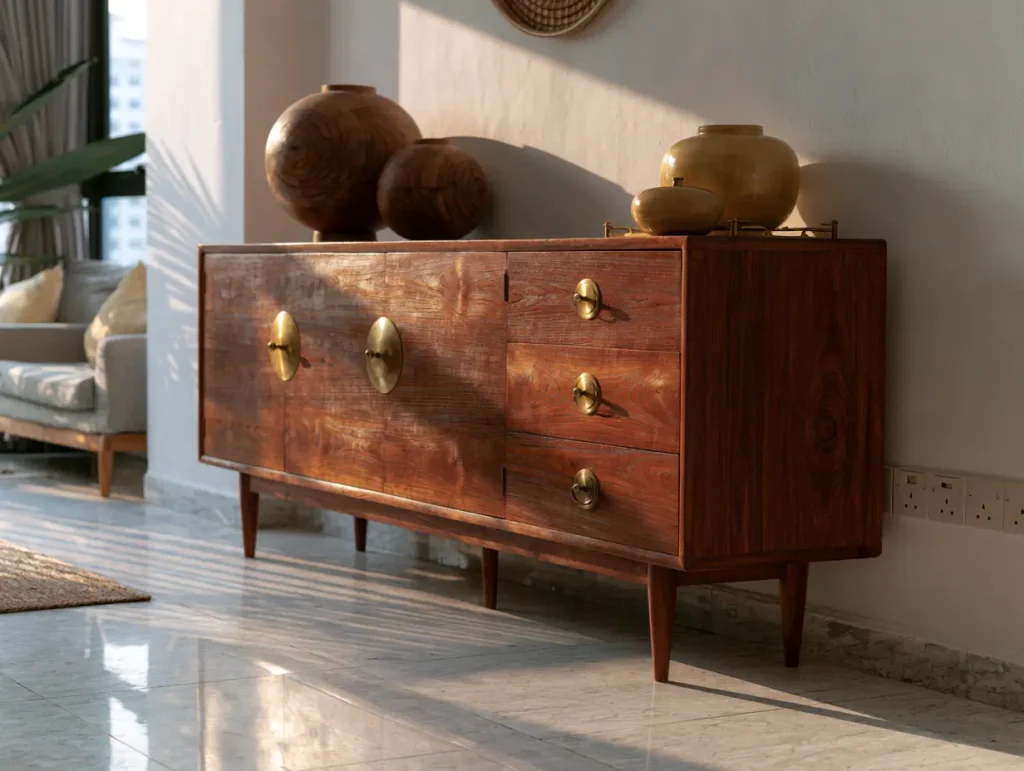
Wood is the material doing the most visual work in a mid-century room, and getting the tone right matters more than getting the exact species right.
Classic mid-century pieces used American walnut for its warm reddish-brown grain, but walnut is imported into Malaysia and reacts poorly to the swing between air-conditioned interiors and ambient tropical humidity — veneer can lift or crack over a few years without careful climate control. Teak, already well established in Malaysian furniture-making and naturally more humidity-stable, gives a near-identical warm tone and grain pattern at a lower cost and with far less long-term risk. Where a piece specifically calls for walnut’s darker, cooler-toned grain, an engineered walnut veneer over a stable local substrate is the safer choice over solid walnut.
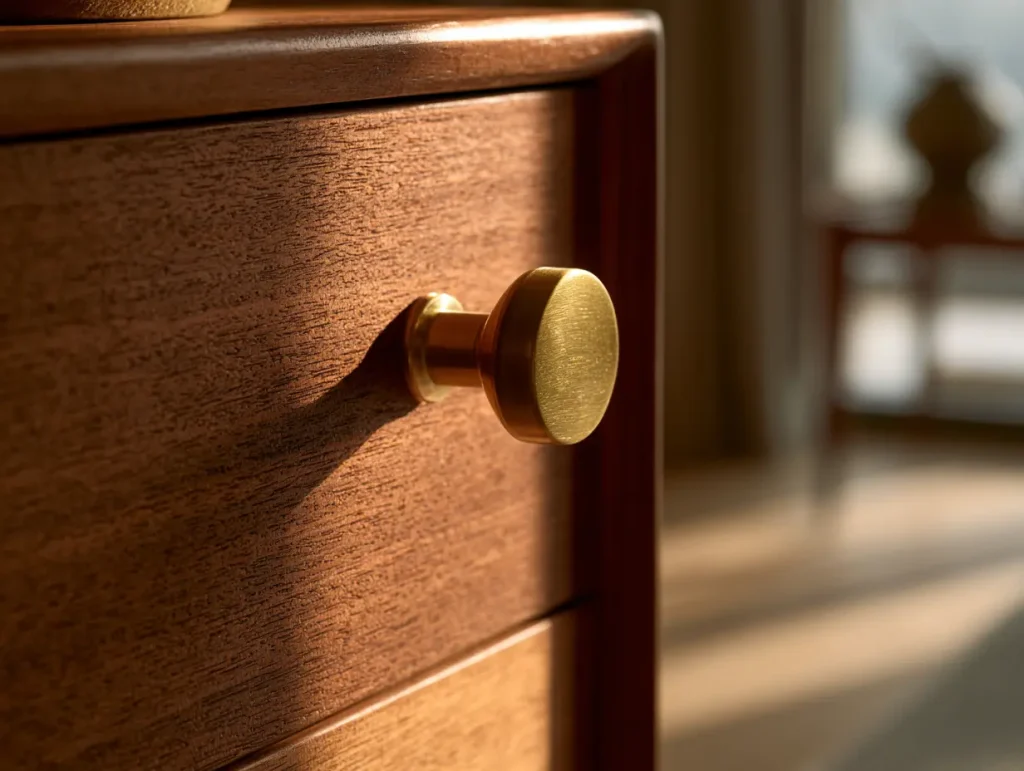
Brass is mid-century modern’s signature metal — used sparingly on furniture legs, door pulls, and lighting rather than as a dominant surface.
Raw or unlacquered brass tarnishes visibly within months in Malaysia’s 70–90% ambient humidity, developing a dull, blotchy patina that reads as neglect rather than the intentional aged look some homeowners actually want. Specify lacquered brass, PVD-coated brass-tone stainless steel, or powder-coated brass-effect finishes for hardware, lamp bases, and furniture legs — all three hold their warm gold tone indefinitely without the periodic polishing raw brass would demand in this climate.
Lighting is where a mid-century room signals its era most clearly, and it’s one of the cheapest elements to get right.
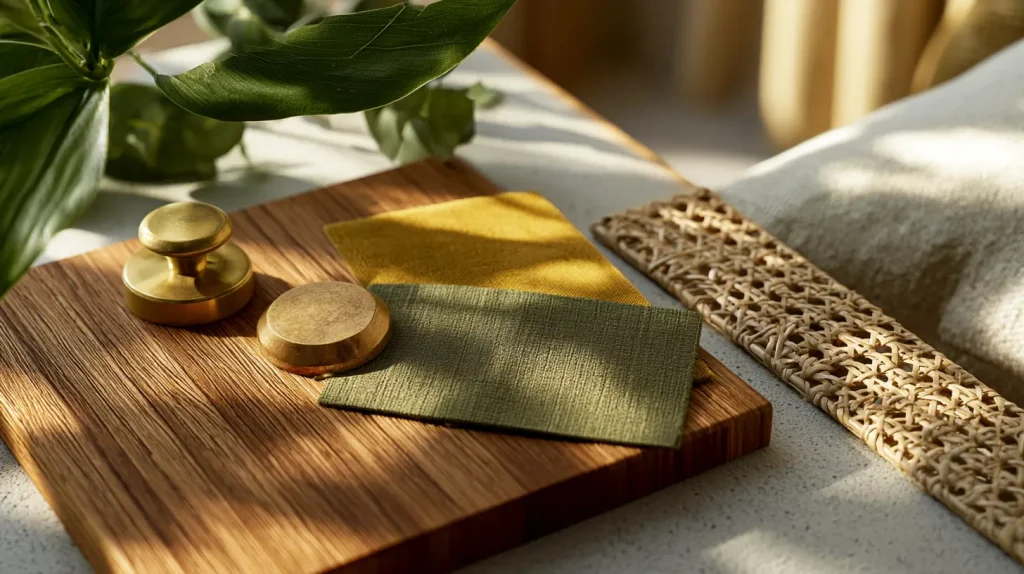
The mid-century palette works on three tiers, and Malaysian homeowners tend to overdo the accent tier when copying reference photos too literally.
Keep the accent to roughly 10% of the room’s visual surface. A single upholstered chair or a patterned rug does the job; matching cushions, curtains, and wall art in the same hue tips the room into costume territory.
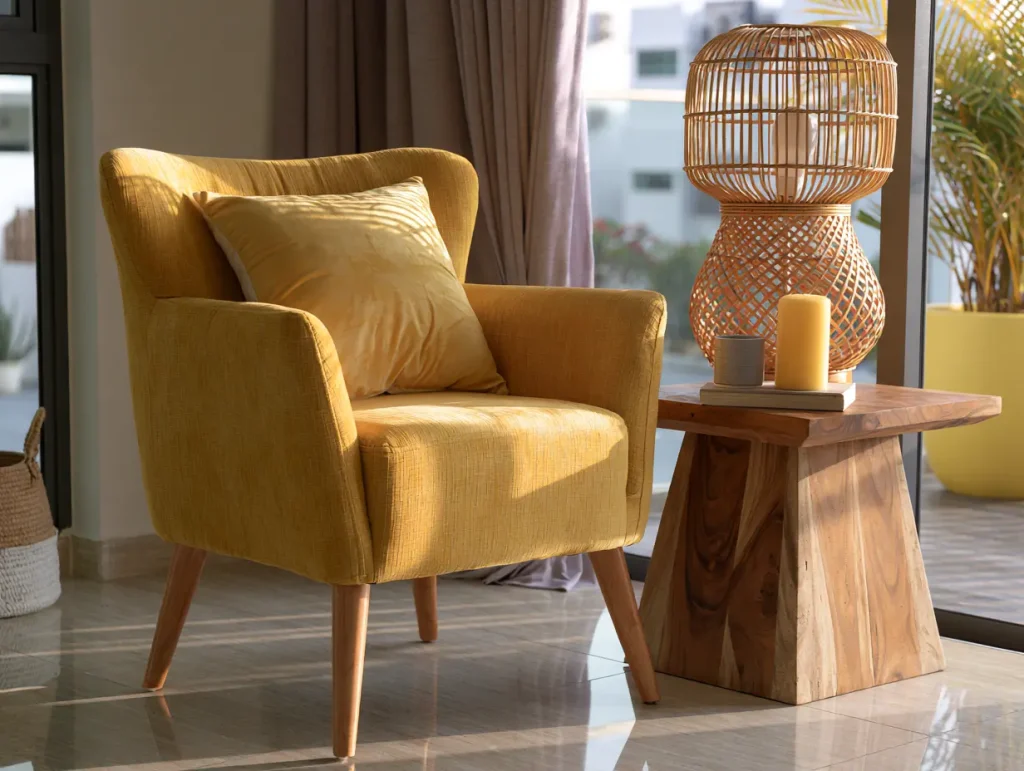
Mid-century design pairs two shape languages that shouldn’t work together but do — hard geometric forms (starburst clocks, angular shelving units) alongside soft organic curves (kidney-shaped coffee tables, rounded armchair backs).
A room that leans entirely geometric can feel stiff, and one that’s entirely organic can feel shapeless — the style’s character comes from the mix. A rectangular teak credenza paired with a round or kidney-shaped coffee table, or an angular shelving unit beside a curved-back accent chair, is the kind of deliberate contrast that reads as intentional rather than mismatched.
Solid imported hardwood and thin veneer are the two most climate-vulnerable choices in a mid-century room, and the failure mode looks different for each.
Raw brass, uncoated steel legs, and unlacquered metal trim all tarnish or dull within a single humid season in most Malaysian homes — a common surprise for homeowners who bought genuine vintage or unfinished-metal pieces expecting an aged patina to develop evenly.
Confirm with the furniture maker or supplier whether hardware is lacquered, powder-coated, or PVD-coated before purchase — this single spec question prevents the tarnishing problem outright, and most reputable local teak furniture makers already finish their brass-tone hardware this way as standard.
Mid-century modern is almost entirely a furniture-and-lighting-driven style rather than a structural one, which means it typically doesn’t require JMB or MC approval the way a feature wall or hacking work would. The one exception is a built-in credenza or wall-mounted shelving unit fixed directly to a shared or load-bearing wall — confirm with your building management whether wall-mounted fittings need sign-off before installation, since rules vary by building.
If you’re pairing this living room refresh with other renovation work in the same unit, our renovation timeline guide covers how long JMB approvals typically take for anything more structural.
| Element | Local Source | Estimated Cost |
|---|---|---|
| Teak credenza or TV console | Local teak furniture makers, Chin Hin Furniture, Shopee/Lazang local sellers | RM 1,200–4,500 |
| Tapered-leg accent chair | Journal East, local furniture showrooms, IKEA (retro-adjacent lines) | RM 600–2,500 |
| Lacquered brass hardware | Local hardware suppliers, Mr. DIY, Shopee local sellers | RM 15–80 per piece |
| Tripod or arc floor lamp | IKEA, Grid Furnishing, Shopee local sellers | RM 150–600 |
| Globe or sputnik pendant light | Local lighting shops (Jalan Ipoh, Klang Lama), Shopee | RM 90–450 |
| Rattan or cane-back accent chair | Local rattan furniture makers, Cameron Highlands rattan suppliers | RM 400–1,800 |
| Mustard or olive accent rug | IKEA, Cotton On Home, Shopee local sellers | RM 150–500 |
| Sintered stone coffee table top (organic-shaped) | Sinno Stone | RM 900–2,600 depending on size and finish |
Prices above are indicative estimates for reference only. Actual costs will vary depending on your interior designer, contractor, material choices, and project scope.
For a typical 12×15 ft Malaysian condo living room:
| Scope | Budget Range |
|---|---|
| DIY-friendly refresh (lighting, hardware swap, accent rug) | RM 1,000–3,500 |
| Mid-range (credenza + accent chair + lighting) | RM 6,000–15,000 |
| Full room (all furniture, custom teak pieces, stone accents) | RM 20,000–45,000 |
Prices above are indicative estimates for reference only. Actual costs will vary depending on your interior designer, contractor, material choices, and project scope.
For a full breakdown of where living room and whole-home renovation costs go, see our 2026 Malaysia renovation cost guide. If the warm-wood, low-profile look appeals but you want something even more pared-back, our Japandi living room guide shows a quieter, less colour-forward take on the same low-furniture instinct — and if you’d rather layer mid-century pieces into a mixed-material scheme, our texture layering guide covers how to combine wood, stone, and fabric without the room feeling busy.
Yes — mid-century furniture’s low profile and tapered legs actually suit small condo living rooms well, since the visible floor space beneath each piece makes the room read larger than a boxy, floor-to-base furniture arrangement would.
Teak is the more climate-appropriate choice for most Malaysian homes, since it’s naturally more humidity-stable than imported walnut and gives a near-identical warm wood tone at a lower cost.
Specify lacquered, powder-coated, or PVD-coated brass-tone finishes rather than raw or unlacquered brass, which tarnishes visibly within a few months of Malaysia’s typical 70–90% ambient humidity.
Usually not, since the style is almost entirely furniture and lighting-driven rather than structural — the one exception is a credenza or shelving unit mounted directly to a shared wall, which some buildings require sign-off for.
A mid-century modern living room in Malaysia doesn’t need to copy a 1960s American showroom wholesale — it needs the warm wood, the tapered leg, and one well-chosen retro accent, built from materials that actually hold up here. Teak does the job walnut was always doing, just better suited to this climate. Lacquered brass keeps its warmth without the upkeep raw brass would demand.
The practical concerns — wood warping, brass tarnish, whether a wall-mounted credenza needs JMB sign-off — are all solvable with the right specifications, not reasons to skip the style. One tapered-leg teak credenza and a single mustard or olive accent piece are usually enough to establish the whole look; the rest of the room can build outward from there. Rumaruma is here to help you make design decisions grounded in real local materials and real Malaysian conditions — this breakdown is your starting point.
Start with one teak credenza on tapered legs — the rest of the mid-century modern look builds naturally around it.
