Our Location
304 North Cardinal St.
Dorchester Center, MA 02124

A practical 2026 breakdown of home renovation costs in Malaysia — by room, house type, and scope — so you can budget with confidence.
You’ve got a home to renovate and a budget that feels either too tight or strangely undefined. Before you even call a contractor, you need one thing: a realistic number to anchor your planning.
The honest answer? Home renovation cost in Malaysia in 2026 ranges from RM15,000 for a light cosmetic refresh all the way to RM300,000 or more for a full-scale overhaul of a landed property. The gap is wide because scope, material choices, house type, and location all pull the number in very different directions. This guide breaks down each variable so you can build a budget that reflects your actual situation — not a best-guess figure from a forum post.
Note: All pricing figures in this guide are for reference and general guidance only. Actual costs vary depending on scope of work, material selections, contractor, and location. Always request written quotations from licensed contractors before making any financial decisions.
Before looking at any price table, understand the four levers that move your budget most dramatically.
This is the single biggest cost driver. A renovation can mean anything from repainting walls and swapping out light fixtures to knocking down every partition wall and starting fresh. Contractors classify work into three broad tiers:
Labour costs are fairly consistent across contractors of similar quality. What moves the needle is materials. A kitchen can cost RM18,000 with laminate cabinets or RM55,000 with solid wood and engineered stone countertops. Flooring alone can range from RM4 per square foot (basic homogeneous tiles) to RM25+ per square foot (large-format marble-look porcelain or timber). Your material choices will often account for 40–60% of the total bill.
A 650 sq ft studio and a 3,000 sq ft semi-D are simply different renovations — more rooms, more wet areas, more ceiling height, more material needed. Cost-per-square-foot estimates are a useful starting point but become less reliable as size increases because the ratio of wet areas (bathrooms, kitchen) to total floor area changes significantly.
Contractors based in Klang Valley — particularly DBKL and MBPJ jurisdictions — typically price 15–25% higher than those in secondary cities like Ipoh, Seremban, or Johor Bahru, reflecting higher overhead, transport costs, and labour rates. Always get at least three quotations and verify your contractor holds a valid CIDB Green Card for all workers on site.
These figures reflect mid-market renovation quality in the Klang Valley for 2026. Budget-tier work runs 20–30% lower; premium or luxury finishes run 50–100% higher.
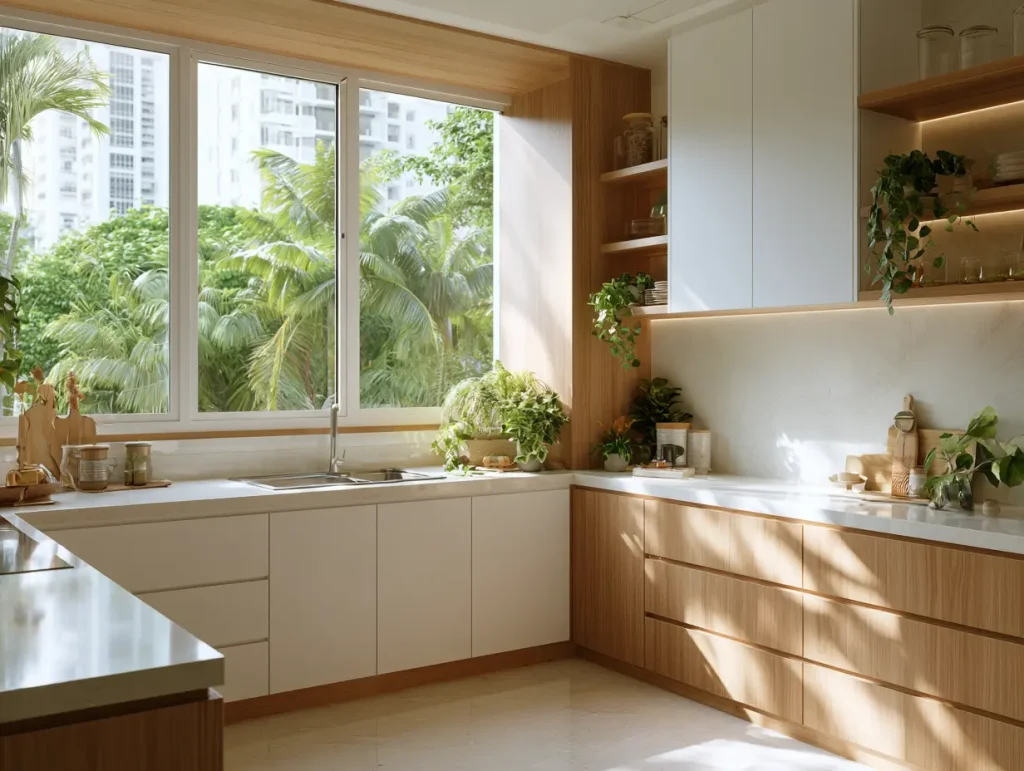
The kitchen is almost always the most expensive room in any renovation. Cabinets, countertops, appliances, tiling, plumbing diversion, and extraction all add up fast.
| Scope | Estimated Cost (RM) |
|---|---|
| Laminate cabinets, basic countertop, no layout change | RM15,000 – RM25,000 |
| Full kitchen with engineered stone countertop, semi-custom cabinets | RM28,000 – RM55,000 |
| Premium kitchen, solid surface / quartz countertop, appliance package | RM60,000 – RM120,000+ |
For Malaysian homes, engineered quartz or sintered stone countertops have become the practical standard — they handle heat, humidity, and the intensity of Malaysian cooking far better than marble or timber surfaces.
Bathroom renovations involve hacking, waterproofing, tiling, sanitary ware, and often lighting and ventilation upgrades. Waterproofing alone should never be skipped — Malaysia’s humidity makes this a structural necessity, not an optional extra.
| Scope | Estimated Cost (RM) |
|---|---|
| Basic retile, new sanitary ware, no layout change | RM8,000 – RM14,000 |
| Full hack, new layout, mid-range fittings | RM15,000 – RM25,000 |
| Premium finishes, rain shower, freestanding bath | RM28,000 – RM55,000 |
| Scope | Estimated Cost (RM) |
|---|---|
| Basic retile, new fittings | RM5,000 – RM10,000 |
| Full hack and refresh | RM10,000 – RM18,000 |
This typically covers flooring, feature wall or partition, built-in TV console or storage, ceiling works, and lighting.
| Scope | Estimated Cost (RM) |
|---|---|
| Paint, new flooring, basic built-ins | RM10,000 – RM20,000 |
| Feature wall, custom cabinetry, new false ceiling with lighting | RM22,000 – RM45,000 |
| Scope | Estimated Cost (RM) |
|---|---|
| Paint and flooring only | RM3,000 – RM7,000 |
| Built-in wardrobe, study desk, headboard panel | RM8,000 – RM20,000 |
The table below gives realistic total renovation ranges for common Malaysian property types in 2026. These assume a moderate renovation scope — not a bare cosmetic touch-up and not a luxury fit-out.
| Property Type | Size Range | Moderate Renovation Range (RM) |
|---|---|---|
| Studio / Serviced Apartment | 400–650 sq ft | RM20,000 – RM55,000 |
| 2-Bedroom Condominium | 700–950 sq ft | RM35,000 – RM80,000 |
| 3-Bedroom Condominium | 1,000–1,400 sq ft | RM55,000 – RM120,000 |
| Single-Storey Terrace | 1,200–1,600 sq ft | RM60,000 – RM130,000 |
| Double-Storey Terrace | 1,600–2,200 sq ft | RM80,000 – RM180,000 |
| Semi-Detached House | 2,200–3,200 sq ft | RM100,000 – RM250,000 |
| Bungalow | 3,500 sq ft+ | RM180,000 – RM400,000+ |
These are directional ranges, not quotes. Your actual number depends on the specific scope you agree with your contractor, material selections, and whether any structural or M&E (mechanical and electrical) work is involved.
The quotation your contractor gives you covers the work you discussed. It rarely covers everything that actually gets spent. Budget for these line items separately.
If you’re renovating a condominium or strata property, your Joint Management Body (JMB) or Management Corporation (MC) will require a renovation permit, a refundable deposit, and approval of your renovation plans before work begins. Deposit amounts vary by building — RM500 to RM3,000 is typical — but the permit process also adds time. Factor in 1–3 weeks for approval before hacking work can start.
For landed properties, check with your local PBT (city or municipal council) whether a building plan submission is required for structural changes.
Hacking generates significant waste. Not all contractors include lorry trips in their base quote. Budget RM500–RM2,000 per lorry load depending on debris volume and your location.
Older properties — particularly those built before 2000 — often have outdated wiring that cannot safely support modern appliance loads. A full rewire for a terrace house can run RM8,000–RM20,000 and is almost never included in a standard renovation quote unless you specifically request it.
Any layout change to kitchen or bathroom positions requires plumbing diversion, which is priced separately. Expect RM2,000–RM8,000 depending on the extent of repositioning.
New air-conditioning units, trunking, and installation are rarely bundled into renovation quotes. Budget RM1,500–RM3,500 per unit installed, plus trunking and wiring.
A renovated home still needs a sofa, dining table, bed frames, mattresses, curtains, and appliances. First-time homeowners frequently underestimate this. Budget a separate furniture envelope of RM15,000–RM50,000 on top of renovation costs, depending on your space and standards.

Contractors price based on what they know. Vague briefs produce vague quotes — and vague quotes become expensive surprises mid-project. Before approaching anyone, define exactly which rooms you’re renovating, what you want done in each, and your approximate material preferences (e.g. porcelain tile vs. vinyl plank flooring). A detailed scope produces comparable quotes and limits variation cost claims later.
Read the complete renovation checklist for Malaysian homeowners to make sure you’ve covered every decision point before your first contractor meeting.
Even the best-managed renovations encounter surprises — hidden pipes in the wrong place, subfloor levelling work, or materials that arrive damaged. Budget an explicit contingency of 15–20% on top of your agreed contract sum. If you don’t use it, it’s a pleasant surprise. If you need it, you’re not scrambling.
If budget is tight, spend where the consequences of cutting corners are most severe: waterproofing, electrical, plumbing, and structural integrity. A leaking bathroom discovered two years after renovation costs far more to fix than the money saved by using a cheaper waterproofing membrane. Aesthetics can be upgraded later; water damage cannot be undone cheaply.
You do not have to renovate everything at once. A practical approach for budget-constrained homeowners is to handle the kitchen, master bathroom, and main living area in Phase 1, then tackle secondary bedrooms and the second bathroom in Phase 2 a year or two later. This spreads cash outflow and lets you refine your preferences based on living in the renovated space.
Understanding how long each phase realistically takes is just as important as knowing the cost — see how long a full home renovation takes in Malaysia for a room-by-room timeline to set your schedule expectations.
Never accept a single verbal quote. Get a minimum of three written quotations from CIDB-registered contractors, and make sure each quote breaks down labour, materials, and individual line items separately. A lump-sum quote with no breakdown makes it impossible to compare fairly or identify where one contractor is cutting corners.
Home renovation cost in Malaysia in 2026 is not a fixed number — but it is a predictable one once you understand what drives it. Scope, materials, house type, and hidden line items all shape the final figure, and the homeowners who end up over budget are almost always the ones who skipped the planning stage.
The best time to make hard decisions about your renovation is before the hacking starts, not after. That means locking in your scope, choosing your materials with a clear budget ceiling per room, and building a contingency that reflects the reality of Malaysian construction rather than an optimistic forum estimate.
Rumaruma covers every stage of the Malaysian home renovation journey — from first-time budgeting questions to material selection deep-dives — so you can make decisions with real local context behind them.
Start with the numbers, plan the scope, and your renovation budget will hold — even when surprises don’t.
