Our Location
304 North Cardinal St.
Dorchester Center, MA 02124

How to turn the default developer-unit finish into an actual Modern Contemporary living-dining space, without a full gut renovation.
How to turn the default developer-unit finish into an actual Modern Contemporary living-dining space, without a full gut renovation.
You moved in, unpacked, and the living-dining area still looks like the showflat — white ceramic tiles, builder-grade white walls, a ceiling light point in the middle of the room and nothing else. It’s not ugly. It’s just nobody’s, and after a year of living in it, that starts to bother you more than any actual flaw would.
Modern contemporary living room design in Malaysia takes that same developer-unit starting point — neutral tiles, white walls, an open-plan living-dining layout — and gives it a defined palette, layered lighting, and a small number of considered material upgrades, rather than replacing everything the developer handed over. It’s the style built to work with the baseline most Malaysian condos already have, not against it.
This breakdown walks through what separates an actual modern contemporary living-dining space from a still-unfinished developer unit — palette, materials, lighting, and layout — plus the Malaysian-specific swaps and a realistic RM budget for getting there.
Key Takeaways:
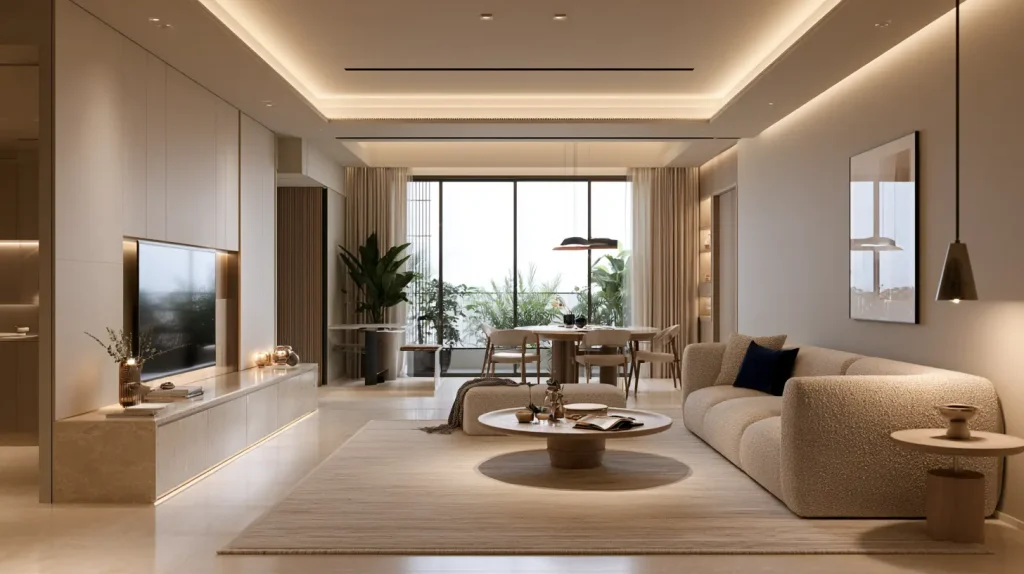
Modern contemporary isn’t one fixed look from one decade, the way mid-century or Art Deco are — it’s a moving target that borrows clean lines from minimalism, warmth from transitional style, and whatever material or colour is current, updated roughly every few years. That’s exactly why it’s the natural “baseline, elevated” style — it starts from the same clean-slate instinct a Malaysian developer unit already has.
The difference between a modern contemporary living room and an unstyled developer unit comes down to three things the showflat skipped: a defined colour palette instead of default white, layered lighting instead of one centre point, and two or three considered material choices instead of none. None of it requires hacking work — it’s a palette and lighting exercise more than a construction one, which makes it one of the more accessible styles to actually finish in a rented or freshly-bought Malaysian condo.
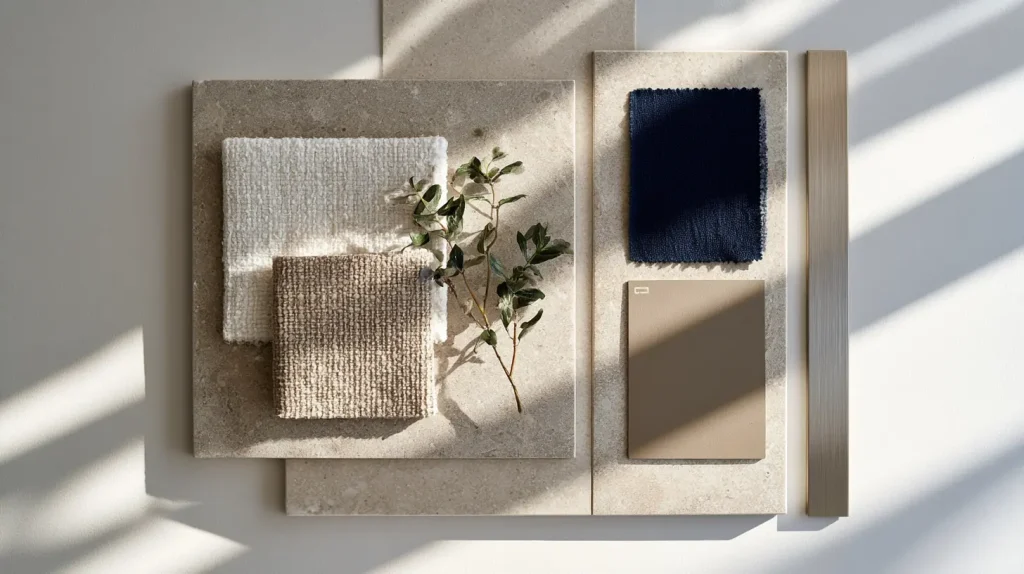
Here’s what separates a finished modern contemporary space from the developer-unit baseline — element by element.
The single biggest tell of an unfinished developer unit is a palette with no warmth in it — white ceramic floor tiles, white emulsion walls, and whatever colour the previous owner’s curtains happened to be.
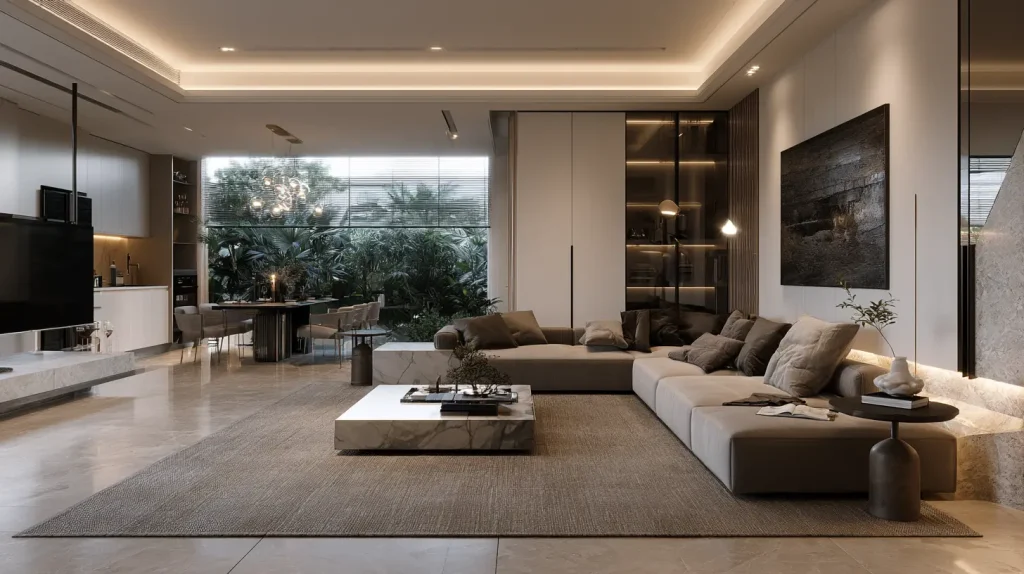
Modern contemporary swaps that flat white for a layered neutral base: a warm off-white or soft greige on the walls, a taupe or warm grey for larger upholstery, and the original white floor tiles left as-is or paired with a large area rug that ties the palette together. The goal isn’t more colour — it’s warmth within neutral, which is what makes a room read “designed” instead of “still moving in.”
Modern contemporary furniture keeps straight lines and simple silhouettes — a low-back sofa, a rectangular coffee table, minimal ornamentation — but avoids minimalism’s total restraint by allowing one deliberate textural contrast per piece.
A boucle or linen sofa paired with a matte-finish engineered stone coffee table gives the room the soft-versus-hard contrast that keeps clean lines from reading cold. The same logic applies to a dining set — a simple rectangular or oval table in a matte finish, paired with chairs in a contrasting material (woven rattan-look synthetic, boucle, or leatherette) rather than a fully matching set from one showroom package.
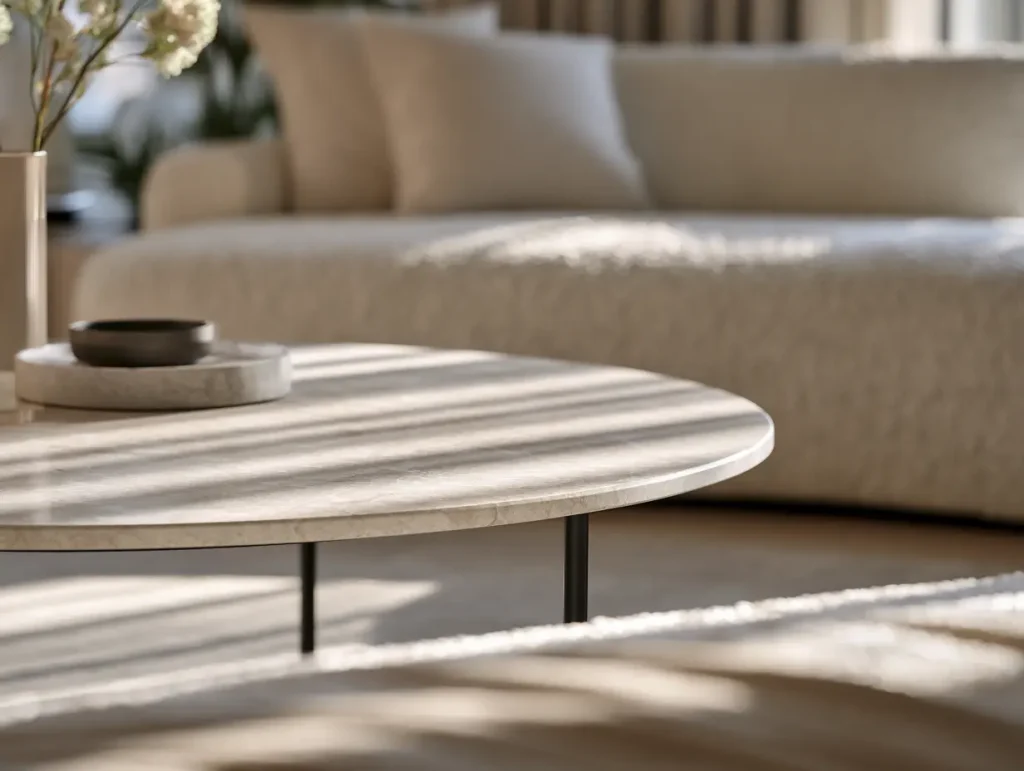
Where mid-century leans on walnut and Japandi leans on light oak, modern contemporary’s defining material is engineered or sintered stone — used on a TV console, coffee table, or dining tabletop for a clean, seamless surface with visible but subtle veining.
Almost every Malaysian developer unit ships with a single ceiling light point in the middle of the living room — functional, but flat, and the fastest way to make a room look unfinished regardless of what furniture sits underneath it.
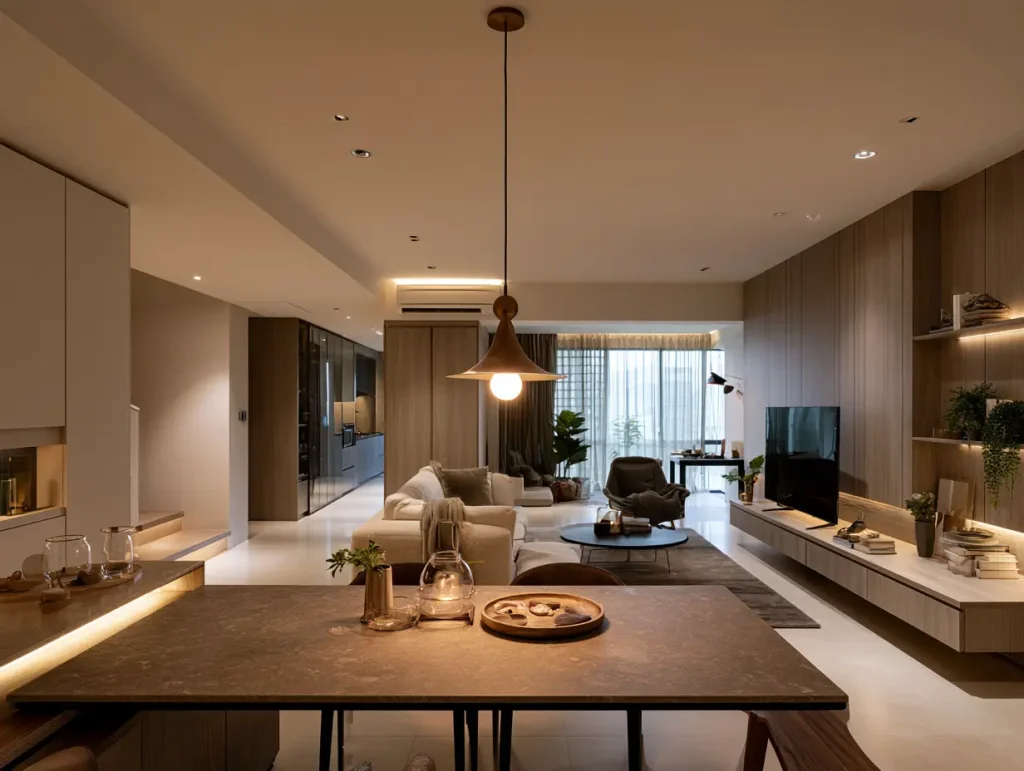
Most Malaysian condos already come with an open-plan living-dining layout by default — the challenge isn’t creating openness, it’s stopping the space from reading as one undefined room.
A large area rug under the sofa marks the living zone without a physical divider; a pendant light directly over the dining table marks that zone the same way. Where a firmer division is wanted, a stone-clad TV console or a slim open shelving unit — positioned side-on rather than as a full wall — keeps sightlines open while still giving each zone its own visual anchor.
Modern contemporary’s materials are generally humidity-friendlier than more wood-heavy styles, but a few specific choices still matter in Malaysia’s climate.
Malaysia’s daylight runs roughly 7am to 7pm year-round with minimal seasonal shift, which means most Malaysian living rooms rely on artificial lighting for a longer stretch of the evening than homes in temperate climates. Layered lighting isn’t just an aesthetic upgrade here — it’s doing real functional work for a room that spends more of its “awake hours” lit artificially than naturally.
Sheer curtains rather than heavy blackout drapes are usually the better daytime choice too, since they diffuse Malaysia’s strong midday glare without blocking the room off from natural light entirely.
Because modern contemporary is largely a palette, furniture, and lighting exercise, most of what’s described here — paint, furniture, a stone-topped console, recessed downlights on the existing ceiling — doesn’t require JMB or MC approval. The one exception is any ceiling rework involving false ceiling installation for cove lighting, which some buildings classify as renovation work requiring notification even without structural hacking.
Check with your building management before starting false ceiling or electrical work — our renovation timeline guide covers how long JMB approvals typically take if your scope grows beyond a cosmetic refresh.
| Element | Local Source | Estimated Cost |
|---|---|---|
| Engineered stone TV console or coffee table top | Sinno Stone | RM 1,000–3,500 depending on size and finish |
| Boucle or linen-look sofa | IKEA, Grid Furnishing, local furniture showrooms | RM 1,800–5,500 |
| Recessed downlights (per point, supply + install) | Local electrician, Mr. DIY (fittings) | RM 60–150 per point |
| LED cove lighting strip (per linear metre) | Local electrical suppliers, Shopee | RM 40–90 per metre |
| Dining pendant light | Local lighting shops (Jalan Ipoh, Klang Lama), IKEA | RM 150–600 |
| Large area rug (living zone) | IKEA, Cotton On Home, Shopee local sellers | RM 200–700 |
| Wall paint (per room, materials + labour) | Nippon Paint, local painter | RM 800–1,800 |
Prices above are indicative estimates for reference only. Actual costs will vary depending on your interior designer, contractor, material choices, and project scope.
For a typical 12×18 ft Malaysian condo living-dining space:
| Scope | Budget Range |
|---|---|
| DIY-friendly refresh (paint, lighting swap, rug, cushions) | RM 1,500–4,000 |
| Mid-range (above + stone console/coffee table + sofa) | RM 8,000–18,000 |
| Full room (custom stone pieces, false ceiling cove lighting, full furniture set) | RM 22,000–50,000 |
Prices above are indicative estimates for reference only. Actual costs will vary depending on your interior designer, contractor, material choices, and project scope.
For a full breakdown of where living room and whole-home renovation costs go, see our 2026 Malaysia renovation cost guide. If the clean-lined look appeals but you’d rather keep every surface pared back to almost nothing, our Japandi living room guide shows a quieter, more minimal take on the same open-plan starting point — and if your space mixes several materials already, our texture layering guide covers how to combine stone, wood, and fabric without it feeling busy.
Modern contemporary allows a defined accent colour, mixed textures, and a slightly warmer palette, while minimalist design strips a room back to as few colours and materials as possible — modern contemporary is closer to “curated,” minimalist is closer to “restrained.”
Yes — for most developer units, a warm neutral repaint, layered lighting, an area rug, and one or two considered furniture pieces get most of the way there without any hacking work or structural change.
Engineered or sintered stone is the better choice over natural marble, since it resists Malaysia’s humidity and daily wear without the etching, staining, or sealing that natural stone requires.
Usually not, since most of the work is paint, furniture, and lighting on existing fixtures — the one exception is false ceiling installation for cove lighting, which some buildings require notification for even without structural hacking.
A modern contemporary living-dining room doesn’t ask a Malaysian homeowner to gut what the developer handed over — it asks for a warm neutral palette instead of stark white, layered lighting instead of one centre point, and one or two considered material choices instead of none. The open-plan layout most condos already have is the style’s natural home, not an obstacle to work around.
The practical concerns — humidity-safe surfaces, which lighting changes need JMB sign-off, where to actually source an engineered stone console locally — are all solvable without a full renovation budget. Rumaruma is here to help you make design decisions grounded in real local materials and real Malaysian conditions, whether you’re refreshing one room or planning a full fit-out.
Start with a warm neutral repaint and one layer of proper lighting — the rest of the modern contemporary look builds naturally from there.
