Our Location
304 North Cardinal St.
Dorchester Center, MA 02124

How to blend classic furniture silhouettes with clean modern lines for a timeless, resale-safe living-dining room in your Malaysian condo.
How to blend classic furniture silhouettes with clean modern lines for a timeless, resale-safe living-dining room in your Malaysian condo.
You’ve bookmarked minimalist living rooms that feel too bare and traditional ones that feel like your parents’ house — and you keep putting off the decision because neither one feels like a safe bet for a room you’ll live with for the next ten years. That hesitation is worth listening to. A renovation in Malaysia isn’t something most homeowners redo every few years, so committing hard to one trend is a real risk.
Transitional living room design solves exactly that problem — it pairs classic furniture silhouettes (rolled arms, tapered legs, camelback curves) with the clean lines and restrained palette of modern design, so the room reads considered and current without chasing a look that dates fast. It’s the style least likely to feel wrong in five years, which is exactly why it’s the easiest one to get right on a first attempt.
This guide breaks down what actually makes a space read as transitional — furniture, palette, texture, and detailing — plus why it suits a Malaysian condo’s open-plan living-dining layout, the humidity-safe material swaps that matter locally, and a realistic RM budget for pulling it off.
Key Takeaways:
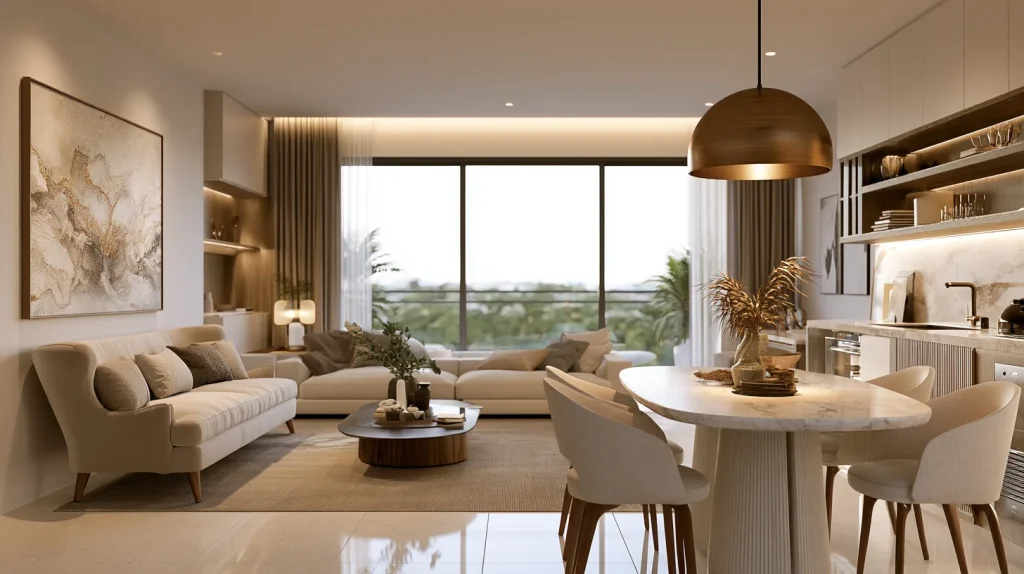
Transitional design sits deliberately between two extremes — the ornate carving and heavy silhouettes of traditional furniture, and the stark, almost furniture-less restraint of pure minimalism. It borrows the comfort and familiar shapes of the former, and the clean lines and lack of clutter from the latter, landing on something that reads timeless rather than trend-driven.
That’s precisely why it suits a Malaysian condo. Most homeowners here renovate once, live with the result for a decade or more, and don’t have the appetite to redo a living-dining space every time a style falls out of favour. Transitional doesn’t ask you to bet on a specific era — a mid-century sputnik chandelier or an industrial exposed-concrete wall — it asks for a handful of classic shapes softened by modern restraint, which ages far more gracefully.
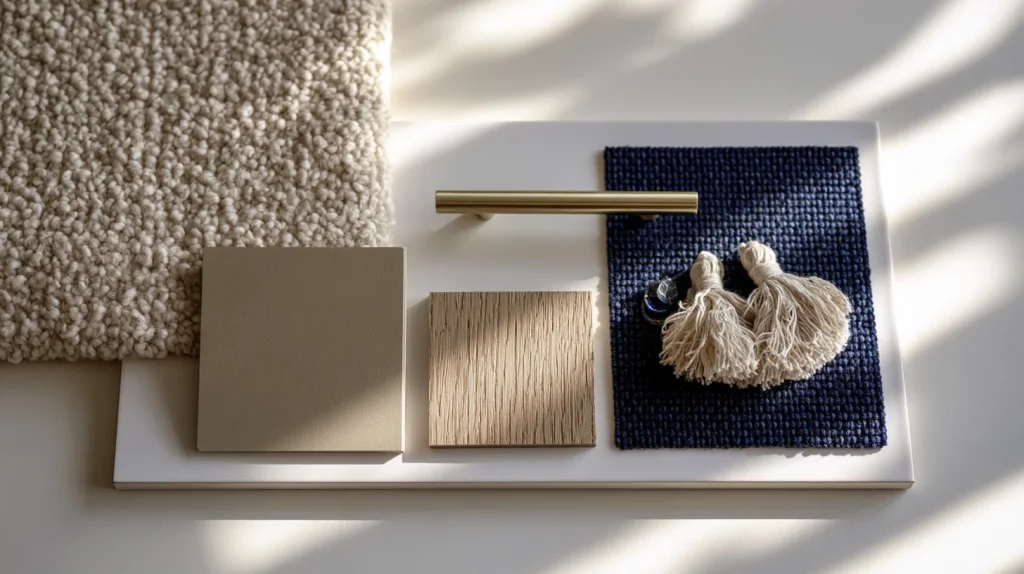
Here’s what actually separates a transitional space from a generic “neutral living room” — the specific choices that give it a recognisable identity.
The defining move in transitional furniture is pairing one curved, classic-shaped piece with otherwise straight-lined surroundings — a rolled-arm or camelback sofa in a slim, modern-depth profile, not the overstuffed version your grandparents had.
Transitional leans on tone-on-tone neutrals — cream, warm taupe, soft camel — built up in layers rather than flat across one wall colour and one furniture colour.
Where traditional design often leans on print — florals, damask, stripes — transitional gets its visual interest from texture contrast instead, which also happens to be a far easier look to keep looking fresh in a humid climate.
Bouclé or linen upholstery next to a brushed brass lamp base, a woven rattan pendant shade over a stone-topped dining table, a nubby wool-look rug under a smooth leather armchair — the room should feel tactile even though every piece is a similar colour. Our texture layering guide covers how to combine stone, wood, and fabric like this without it tipping into visual clutter.

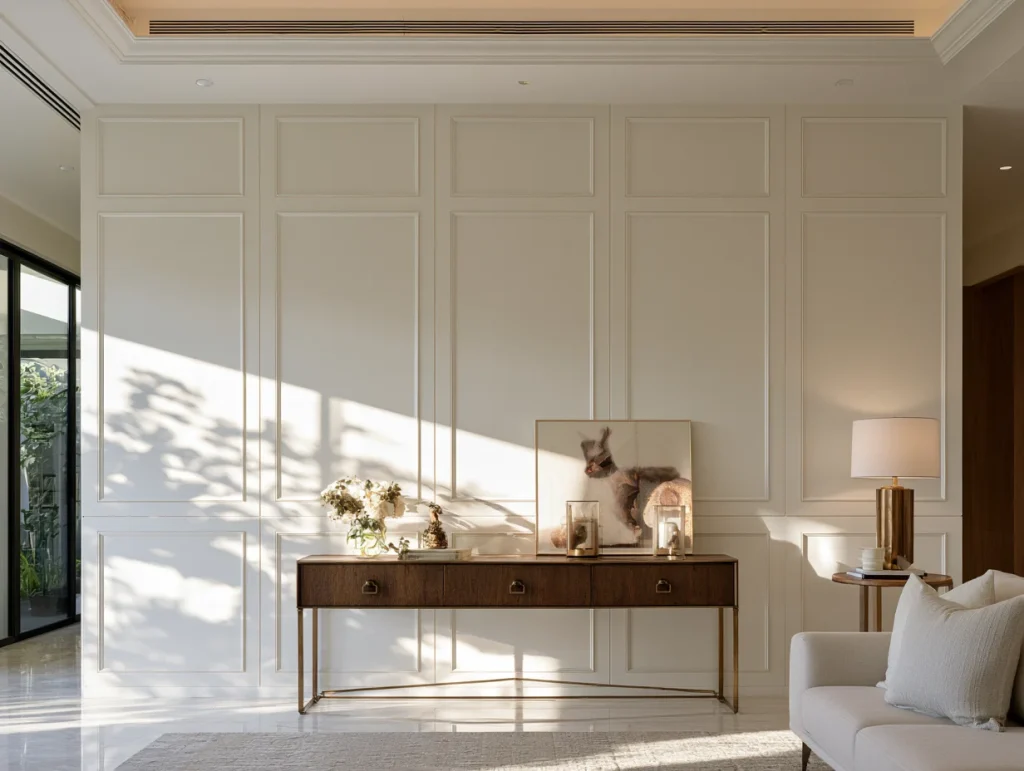
A small number of classic architectural or hardware details go a long way in transitional design, as long as they’re used with restraint rather than layered on thick.
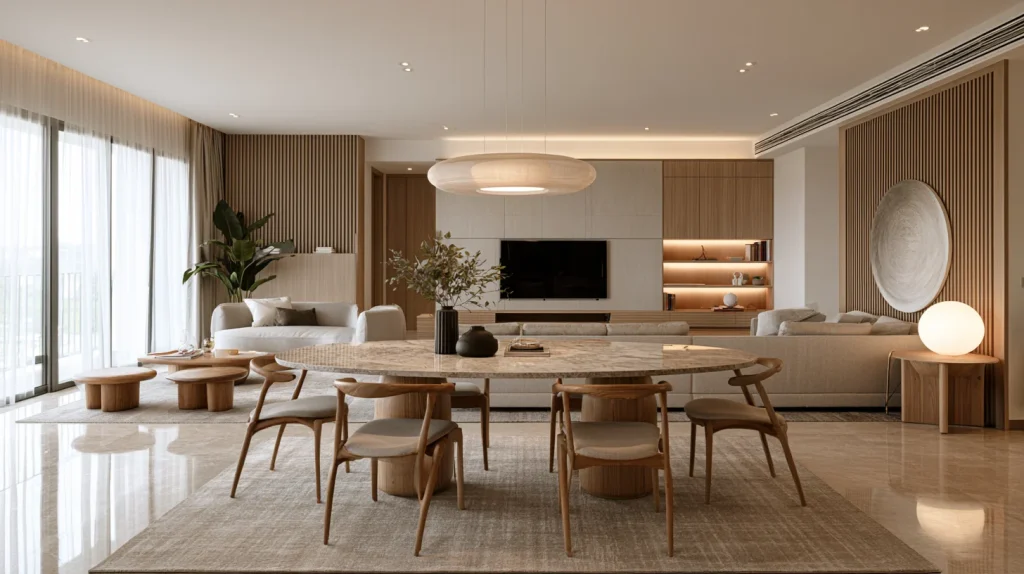
Most Malaysian condos hand over an open-plan living-dining space by default, and transitional style is unusually good at making that single room feel like one considered scheme rather than two mismatched zones.
An oval or rounded-edge dining table echoes the curves in the living zone’s sofa and coffee table, while a consistent neutral palette and repeated brass or wood tones across both areas tie the eye through the whole space. A rug under the sofa and a pendant over the dining table mark the two zones without needing a physical divider — the same zoning trick modern contemporary uses, just carried by softer, more classic shapes.
Transitional style traditionally leans on solid dark timber, but a few local substitutions matter in Malaysia’s climate.
Malaysia’s daylight runs roughly 7am to 7pm with little seasonal shift, so a transitional living-dining room spends a long evening stretch relying on artificial light — and warm-toned lighting matters more here than in a climate with longer natural daylight hours.
A single classic-shaped pendant (drum, lantern, or fluted glass) over the dining table, paired with warm 3,000K bulbs throughout, keeps the room feeling inviting after dark rather than clinical. Sheer curtains diffuse Malaysia’s strong midday glare during the day without shutting the room off from natural light the way heavy blackout drapes would.
Most of what makes a room read as transitional — paint, furniture, a stone-topped console, hardware swaps, a new pendant light — doesn’t require JMB or MC approval since it doesn’t touch structure or building systems. Panel moulding or wainscoting applied directly to an existing wall is usually cosmetic too.
The exception is any built-in carpentry that involves false ceiling work for a statement pendant’s electrical point, or wall furring to install deeper wainscoting — some buildings classify that as renovation work requiring notification. Check with your building management before starting, and see our renovation timeline guide for how long JMB approvals typically take once a scope grows beyond a cosmetic refresh.
| Element | Local Source | Estimated Cost |
|---|---|---|
| Engineered stone dining or console top | Sinno Stone | RM 1,200–4,000 depending on size and finish |
| Rolled-arm or camelback sofa | IKEA, Grid Furnishing, local furniture showrooms | RM 2,500–6,500 |
| Panel moulding / wainscoting (per linear ft, materials + install) | Local carpenter, Mr. DIY (mouldings) | RM 35–80 per linear ft |
| Brass or aged-brass cabinet hardware (per pull) | Local hardware suppliers, Shopee | RM 15–45 per pull |
| Statement pendant light (drum or lantern style) | Local lighting shops (Jalan Ipoh, Klang Lama), IKEA | RM 200–800 |
| Bouclé or linen-look armchair | Grid Furnishing, local furniture showrooms | RM 900–2,800 |
| Wall paint (per room, materials + labour) | Nippon Paint, local painter | RM 800–1,800 |
Prices above are indicative estimates for reference only. Actual costs will vary depending on your interior designer, contractor, material choices, and project scope.
For a typical 12×18 ft Malaysian condo living-dining space:
| Scope | Budget Range |
|---|---|
| DIY-friendly refresh (paint, hardware swap, pendant light, cushions) | RM 1,800–4,500 |
| Mid-range (above + stone console/table top + one statement sofa or armchair) | RM 9,000–20,000 |
| Full room (custom stone pieces, wainscoting, full furniture set) | RM 24,000–55,000 |
Prices above are indicative estimates for reference only. Actual costs will vary depending on your interior designer, contractor, material choices, and project scope.
If you’re weighing transitional against a cleaner-lined alternative, our modern contemporary living room guide covers the more minimal, palette-and-lighting-led version of the same open-plan starting point. For where these costs sit against a full renovation, our 2026 Malaysia renovation cost guide breaks down room-by-room and whole-home budgets in more detail.
Transitional style combines classic furniture silhouettes — rolled arms, tapered legs, curved backs — with the clean lines and restrained palette of modern design, landing between traditional and contemporary rather than committing fully to either.
Yes — because it relies on a small number of considered pieces and a tone-on-tone palette rather than heavy ornamentation, it works well in a compact open-plan living-dining layout without feeling crowded.
A warm neutral base — cream, taupe, or soft camel — paired with one richer accent tone like navy, forest green, or burgundy used on a single piece, rather than a full traditional colour scheme.
Usually not, since panel moulding applied directly to an existing wall is cosmetic — approval is typically only needed if the work involves false ceiling changes or structural wall furring.
A transitional living-dining room isn’t a compromise between two styles you couldn’t choose between — it’s a deliberate bet on shapes and materials that don’t date the way a single decade’s trend does. One curved sofa, a tone-on-tone palette, and a little restrained detailing does more work than a room full of ornamentation ever would.
The practical questions — which materials survive Malaysia’s humidity, what actually needs JMB sign-off, where to source an engineered stone tabletop locally — are all solvable without overthinking the style itself. Rumaruma is here to help you make those calls with real local materials and real Malaysian conditions in mind, whether you’re refreshing one room or planning the whole unit.
Start with one classic-shaped piece and a tone-on-tone palette — the rest of the transitional look builds naturally around it.
