Our Location
304 North Cardinal St.
Dorchester Center, MA 02124

How to bring industrial style into a Malaysian living room — exposed concrete, black metal, and factory lighting that hold up in the humidity.
How to bring industrial style into a Malaysian living room — exposed concrete, black metal, and factory lighting that hold up in the humidity.
You’ve pinned enough loft-style living rooms to know the look you want — raw concrete, black steel frames, that stripped-back warehouse feel with nothing dressed up or hidden away. Then you remember you live in a 900 sq ft condo in Petaling Jaya, not a converted factory in Brooklyn, and the whole thing suddenly feels like it belongs somewhere else.
Industrial living room design in Malaysia works by pairing raw, unfinished-looking materials — exposed concrete or textured plaster, black metal fixtures, factory-style pendant lighting — with humidity-safe finishes and warm accents that stop the room from reading cold in a tropical climate. Done right, it swaps the polished condo-developer look for something with more texture and character, without needing an actual factory shell to pull it off.
This breakdown walks through what makes industrial style work in a Malaysian living room, element by element — the wall treatment, the metal hardware, the lighting, and the colour palette — plus the local adaptations, rust-proofing, JMB approval, and where to source the look, that keep it liveable through a full year of humidity and monsoon season.
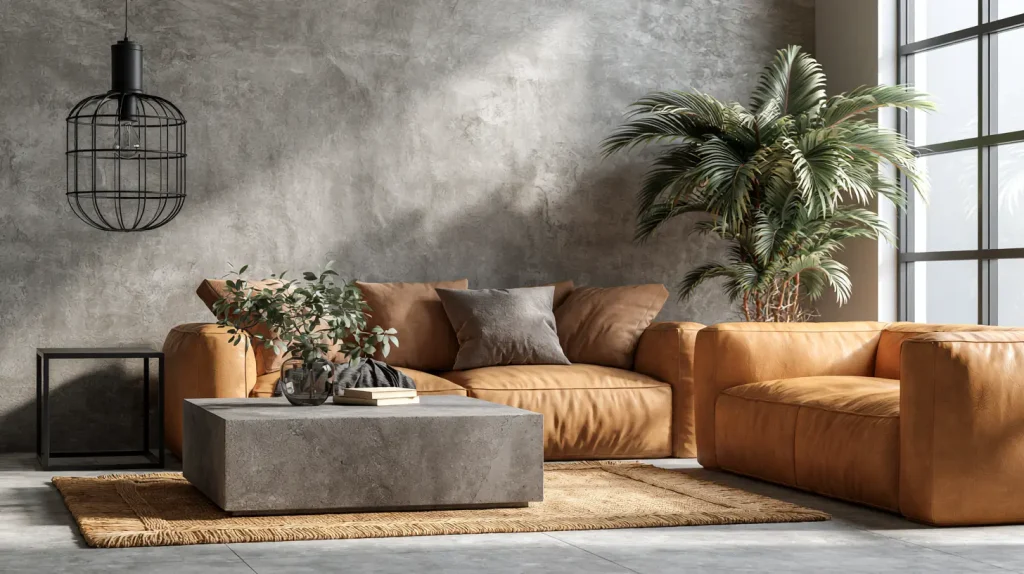
Industrial design comes from converted warehouses and factory floors — spaces where concrete, brick, and steel were structural necessities, not decoration, and nobody bothered to hide them behind plaster and paint. The style took that honesty and turned it into an aesthetic: nothing polished for the sake of polish, materials left visibly doing their job.
Strip away the factory-conversion backstory and what’s left translates surprisingly well to a Malaysian condo. Most units already have a raw concrete slab under the flooring and a bare structural column or two hiding behind plasterboard — the bones of the look are often already there, just covered up. The real design work is choosing which surfaces to expose or mimic, and which black metal and warm accents to layer on top so the room reads considered rather than unfinished.
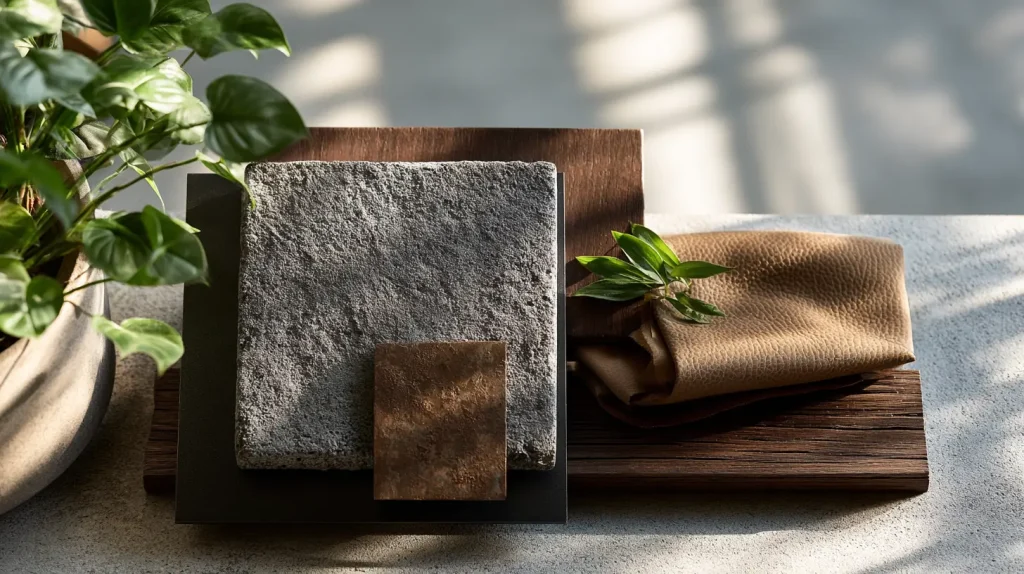
Here’s what makes this industrial living room work — element by element.
The feature wall sets the tone for the whole room, and in industrial style it’s almost always some version of raw concrete — real, exposed, or convincingly faked.
Genuinely exposing structural concrete in a Malaysian condo is rarely realistic — it usually means hacking through finished plaster on a shared or load-bearing wall, which most JMBs won’t approve. The workaround most Malaysian homeowners use instead is a microcement or concrete-effect skim coat applied over the existing wall, which gives the same matte, faintly imperfect surface without touching the structure underneath. A single feature wall behind the sofa or media console is usually enough — wrapping the whole room in concrete-look finish tends to feel more like a basement than a living room.
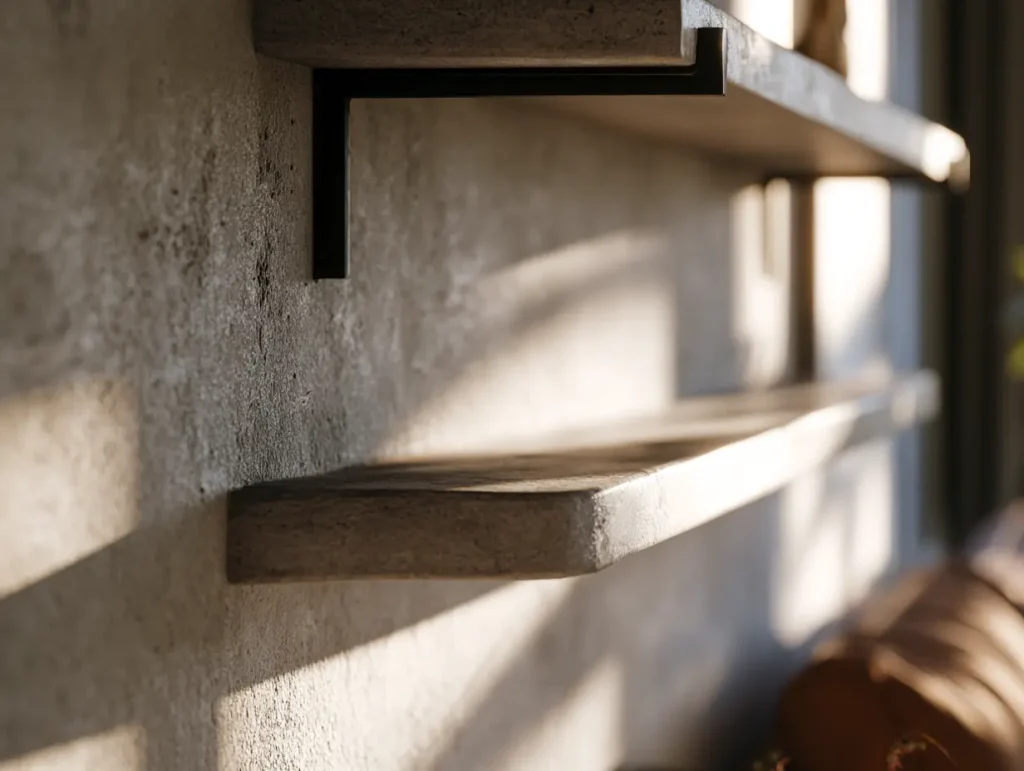
If concrete is the backdrop, black metal is what makes a room read as industrial rather than just unfinished — it’s the material doing the most visual work relative to its cost.
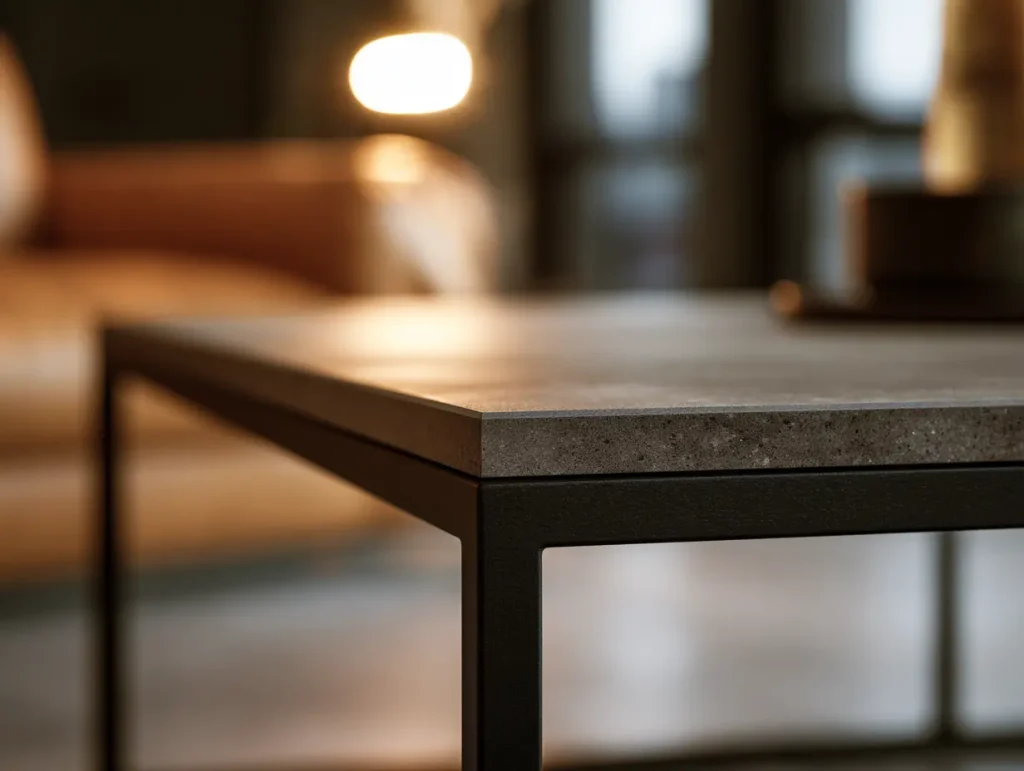
Industrial rooms need one grounding surface that isn’t concrete or metal, and a stone tabletop does that job while staying entirely within the palette.
A sintered stone slab in a concrete-grey or basalt-toned finish — Sinno Stone offers several finishes that read as raw, unpolished concrete without the porosity real concrete would bring into a living room — works as a coffee table top or console surface on a simple black steel frame. Unlike actual concrete furniture, which is heavy, prone to hairline cracking, and needs periodic resealing in Malaysia’s humidity, sintered stone is non-porous, scratch-resistant, and needs no maintenance beyond a wipe-down. It gives the room its “raw material” anchor point without any of the upkeep real raw materials would demand.
Lighting is where an industrial living room either reads intentional or reads like an empty warehouse — the fixture choice matters more here than in almost any other style.
Cage pendants, exposed-bulb fixtures, and articulated wall-mounted task lamps in black or aged bronze are the signature lighting move, typically hung over a console table, reading nook, or the sofa’s side rather than centred on the ceiling. Filament-style warm LED bulbs at 2,700K keep the exposed-fixture look from feeling harsh — a cool white bulb in an open cage pendant reads clinical, not warehouse-chic. Group two or three pendants at slightly different drop heights over a console or bar cart for the layered look industrial interiors are known for, rather than a single central fixture doing all the work.
Industrial rooms favour an open, loosely zoned layout over closed-off furniture arrangements — the style’s warehouse roots mean it reads best when the room can breathe.
In a typical Malaysian condo living-dining layout, this usually means pulling the sofa away from the wall to float it slightly, using an open black-metal shelving unit instead of a solid cabinet to divide the living and dining zones, and keeping the floor material consistent — polished concrete-look tiles or a dark stained timber — right through both areas. The goal is a single continuous volume the eye can travel across, the way it would in an actual converted warehouse unit.
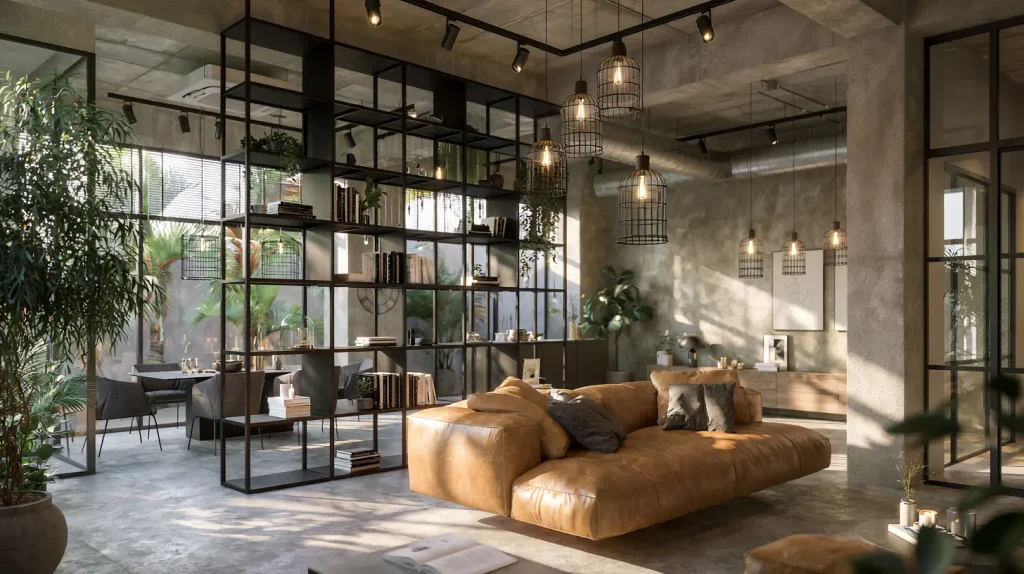
An all-concrete-and-metal room reads cold fast in photos and colder in person, which is where a deliberate textile layer earns its place.
The industrial palette works on three tiers:
Keep the ratio roughly 60% base, 30% mid-tone, 10% accent — industrial rooms feel intentional, not incomplete, when the warm accent is present but restrained.
Genuine raw or blackened steel is one of the least humidity-friendly materials you can put in a Malaysian home — untreated steel will show surface rust within months in 70–90% ambient humidity, especially near windows or an unenclosed balcony. A few specifications keep the look intact without the maintenance headache.
Genuinely exposing structural concrete, brick, or a load-bearing column means removing existing finishes down to the structure — and most JMBs and MCs classify this as structural or major internal work requiring formal approval, a refundable deposit, and restricted working hours, even if the wall itself isn’t being altered structurally. Some buildings prohibit it outright on shared walls.
A microcement or concrete-effect skim coat over existing plaster, by contrast, is a surface-level, non-structural change that most JMBs treat as ordinary renovation work — but confirm this in writing with your building’s management before starting, since house rules vary between buildings. Our guide on renovation timelines in Malaysia covers how long JMB approvals typically take once submitted, useful context if your plan does involve structural exposure.
| Element | Local Source | Estimated Cost |
|---|---|---|
| Microcement / concrete-effect wall finish | Local microcement applicators, renovation contractors | RM 25–60 per sq ft installed |
| Concrete-tone paint approximation | Nippon Paint, Dulux stockists | RM 80–150 per 5L tin |
| Sintered stone coffee table / console top | Sinno Stone | RM 900–2,800 depending on size and finish |
| Black steel table or shelving frame | Local metal fabricators, custom furniture makers | RM 300–1,200 per piece |
| Matte black hardware and switch plates | Mr. DIY, Ace Hardware, Shopee local sellers | RM 15–60 per piece |
| Cage / filament pendant lights | IKEA, Shopee, KL lighting shops (Jalan Ipoh, Klang Lama) | RM 60–350 per pendant |
| Leather or canvas sofa | Local furniture shops, IKEA, Shopee local sellers | RM 1,500–5,000 |
| Jute or flatweave rug | IKEA, Cotton On Home, Shopee local sellers | RM 150–500 |
Prices above are indicative estimates for reference only. Actual costs will vary depending on your interior designer, contractor, material choices, and project scope.
For a typical 12×15 ft Malaysian condo living room:
| Scope | Budget Range |
|---|---|
| DIY-friendly refresh (hardware swap, pendant lights, textiles) | RM 1,500–4,000 |
| Mid-range (feature wall + stone coffee table + pendant lighting) | RM 8,000–18,000 |
| Full renovation (all of the above + custom steel shelving + furniture) | RM 25,000–50,000 |
Prices above are indicative estimates for reference only. Actual costs will vary depending on your interior designer, contractor, material choices, and project scope.
For a full breakdown of where living room and whole-home renovation costs go, see our 2026 Malaysia renovation cost guide. If the full concrete-and-steel look feels like too much contrast for your home, our dark moody dining room breakdown covers a softer way to bring deep tones and dramatic lighting into an adjacent space, and our Japandi living room guide shows the warmer, more pared-back alternative if industrial ends up reading too stark.
An industrial living room in Malaysia isn’t about copying a Brooklyn loft wholesale — it’s about borrowing the honesty of exposed materials and pairing it with the warmth a tropical home needs to actually feel liveable. Concrete and black steel do the structural half of the job. Leather, timber, and a warm-toned pendant bulb do the rest.
The practical objections — humidity, rust, JMB approval for anything structural — are all solvable with the right specifications, not reasons to avoid the style altogether. A microcement feature wall, powder-coated black metal, and a sintered stone tabletop get you the full aesthetic without the maintenance problems real concrete and raw steel would bring into a Malaysian home. Rumaruma is here to help you make design decisions grounded in real local materials and real Malaysian conditions — this breakdown is your starting point.
Start with one black steel and stone element — a coffee table or console — and build the rest of the room’s raw textures around it.
