Our Location
304 North Cardinal St.
Dorchester Center, MA 02124

A full design breakdown of the quiet luxury master bedroom — neutral palette, stone feature wall, and premium linen for Malaysian homes.
A full design breakdown of the quiet luxury master bedroom — neutral palette, stone feature wall, and premium linen for Malaysian homes.
Most Malaysian master bedrooms chase the wrong kind of impressive. A feature wallpaper, an oversized upholstered headboard with diamond tufting, a statement chandelier — the room is loud, but it doesn’t actually feel expensive. It feels like it’s trying.
Quiet luxury is the opposite approach. There is no logo, no obvious “design moment,” no single element shouting for attention. Instead, the room is built from a small number of genuinely good materials — a tonal palette, a honed stone surface, linen that has real weight in your hand — and the quality does the talking. This article breaks down exactly how to build a quiet luxury master bedroom in a Malaysian home: the palette, the stone feature wall, the upholstered headboard, the textiles, the lighting, and the Malaysian-specific adjustments — humidity, JMB rules, local sourcing — that make the look achievable rather than aspirational.
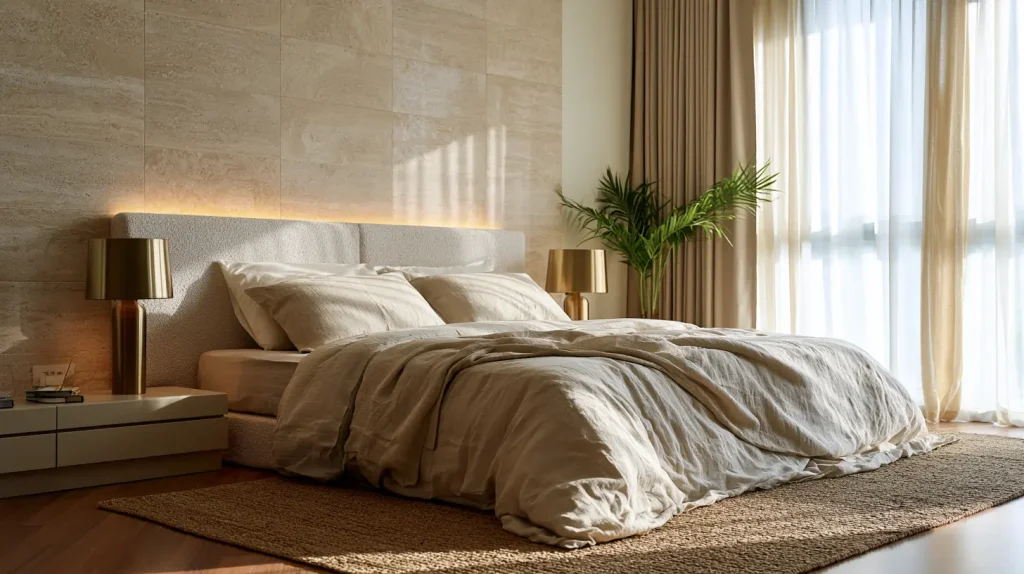
Quiet luxury borrows its name from fashion — the idea that real quality doesn’t need a visible label to prove itself — and translates almost perfectly into interior design. In a bedroom, it means restraint: a tonal palette in two or three closely related neutrals, a small number of high-quality materials repeated rather than a wide mix of cheaper ones, and an absence of decorative clutter. Nothing is there to impress a visitor, because the room is rarely seen by anyone but you.
What sets quiet luxury apart from plain minimalism is texture. A minimalist room can feel cold if every surface is flat and matte. Quiet luxury solves this by layering tactile materials within a narrow colour range — a honed stone panel next to a bouclé bench, heavyweight linen against a brushed-brass reading light — so the room reads as rich and considered even though the palette barely moves.
For Malaysian master bedrooms, this is a genuinely practical style choice, not just an aesthetic trend. Most local bedrooms — condo or landed — are modest in floor area, and a tonal neutral palette makes a room read larger and calmer than a busy, high-contrast scheme ever could. It also sidesteps two real Malaysian constraints: tropical humidity, which punishes heavily textured wallpaper and unsealed soft furnishings, and the practical need for a wind-down space after a day spent in bright, high-stimulus environments — traffic, malls, fluorescent-lit offices. A quiet luxury master bedroom is, by design, the most restful room in the house.
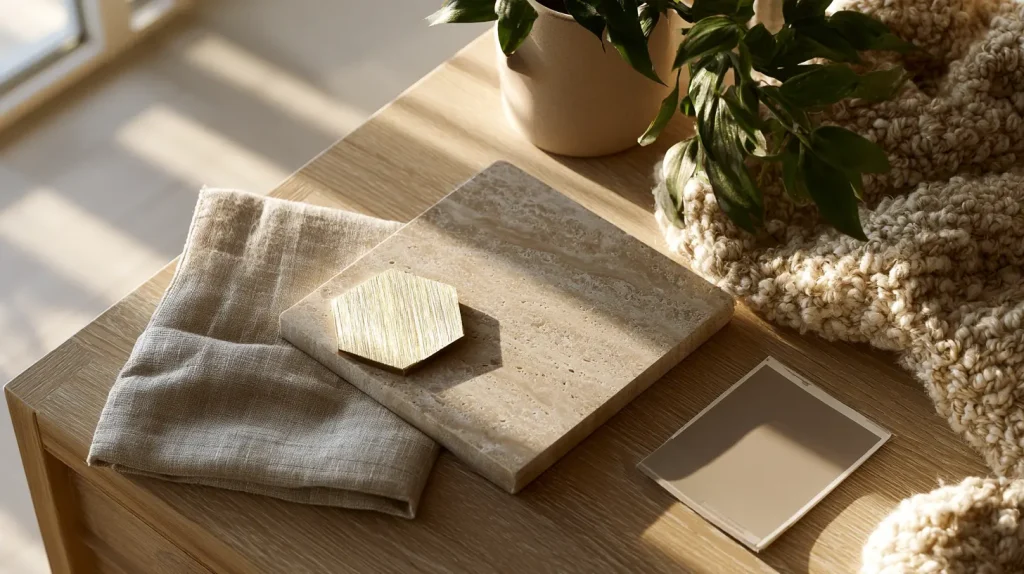
Here is what makes this look work — element by element.
The wall colour is the quietest decision in the room, and the most important one. It needs to sit so close to the furniture and linen tones that the eye stops registering “wall” as a separate element at all.
Work within warm, muted neutrals — bone, oat, warm greige, soft taupe, or a pale travertine tone — rather than stark white or cool grey. Stark white reads clinical under Malaysian fluorescent-adjacent LED lighting, and cool grey can feel flat and lifeless in a tropical climate that already lacks the soft seasonal light of temperate countries. Nippon Paint’s Quietude and Soulful Sand tones, and Dulux’s Travertine Whisper and Warm Linen ranges, are widely stocked local options that sit in exactly this register.
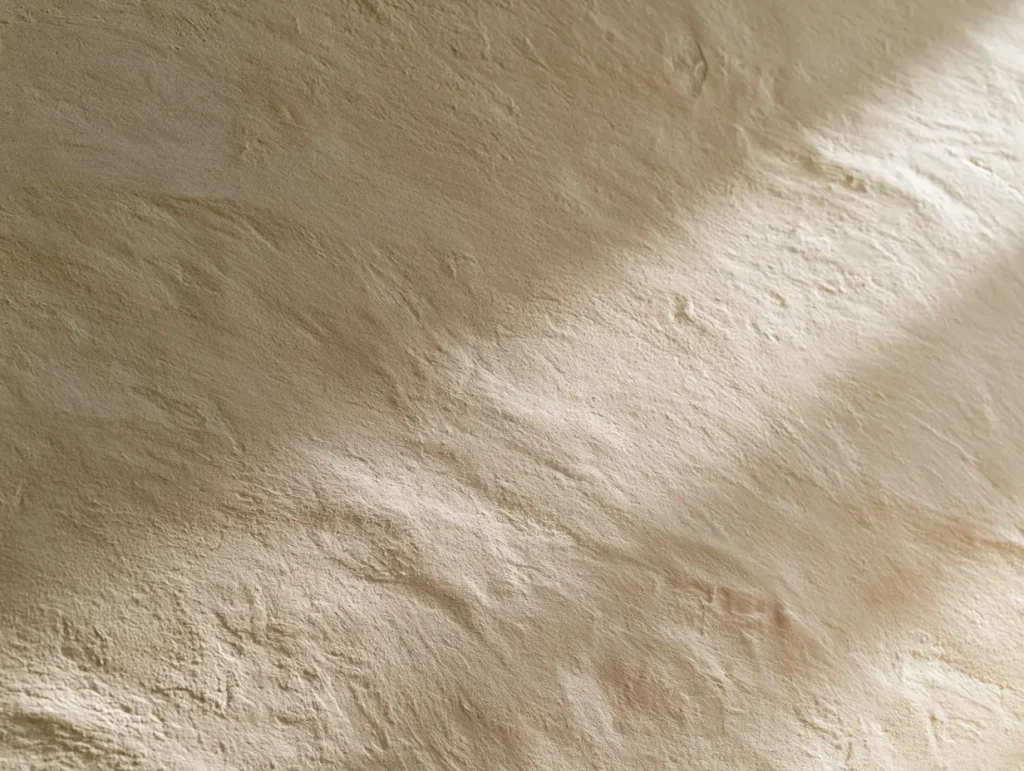
Finish matters as much as colour. Use a matte or low-sheen eggshell — never high-gloss or pearl — so the wall absorbs light softly rather than bouncing it back as a hard reflection. If budget allows, a limewash or Venetian plaster finish in a warm neutral adds the kind of subtle tonal variation across the surface that flat paint cannot replicate, and it is this micro-texture, more than the actual colour, that gives quiet luxury rooms their depth.
If the wall colour sets the temperature of the room, the feature wall behind the bed is where the quality becomes visible — the architectural backdrop the rest of the room is composed around.
A full-height or partial sintered stone panel behind the bed, in a soft travertine, warm beige marble-look, or honed taupe finish, does for a quiet luxury bedroom what a sintered stone table does for a dark moody dining room — it grounds the aesthetic in a material that is unmistakably premium without being decorative for its own sake. Sinno Stone’s sintered stone slabs can be fabricated into a feature wall panel sized to suit a standard Malaysian king or queen bed — typically 2.2–2.6m wide and 1.8–2.4m high, extending well above the headboard — with a honed or matte finish that catches light softly rather than glaring under a bedside lamp. Stone is specified here as a wall surface, not a head-contact surface — it sits behind and above the actual headboard, never something you lean or rest your head against.
The practical case is as strong as the visual one. Sintered stone is non-porous and will not absorb moisture or the ambient humidity that gradually dulls a painted feature wall over a few years of Malaysian use. It needs no sealing, no repainting, and no maintenance beyond an occasional wipe — which matters in a room you are not redecorating every two years.
Keep the panel’s edges minimal — a simple square or pencil edge, mounted flush to the wall — so it reads as architecture rather than furniture. Avoid heavy applied trim or a built-up frame around the panel; the entire point of quiet luxury is that the material is allowed to speak without ornamentation.
The headboard itself — the surface you actually lean against — should always be soft, not stone. A sintered stone slab is too hard and too cold against the body to function as a headboard, so the comfort layer is built separately, in front of the stone feature wall.
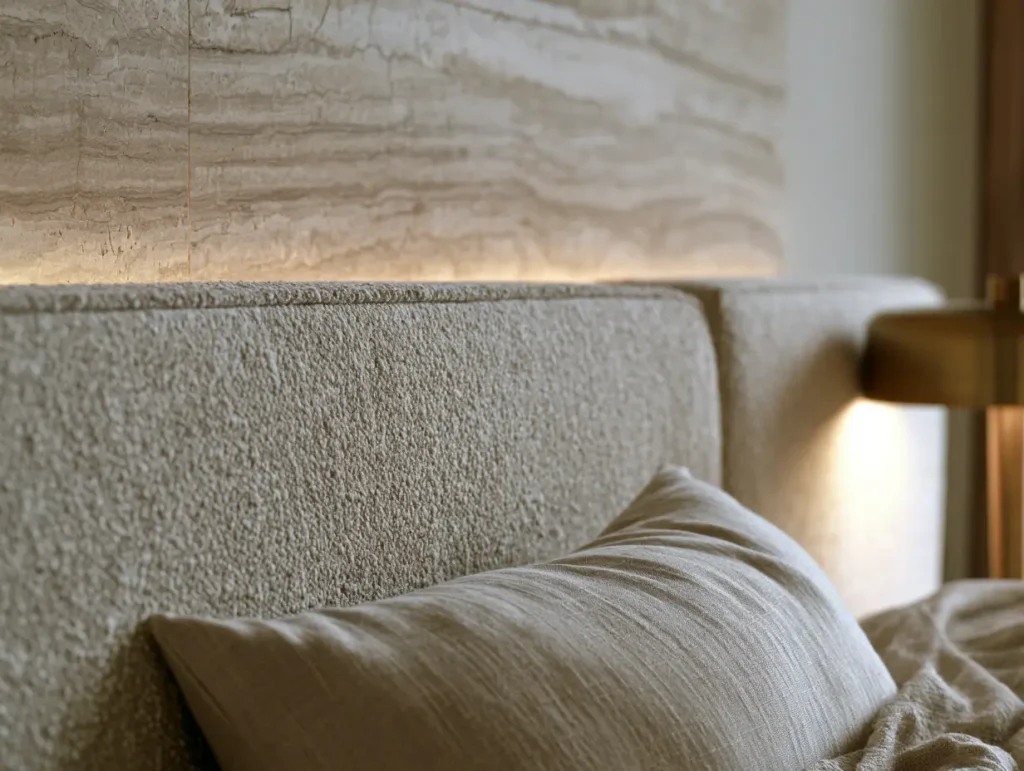
Specify a simple boxed or channel-tufted upholstered headboard in bouclé, linen, or a linen-blend fabric, in a tone one or two shades from the wall and stone — oatmeal, bone, or warm taupe. Keep the silhouette low and unfussy: a single boxed cushion 100–120cm tall is enough to read as quiet luxury, where an oversized or heavily buttoned headboard would tip the room back into the “trying too hard” look this style avoids. Local upholstery workshops and custom furniture makers across the Klang Valley can build a headboard to the exact width of a Malaysian king or queen bed frame, in a fabric and foam density suited to daily use.
Mount the headboard directly to the bed frame or wall, set roughly 10–15cm in front of the stone panel behind it. This gap lets a thin edge of stone show around the headboard’s silhouette — visible at the sides and above — so the two materials read as a single composed moment: soft where you touch it, stone where you see it.
Fabric is where quiet luxury earns its name in the most literal sense — these are rooms designed to be felt as much as seen, and bedding is the surface you spend eight hours a night in direct contact with.
Specify bedding in 100% linen or a high-thread-count (300+ TC) long-staple cotton, in tones that sit within the same neutral family as the walls and headboard — oatmeal, bone, sand, or a soft taupe. Avoid pure white sheets in a quiet luxury scheme; they create too sharp a contrast against a warm neutral wall and pull the eye away from the tonal calm the rest of the room is built around. Linen specifically suits Malaysia’s climate better than heavier cotton blends — it breathes, dries quickly after a humid night, and develops a relaxed, slightly rumpled texture that ages into the look rather than away from it.
Layer texture rather than colour: a bouclé or boiled-wool throw at the foot of the bed, a ribbed linen bench cushion, a low-pile wool or jute rug underfoot. Each material should differ in tactile quality — smooth stone, nubby bouclé, soft linen, coarse jute — while staying within a two-to-three-tone neutral range. This is what separates quiet luxury from a plain beige room: the variation is in touch, not in colour.
Quiet luxury lighting avoids anything that reads as a statement fixture. The goal is warm, low, indirect light — illumination that makes the room feel held rather than lit.
Skip the single central ceiling pendant or bright panel LED entirely. Instead, layer three light sources at different heights: a pair of matching brushed-brass or ceramic table lamps on the bedside tables, a wall-mounted or recessed cove light along one wall to wash the ceiling with soft indirect glow, and a slim adjustable reading light if the bed is used for reading or screen time before sleep. All bulbs should sit at 2,700K warm white, identical to the temperature used in dark moody and Japandi schemes — cooler bulbs read as office light and undo the entire mood regardless of how well the palette and materials are specified.
Dimmable circuits are worth the modest electrical cost at renovation stage. A quiet luxury bedroom should be able to shift from a brighter, functional light level in the morning to a low, warm glow at night without changing fixtures — and that flexibility is what makes the room feel genuinely luxurious rather than simply well-decorated.
The quiet luxury palette is intentionally narrow — the discipline is the point.
Resist the temptation to add a “pop” of colour. A quiet luxury bedroom is one of the few rooms where the absence of contrast is the design decision, not a missed opportunity. If the room needs visual interest, add it through material texture, not colour.
The most common mistake in a Malaysian quiet luxury bedroom is sizing the stone feature wall to match the headboard exactly, which removes the reveal line that gives the composition depth and makes the stone read as a flat backdrop rather than architecture.
Size the stone panel wider and taller than the upholstered headboard on every side — roughly 20–30cm of exposed stone at the top and sides, and let it run the full height of the wall if ceiling height allows. This creates a visible stone “frame” around the soft headboard, so the eye reads two distinct, deliberately layered materials rather than one busy surface. In compact Malaysian master bedrooms, this also has the side effect of making the headboard wall feel intentionally composed rather than cramped, even when the room itself is under 12×14 ft.
Quiet luxury depends on a small number of materials staying visually consistent over years, which makes Malaysia’s year-round 70–90% ambient humidity a real design consideration rather than a footnote.
Limewash and Venetian plaster finishes, while beautiful, require a properly prepared and sealed substrate in a Malaysian bedroom — unsealed plaster finishes can develop uneven sheen or surface staining in rooms with poor air circulation. If the master bedroom has limited window ventilation or sits on a humid-prone floor (ground floor landed homes, units facing dense greenery), a standard washable matte emulsion in the same neutral tone is a safer, lower-maintenance substitute that still achieves the tonal effect.
Linen bedding and bouclé throws should be laundered and fully dried before storage during the monsoon months — both materials hold moisture longer than synthetic blends, and a damp linen set left folded in a closet during a wet spell will develop a musty smell within days. A small closet dehumidifier or moisture-absorbing canister is a worthwhile RM 20–40 addition for households layering natural-fibre textiles throughout the bedroom.
A quiet luxury master bedroom makeover — repainting walls, installing a sintered stone feature wall panel mounted on the existing wall, building and mounting an upholstered headboard, replacing light fixtures, and swapping bedding and soft furnishings — generally does not require JMB approval, as these are non-structural, non-wet works within the unit.
Where it changes: if the stone feature wall installation requires new electrical wiring run through the wall for the cove lighting or bedside circuits, most JMBs in Kuala Lumpur and Selangor still classify this as minor internal electrical work that doesn’t need a formal application, but it is worth notifying your JMB or MC in writing regardless, particularly in older buildings where house rules are stricter about any wall penetration. If your renovation plan includes broader bedroom layout changes — moving a wall, altering the en-suite bathroom — that falls under standard renovation approval, and our guide on how long home renovation takes in Malaysia covers the JMB process and realistic timelines in full.
| Element | Local Source | Estimated Cost |
|---|---|---|
| Neutral matte wall paint (Bone / Greige / Warm Sand) | Nippon Paint, Dulux stockists | RM 80–150 per 5L tin |
| Limewash / Venetian plaster finish | Specialist plaster applicators, KL/Selangor | RM 15–28 per sq ft applied |
| Sintered stone feature wall panel | Sinno Stone | RM 1,800–4,500 depending on size and finish |
| Custom upholstered headboard (bouclé / linen) | Klang Valley upholstery workshops, IKEA, Shopee custom sellers | RM 450–1,500 depending on size and fabric |
| 100% linen bedding set | IKEA, Naiise, Cotton On Home, Tangerine | RM 250–650 per set |
| Brushed-brass or ceramic table lamps (pair) | IKEA, Shopee local sellers, KL lighting shops | RM 150–500 for the pair |
| Bouclé or wool throw | Naiise, local homeware boutiques, Lazada | RM 90–280 |
| Low-pile wool or jute rug | IKEA, local rug specialists, Shopee | RM 250–900 |
Prices above are indicative estimates for reference only. Actual costs will vary depending on your interior designer, contractor, material choices, and project scope.
For a standard Malaysian master bedroom:
| Scope | Budget Range |
|---|---|
| Cosmetic refresh only (paint + linen + lamps) | RM 1,000–3,000 |
| Mid-range (stone feature wall + upholstered headboard + paint + lighting circuit + textiles) | RM 8,500–19,500 |
| Full renovation (all of the above + flooring + custom joinery + curtains) | RM 25,000–50,000 |
Prices above are indicative estimates for reference only. Actual costs will vary depending on your interior designer, contractor, material choices, and project scope.
For a full breakdown of where bedroom and whole-home renovation costs go in Malaysia, see our 2026 renovation cost guide.
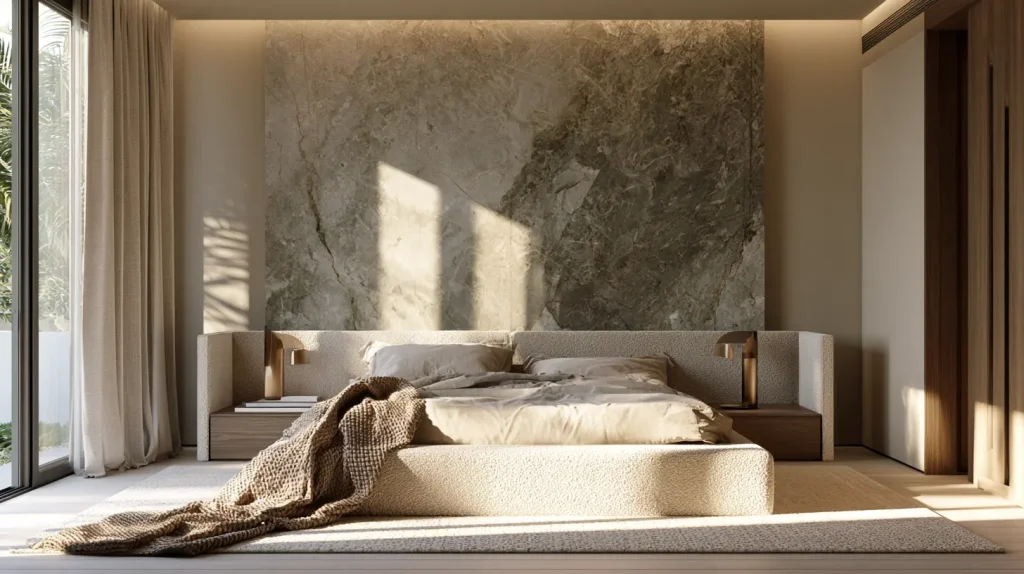
A quiet luxury master bedroom works because it refuses to compete for attention — there is no single statement piece, just a small set of genuinely good materials repeated with discipline across the room. That restraint is what reads as expensive, far more than any one decorative flourish could.
It is also one of the more forgiving styles to execute well in a Malaysian home. A narrow, warm neutral palette is naturally generous to smaller room footprints, sintered stone solves the humidity and longevity problem that derails so many feature-wall ambitions, and the entire look can be built incrementally — paint first, stone feature wall next, the upholstered headboard and textiles layered in over time — without ever looking unfinished along the way. If your current bedroom feels more like Wabi-Sabi’s raw, imperfect warmth than this tonal restraint, our guide to building a wabi-sabi bedroom in a Malaysian condo lays out the contrasting approach. Rumaruma exists to help Malaysian homeowners make these style decisions with real local materials, real RM budgets, and real climate constraints in mind — not aspirational references that fall apart in year-round humidity.
Start with the wall colour and the stone feature wall — once those two elements are right, everything else in the room only needs to get quieter.
