Our Location
304 North Cardinal St.
Dorchester Center, MA 02124

A full design breakdown of the coastal boho bathroom — natural stone basins, pandan-weave accents, and monsoon-proof materials for Malaysian homes.
A full design breakdown of the coastal boho bathroom — natural stone basins, pandan-weave accents, and monsoon-proof materials for Malaysian homes.
Most Malaysian bathrooms tell the same story. White or beige tiles, a plastic-framed mirror above the vanity, a fluorescent tube overhead, and a shower head that is technically functional but brings zero joy. It gets the job done — but the bathroom is often the one room that gets left behind when homeowners start thinking about design.
Coastal boho changes that. It is the style that makes a bathroom feel like a retreat — without requiring a demolish-and-rebuild. A natural stone basin, a rattan-framed mirror, a set of pandan-weave accessories, and the right tile palette can transform even a standard 5×8 ft Malaysian condo bathroom into a space that feels genuinely considered.
This article breaks down every element of the coastal boho bathroom — the materials, the palette, the lighting approach, and the Malaysian-specific adaptations — so you can recreate this look with local materials and a realistic budget.
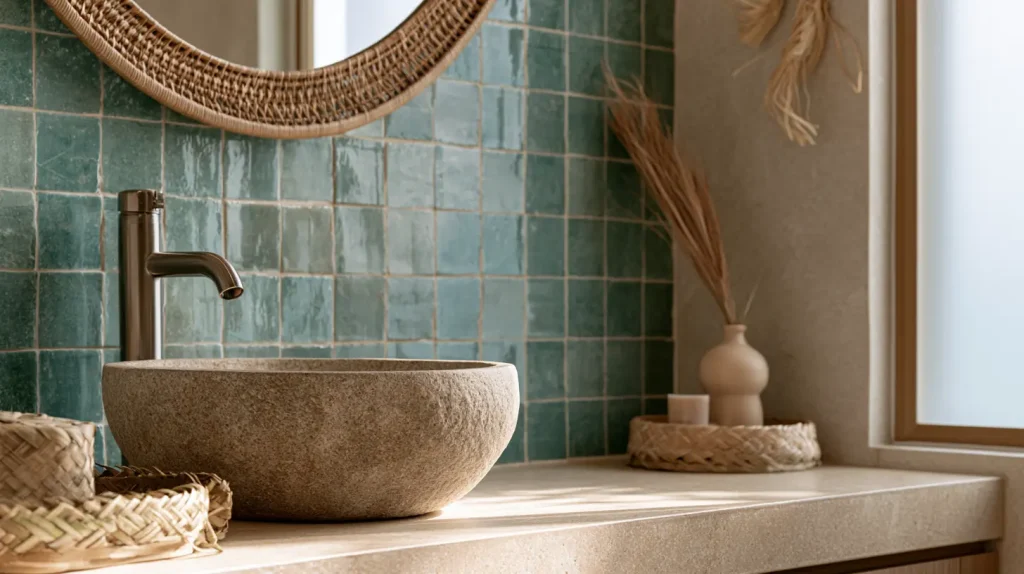
Coastal boho sits at the intersection of two design sensibilities. Coastal design brings the calm of natural light, sea-toned palettes, and airy spaces — ocean blues, sandy beiges, driftwood textures, and the general feeling that nothing here is rushed. Bohemian design layers in warmth and handcrafted character — woven accessories, organic shapes, curated imperfection, and natural materials that show their origins honestly.
Together, the result is a space that feels relaxed without being careless, and layered without being cluttered.
For Malaysian bathrooms specifically, this style is easier to achieve authentically than it might seem. Our natural material landscape — rattan, bamboo, pandan weave, tropical stone — maps directly onto boho’s material vocabulary. Our equatorial light and climate mean sea-toned palettes do not feel forced or aspirational; they feel genuinely at home. And because coastal boho tolerates visible imperfection in materials — handmade tile glaze variation, organic stone veining, uneven weave texture — it is fundamentally more forgiving to live with than high-gloss minimal styles that show every watermark and fingerprint.
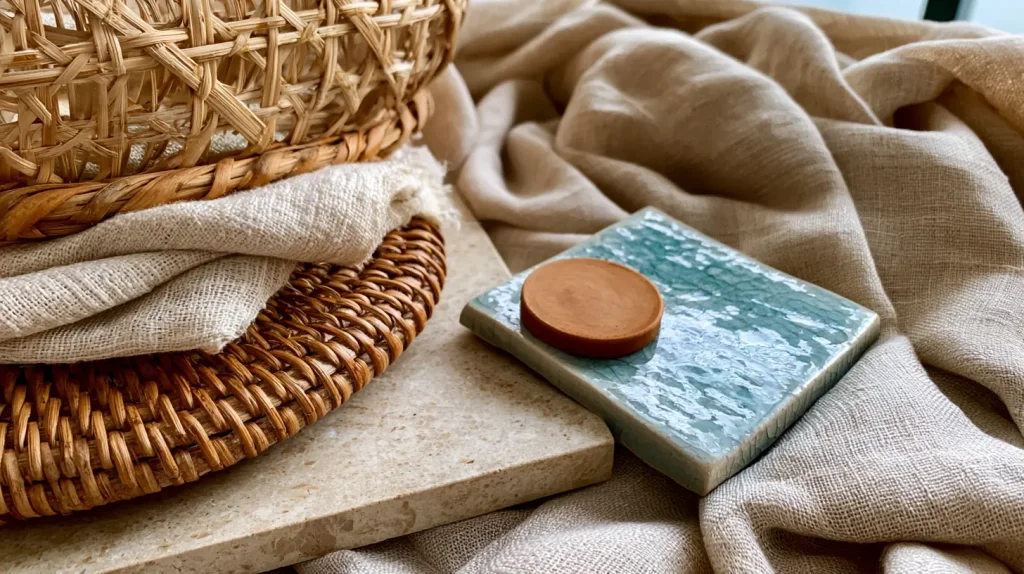
Here is what makes this look work — element by element.
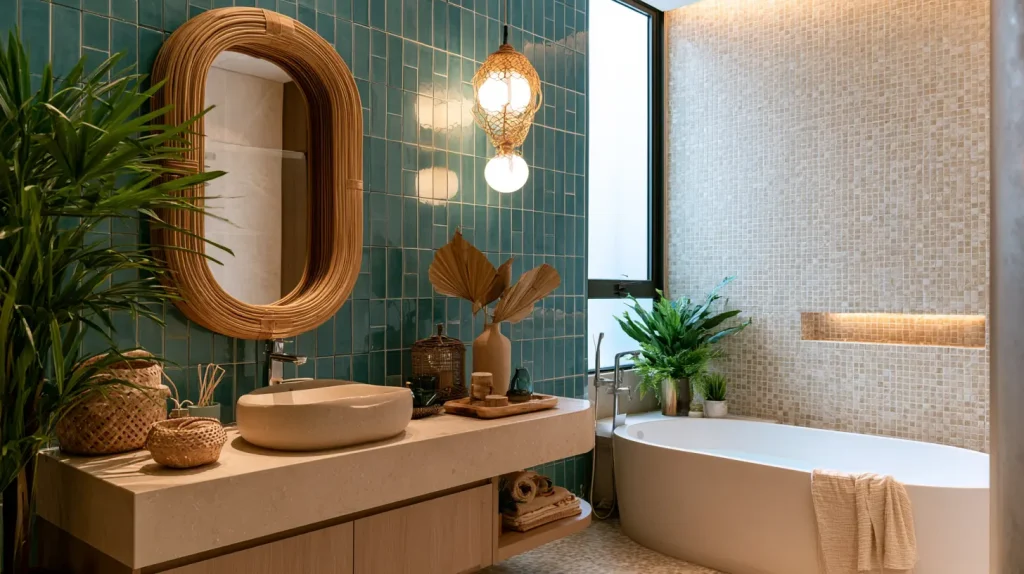
The stone basin is the centrepiece. Everything else in the room defers to it.
A vessel or undermount basin in a natural stone finish — travertine, sandy limestone-look sintered stone, or a matte cream marble — immediately signals that this bathroom was designed with intention. Sinno Stone’s sintered stone slabs can be fabricated into a basin countertop or waterfall vanity top that achieves this look with the added benefit of being fully non-porous and humidity-resistant — critical in a wet room that sees daily splashing and high ambient moisture.
Avoid unsealed natural stone for the basin surface itself. Genuine travertine and marble need regular sealing to prevent staining and moisture penetration — easy to forget, costly when neglected. Sintered stone gives you the same visual warmth as natural stone with none of the maintenance overhead.
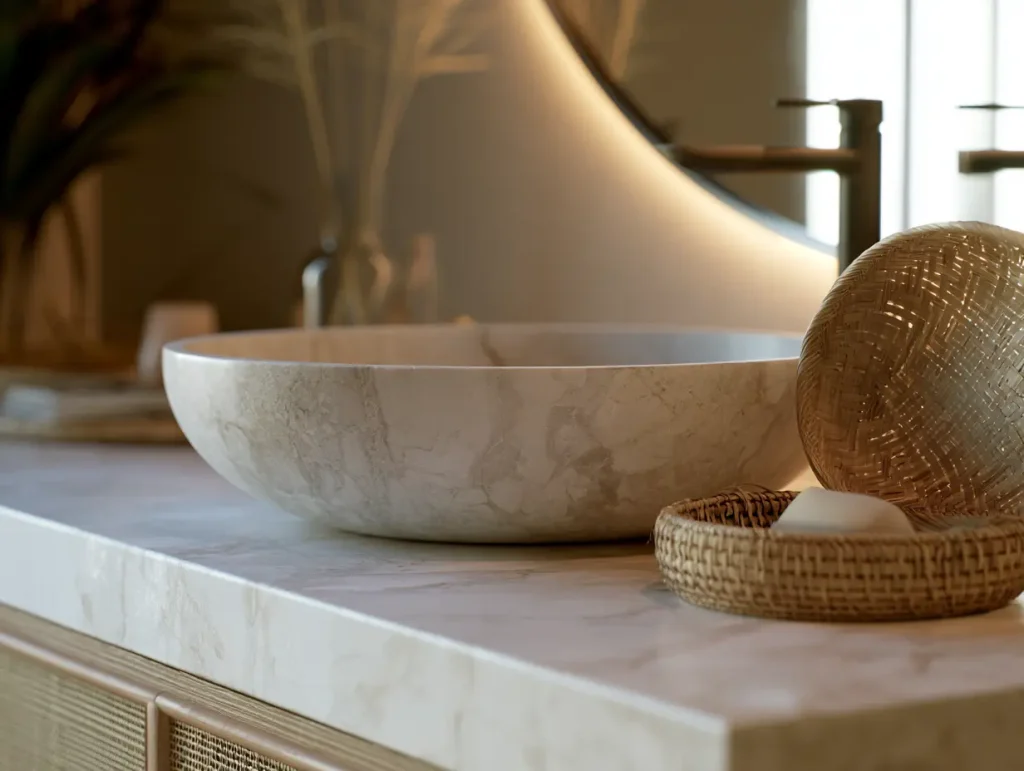
The tile palette is where the coastal element shows most clearly. A coastal boho bathroom typically works with two or three tile choices in concert:
In Malaysia, textured ceramic tiles are available from local tile importers and specialist tile shops concentrated in Puchong, Petaling Jaya, and Penang. Budget RM 4–12 per square foot for quality textured ceramic; handmade zellige imports run higher at RM 15–30 per square foot.
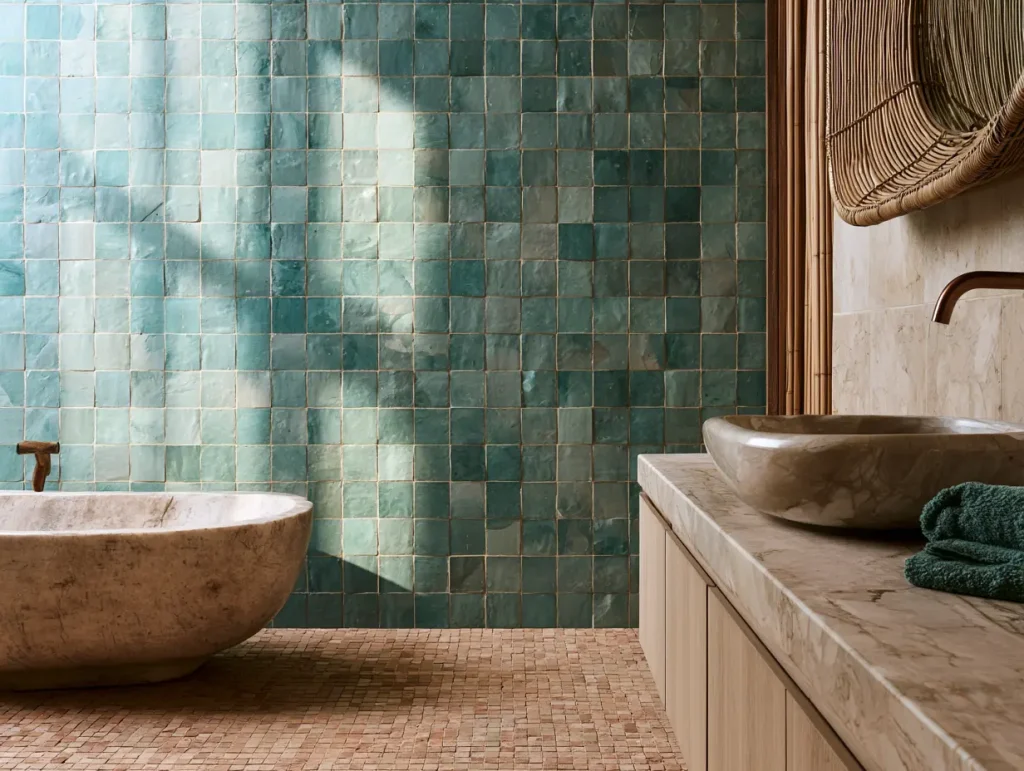
This is the most distinctly Malaysian element of this style — and one of its strongest.
Pandan weave is produced from screwpine leaves woven into a tight, checkerboard-patterned basket with a natural green-to-cream colouring as the leaves dry. Used as bathroom storage — soap dishes, cotton pad holders, small lidded baskets under the vanity — pandan-weave accessories introduce a handcrafted, tropical authenticity that imported rattan or seagrass accessories cannot replicate. You are not approximating a global boho aesthetic; you are using a material that genuinely belongs here.
Pair these with a rattan-framed mirror above the basin, a bamboo toothbrush holder, and one or two textured linen hand towels in cream or sandy beige. These are available at Mr. DIY, Daiso, local pasar malam craft stalls, and from Malaysian artisanal sellers on Shopee and Lazada.
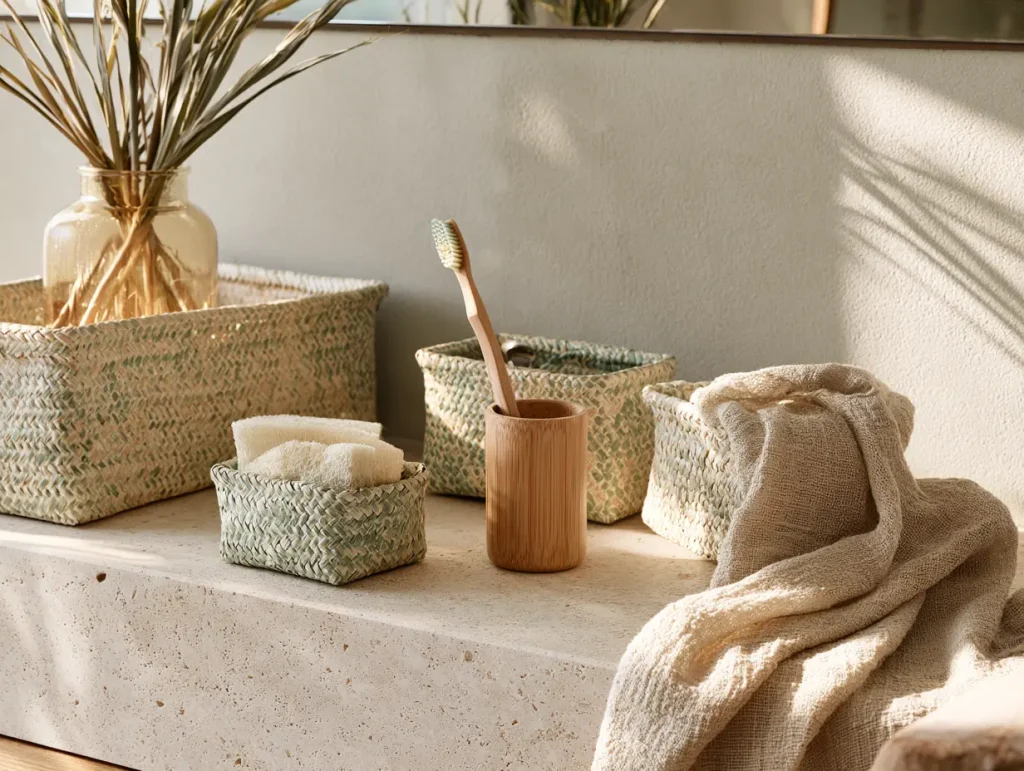
The coastal boho palette in a bathroom operates across four tones:
Avoid brilliant white anywhere in a coastal boho space. Pure white reads clinical and hard — the opposite of what this style is trying to achieve.
A coastal boho bathroom needs warm, soft light — never cool fluorescent or daylight-white LEDs.
The approach that works best: two wall sconces flanking the mirror, or one overhead pendant positioned above it, fitted with warm white globe-style bulbs at 2,700K. This eliminates the harsh downward shadows that a single ceiling downlight creates, and the warm filament tone reinforces the organic, unhurried character of the space.
In Malaysian condos, the bathroom typically has one ceiling light point and no existing provision for wall sconces. Adding sconces usually means running new wiring — factor this into your renovation scope if you are doing a full overhaul. If you are working with the existing single point, a large warm globe pendant on a short drop is a strong alternative that avoids new electrical work entirely.
Malaysian condo bathrooms are compact — typically 5×8 ft or 6×9 ft. Scale is the most common mistake in small bathrooms: a modest mirror, small accessories, and a lot of visible tile creates a space that reads fragmented and unintentional.
The fix is to go large with the mirror. A rattan-framed mirror that fills 70–80% of the wall above the vanity — extending close to the ceiling if proportions allow — does two things simultaneously. It makes the room feel significantly larger by reflecting light and the opposite wall, doubling the visual depth of a small space. And it becomes the main visual statement that the rest of the room organises around. Pair it with the stone basin directly below, and the vanity wall looks designed, not assembled.
Any bathroom renovation that involves hacking existing tiles, screeding, or laying new floor or wall tiles requires a full wet area waterproofing membrane before new work goes down. In Malaysia’s strata properties, this is a non-negotiable requirement — most JMBs and MCs will ask for a waterproofing completion certificate before releasing the renovation deposit refund.
Use a liquid-applied membrane system — polyurethane or cementitious — on all floor areas and wet wall zones up to at least 1.8m in height, and across the full shower area. Budget RM 8–15 per sq ft for supply and application. This is not a line item to cut.
Malaysia’s average humidity of 70–90% year-round is the defining constraint in any bathroom renovation. Materials that perform beautifully in drier climates deteriorate fast here without the right specification:
Bathroom hacking and re-tiling is classified as wet work in most Malaysian strata buildings. This means:
Our guide on how long home renovation takes in Malaysia covers the JMB approval process in detail, including typical lead times between application submission and work commencement.
| Element | Local Source | Estimated Cost |
|---|---|---|
| Sintered stone basin top / vanity countertop | Sinno Stone | RM 600–2,000 depending on size |
| Sea-toned textured ceramic wall tiles | Local tile importers, Puchong / KL / Penang tile shops | RM 4–12 per sq ft |
| Handmade zellige tiles (imported) | Specialist tile retailers | RM 15–30 per sq ft |
| Pandan-weave accessory set | Mr. DIY, Daiso, Shopee artisanal sellers, pasar malam | RM 20–80 per set |
| Rattan-framed mirror | IKEA, Shopee, local homeware shops | RM 80–350 |
| Warm globe wall sconces or pendant | Mr. DIY, IKEA, Shopee local sellers | RM 60–200 per fixture |
| Warm wall paint (Sandy Beige / Teal Mist) | Nippon Paint, Dulux | RM 80–150 per 5L tin |
For a standard 5×8 ft Malaysian condo bathroom:
| Scope | Budget Range |
|---|---|
| Accessory refresh only (mirror, accessories, towels, bulb swap) | RM 500–1,500 |
| Mid-range (re-tile one feature wall + new accessories + lighting) | RM 3,000–8,000 |
| Full renovation (all tiles, stone basin top, vanity, lighting, wet works) | RM 12,000–28,000 |
For a full breakdown of where bathroom renovation costs go in Malaysia, see our 2026 renovation cost guide.
The bathroom is the first room most people enter in the morning and the last before bed. Designing it with the same care as the living room or master bedroom is not indulgent — it changes the quality of your daily routine in a way that new furniture or a feature wall in the living room rarely does.
Coastal boho is one of the most achievable styles for Malaysian homeowners precisely because it is honest about materials. It does not ask for perfect surfaces or precision joints. It asks for stone that looks like stone, weave that feels like weave, and a palette that acknowledges where you actually live — somewhere tropical, somewhere warm, somewhere that has every reason to feel close to the coast even if your condo is in the middle of Kuala Lumpur.
Rumaruma is built for homeowners who want to make better design decisions — not just find inspiration, but understand what actually works in Malaysian homes, at real local costs. This breakdown is your starting point.
Start with the mirror — find one large rattan-framed piece that fills most of the wall above your basin, and watch how the whole bathroom organises itself around it.
